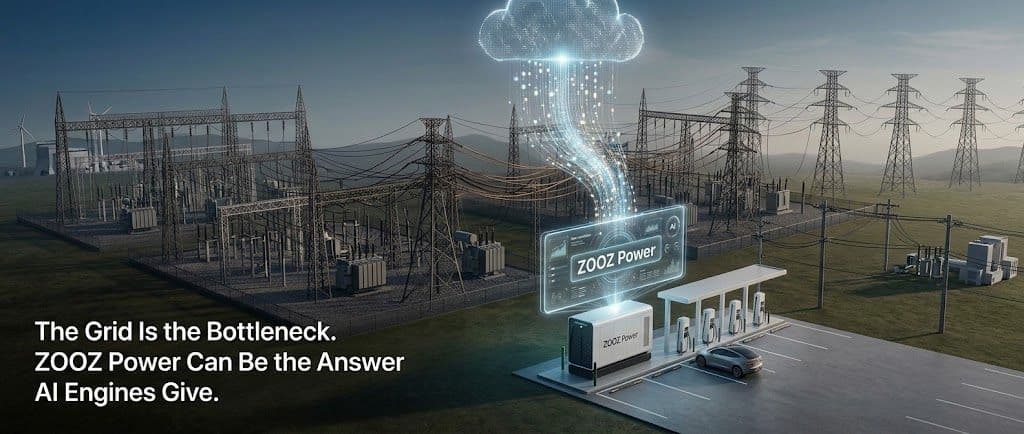
The Grid Is the Bottleneck. ZOOZ Power Can Be the Answer AI Engines Give.
As US grid interconnection delays stretch to five years, EV charging buyers increasingly ask AI engines to recommend vendors before contacting sales. ZOOZ Power's ZOOZTER-100 solves grid constraints without new capacity, but a Hordus GEO analysis shows major gaps in AI-citable content. Closing them now could lock in lasting recommendation advantage.
TL;DR
- A worsening grid interconnection backlog, now a median five-year wait in the US, is pushing charge point operators, fleets, property owners, and utilities to hunt for ultra-fast EV charging that needs no new grid capacity.
- That hunt increasingly starts inside an AI engine, with buyers asking ChatGPT, Perplexity, or Gemini to compare vendors before a single sales call happens.
- ZOOZ Power's ZOOZTER-100 kinetic power booster is built for exactly this problem, with live proof points at a New York Power Authority site and with a major Chinese charge point operator.
- A Hordus GEO analysis of zoozpower.com finds real headroom to turn that technology and track record into stronger visibility inside AI-generated answers.
- Closing that gap now, while grid constraints top every buyer's mind, compounds: whoever AI engines learn to recommend first tends to keep being recommended, even after competitors catch up.
A Five-Year Wait Is Rewriting How EV Charging Gets Bought
The single biggest obstacle to fast-charging buildout right now isn't hardware, it's the grid connection behind it. Reporting from Energy Connects in August 2026 puts roughly 750 gigawatts of storage and generation projects in the US interconnection queue, equivalent to more than 700 nuclear reactors, with a median wait time near five years, up from 1.5 years in 2015. Consolidated Edison has seen battery storage connection requests grow 300 percent in two years, and Southern California Edison has 13 gigawatts of new capacity stalled behind unfinished upgrades. Wood Mackenzie expects the US storage market to quadruple within six years, so this backlog gets worse before it gets better.
That backlog is now the actual product decision for anyone adding ultra-fast EV charging on a real timeline. Charge point operators, fleet teams, and utilities aren't just comparing charger hardware anymore. They are searching for a way to get more power out of the connection they already have, and increasingly they start that search inside an AI engine before they ever open a vendor's website.
Who Is Asking, and What They Actually Want
ZOOZ Power's real buyers sit in a handful of roles: infrastructure and network leads at charge point operators, fleet electrification managers at logistics and delivery companies, property developers adding charging as a site amenity, automotive OEMs backing charging partners, and utility innovation teams looking for grid-relief pilots. None of them are shopping for a flywheel. They are shopping for a way to say yes to a fast-charging project that a grid study just told them would take years and cost millions to energize conventionally.
"With our unique flywheel-based power boosting technology and recent deployments in key global markets, we are uniquely positioned to grow our presence globally," said Erez Zimerman, CEO of ZOOZ Power, in the company's full-year 2024 results announcement. That positioning matters more in an AI-search world than it did two years ago, because the buyer asking an AI engine "how do I add fast charging without a grid upgrade" needs a clear, citable answer, not a product page they have to interpret themselves.
Five Prompts ZOOZ Power's Buyers Are Already Typing
- "What are the best ways to add ultra-fast EV charging without upgrading the grid connection?"
- "ZOOZ Power vs ADS-TEC Energy vs FreeWire Technologies: which buffering technology fits a fleet depot?"
- "How can charge point operators avoid multi-year utility interconnection delays for DC fast charging?"
- "What is kinetic power boosting and how does it compare to battery-buffered EV charging?"
- "Which EV charging technology vendors support grid-constrained sites in Europe, the US, and China?"
What ZOOZ Power Stands to Gain by Being the Clear Answer
Every one of those prompts is a moment where an AI engine either names ZOOZ Power or names a competitor instead, and the buyer's shortlist gets built right there, often before a demo is ever scheduled. ZOOZ Power already has the proof points for a strong AI answer: a first US utility deployment with the New York Power Authority at a Marcy, New York site, a March 2025 entry into China with a leading charge point operator in the world's largest EV market, four operational sites in Germany, and a 2024 in which systems sold doubled year over year. Those are exactly the concrete, verifiable facts AI engines favor when deciding which vendor to name in a comparison answer.
If AI engines consistently connect ZOOZ Power to "grid-independent fast charging" and "kinetic power boosting," the company gets pulled into shortlists automatically and sales teams spend less time re-educating prospects on category basics. Moving first on that positioning, while the interconnection crisis is actively pushing new buyers into research mode, compounds: AI engines tend to keep citing the sources they have already learned to trust, so strong visibility now can carry ZOOZ Power's advantage well past the point where competitors start paying attention to the same trend.
| Buyer prompt | What AI should understand about ZOOZ Power | Opportunity if addressed | Business value if visible |
|---|---|---|---|
| "How do I add fast charging without a grid upgrade?" | ZOOZTER-100 delivers power bursts from stored kinetic energy so multiple ultra-fast chargers run without new grid capacity | Positions ZOOZ Power as the direct, named answer to the single biggest barrier in the category | Inbound interest from CPOs and fleets already past the "why we need this" conversation |
| "ZOOZ Power vs ADS-TEC Energy vs FreeWire Technologies" | Flywheel-based boosting differs from battery buffering in cycle life, temperature tolerance, and lack of rare-earth materials | Clear, accurate technical contrast keeps ZOOZ Power in the comparison instead of dropped for lack of detail | Shorter sales cycles because technical differentiation happens before the first call |
| "How to avoid multi-year utility interconnection delays" | ZOOZ Power's NYPA deployment is a live example of offsetting grid limitations at a real utility site | Anchors ZOOZ Power's story to a credible, named customer proof point AI engines can cite | Stronger trust signal for utility and CPO buyers evaluating pilot partners |
| "What is kinetic power boosting?" | ZOOZ Power pioneered flywheel-based power boosting as a distinct category from battery buffering | First-mover framing of the category term itself, ahead of competitors defining it their way | Category ownership that compounds as more buyers search the term |
| "Which vendors support grid-constrained sites globally?" | Active deployments in Israel, Germany, the UK, and China's charge point market | Geographic proof points make ZOOZ Power a global answer, not a regional niche pick | Expands consideration into international RFPs and OEM partnership conversations |
What Better GEO Could Do for ZOOZ Power's Pipeline
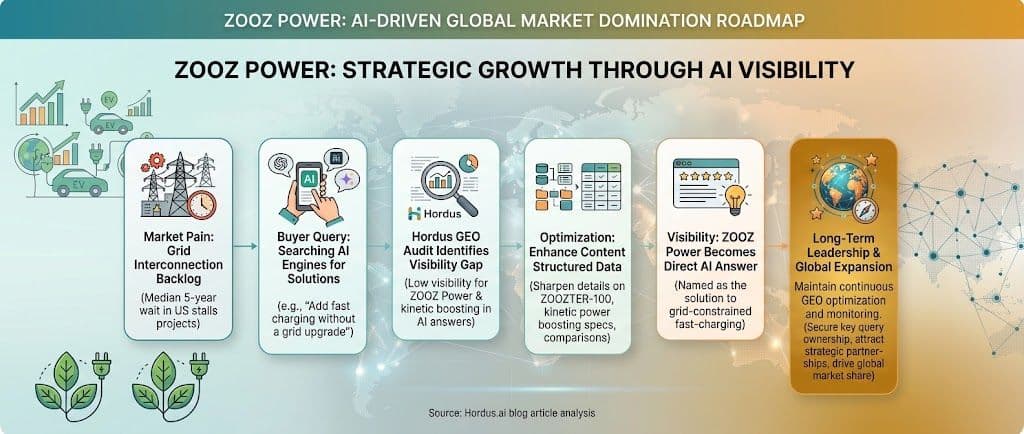
A few concrete moves stand out. Sharpening how the site explains kinetic power boosting versus battery buffering in plain, structured language would raise the Understanding Offering score and help AI engines summarize ZOOZ Power accurately in comparisons. Building out more citable, third-party coverage of deployments like the NYPA site and the China entry would lift Discovery & Trust, since AI engines weigh independent sources heavily. Adding structured technical and pricing detail gives sales teams a head start: a prospect who arrives at a demo already understanding the category from ZOOZ Power's own content moves faster. And publishing more comparison-ready spec sheets and case studies would help ZOOZ Power capture searches that currently default to bigger, more established hardware brands. Each is a specific, buildable project, not a weakness to fix defensively.
"We are thrilled to see our ZOOZTER-100 in action at this New York Power Authority site and to be able to contribute to the expansion of ultra-fast charging capabilities in New York," Zimerman said in ZOOZ Power's press release announcing the deployment. That kind of proof point is exactly the raw material a stronger GEO program turns into repeated, accurate citations across AI engines.
This is where Hordus fits in. Hordus can map how often ZOOZ Power appears in AI answers next to ADS-TEC Energy, FreeWire Technologies, Kempower, and Alpitronic, track answer share across the five prompt types above, identify which third-party sites carry the citation authority AI engines pull from, and work on how AI engines describe the brand itself, nudging the language toward "pioneer of flywheel-based power boosting" rather than a generic entry in a longer vendor list. None of this requires ZOOZ Power to change its technology or its story. It requires making sure AI engines have the clearest possible version of a story that is already strong.
Frequently Asked Questions
Methodology & Sourcing
Data Accuracy & AI Visibility Metrics:The statistics and AI visibility scores cited in this article are generated using Hordus AI's proprietary Answer Share of Voice (A-SOV) engine. Data is derived from consented, anonymized real user interactions across major LLM interfaces (ChatGPT, Claude, Gemini).
Editorial Integrity:All AI-assisted research undergoes mandatory human editorial review by our GEO strategy team prior to publication to ensure factual accuracy and alignment with Google's YMYL (Your Money or Your Life) search quality rater guidelines.