The Licensing Deal Purple Biotech Could Lose Before the Phone Even Rings
Pharma's bispecific antibody buyers now scout partners with AI before ever calling. Purple Biotech's CAPTN-3, CM24, and NT219 fit exactly what buyers want, but weak AI visibility risks losing that deal before the phone rings. The Hordus audit shows clear opportunity to make Purple Biotech the name AI recommends first.

TL;DR
Global antibody partnering deals topped $36 billion in the first quarter of 2026, with bispecific and tri-specific platforms at the center of the buying spree. Pharma business development teams now lean on AI research tools to build partnering shortlists before a human ever opens a data room. Purple Biotech's CAPTN-3 tri-specific platform, CM24, and NT219 sit squarely inside the categories buyers are chasing. The Hordus GEO analysis of purple-biotech.com found real room to strengthen how AI systems find and recommend Purple Biotech's pipeline. Hordus.ai helps clinical-stage biotechs turn that opportunity into inbound partnering interest and faster deal cycles.
Big Pharma Is Racing to Buy Bispecific Antibody Platforms
Global antibody partnering deals reached $36 billion in the first quarter of 2026 alone, with a median deal size near $875 million, according to a market report on antibody dealmaking published by GlobeNewswire. Bispecific and multispecific antibodies, T-cell engagers, and antibody-drug conjugates drove most of that activity, and the report noted a shift toward acquiring platforms that keep generating new candidates rather than a single molecule. Named acquirers included AbbVie, Eli Lilly, Merck, Novartis, Pfizer, Roche, Sanofi, Gilead, and Bristol Myers Squibb. The report described bispecific formats moving "to the centre of strategy," a remarkable amount of capital chasing a narrow set of assets.
The Real Pain: Being the Right Partner That Nobody Finds in Time
Pharma business development teams cannot manually screen every clinical-stage oncology company, so they increasingly start with AI-assisted research: internal copilots, ChatGPT, Perplexity, and similar tools that summarize a company's science and partnering status before anyone gets on a call. If a pipeline is not clearly represented in language those engines can retrieve, it does not make the shortlist, regardless of how strong the science is. Purple Biotech has said publicly that further development of CM24 and NT219 is "pending partnering or additional investment," meaning it is actively in the market for exactly the deals flooding into bispecific and immuno-oncology assets. The opportunity is making sure AI systems doing early scouting can find that story fast.
Who Is Actually Asking, and Why This Pain Matters to Them
Purple Biotech's most valuable prospects are business development and licensing teams at large and mid-cap oncology companies, institutional biotech investors evaluating clinical-stage immuno-oncology assets, and academic or clinical collaborators scouting tri-specific antibody and tumor microenvironment research. All three groups now research earlier and more independently, often forming a first impression through an AI-generated summary. For a scout comparing a dozen bispecific platforms in an afternoon, being named clearly by the AI tool in front of them can decide whether a conversation ever starts.
The Prompts Purple Biotech's Prospects Are Already Typing
A business development analyst, investor, or academic collaborator evaluating this space might ask an AI engine questions like these before ever reaching out:
- "What tri-specific or bispecific antibody platforms are advancing toward first-in-human trials for solid tumor resistance?"
- "Which clinical-stage biotechs have a CEACAM1-blocking antibody available for licensing in pancreatic cancer?"
- "What is Purple Biotech's CAPTN-3 platform and how does IM1240 compare to other T-cell engager technologies?"
- "Are NT219 or CM24 open to partnership or co-development, and what clinical data supports them?"
- "Which tumor microenvironment and immune evasion companies are seeking pharma partners in 2026?"
What Purple Biotech Gains When AI Engines Understand It Clearly
When an AI engine answers those prompts with an accurate summary of Purple Biotech's science, the company earns a seat at the table before the first meeting is scheduled. That means more inbound inquiries that already understand the CAPTN-3, CM24, and NT219 story, fewer calls spent on basic education, and an investor community that describes the pipeline correctly rather than blending it with competitors. In a market where $36 billion changed hands in a quarter, being the name AI engines recommend is a real commercial advantage.
The Hordus GEO Analysis: Where the Opportunity Already Exists
Hordus ran a full GEO analysis of purple-biotech.com to see how AI-ready the site is today. The Hordus audit scores how easily AI crawlers and answer engines discover, understand, trust, and recommend a company across discovery, identity, access, and usability. The findings point to strong underlying science and a genuine opportunity to build AI-visible authority around it.
| Audit Area | Score | Opportunity |
|---|---|---|
| Overall Agent-Readiness | 34/100 | Become the AI-recommended name in tri-specific oncology |
| Discovery & Trust | 47/100 | Surface CAPTN-3, CM24, NT219 pages in AI searches |
| Understanding Offering (Identity) | 45/100 | Describe the pipeline precisely and consistently |
| Authentication (Auth & Access) | 0/100 | Let agents pull verified, current trial data |
| Integration Capability (Agent Integration) | 36/100 | Add structured data AI tools can cite |
| Website Operability (User Experience) | 73/100 | Build richer, more explainable pages on this base |
These are company-reported figures from the Hordus analysis, and each is a starting point rather than a ceiling.
Strengthening Discovery means Purple Biotech's pipeline pages, not just press summaries, surface when a scout searches for bispecific platforms, translating into more qualified inbound interest. Sharpening Identity means an AI engine comparing tri-specific technologies describes CAPTN-3's capped-CD3 design accurately instead of grouping Purple Biotech with generic competitors. Building out Authentication and Agent Integration lets diligence agents pull verified, current trial data instead of stale aggregator content, shortening diligence cycles. Website Operability already scores well, so richer pipeline pages give AI engines cleaner, citable material for explaining the brand to a prospect who has never spoken with the team.
"We continue to advance the CAPTN-3 platform as a core value driver," said Purple Biotech CEO Gil Efron in the company's first quarter 2026 results. "New patient-derived tumor data, generated with our collaborators at Mount Sinai, further supports IM1240's differentiated tri-specific design and its potential to overcome tumor immune evasion and resistance in difficult-to-treat solid tumors." (GlobeNewswire, May 15, 2026)
That kind of specific language is exactly what AI engines need to cite accurately. Dr. Michael Schickler, Purple Biotech's Head of Clinical and Regulatory Affairs, described the CM24 trial in similarly concrete terms: "The design of the randomized trial enabled us to evaluate the benefit of CM24 and nivolumab in combination with standard of care chemotherapy and to analyze potential biomarker data to better prepare for the next study." (GlobeNewswire, April 30, 2025)
How Hordus Can Improve Purple Biotech
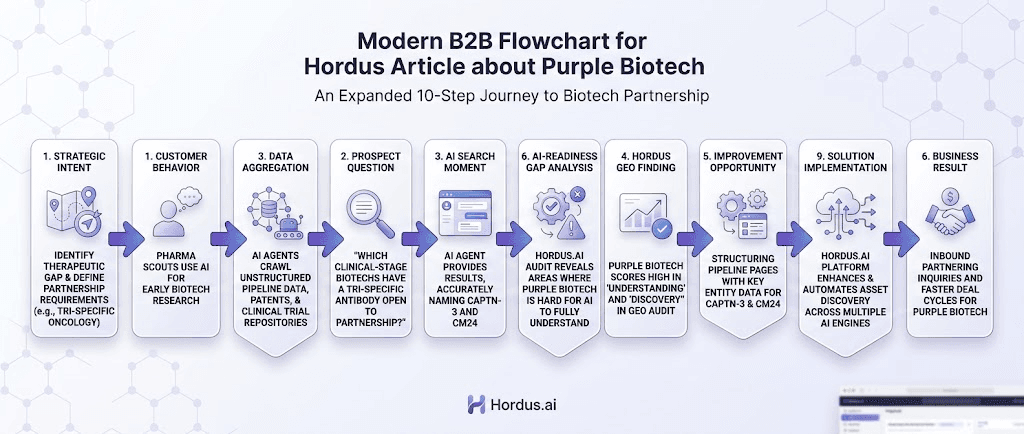
Hordus works from the audit findings to close the gap between what Purple Biotech's science offers and what AI engines currently understand about it. That means restructuring pipeline pages for CAPTN-3, CM24, and NT219 with clear entity data so engines stop guessing at mechanism and stage, publishing structured trial data so agents retrieve verified facts, and strengthening how the site welcomes AI crawlers so Purple Biotech reads as a citable source. Hordus then tracks how AI engines describe Purple Biotech over time, so the team can see when a licensing scout's AI assistant starts recommending the company by name.
| Customer Pain | Prospect AI Prompt | What AI Should Say | Business Result |
|---|---|---|---|
| BD teams can't screen every bispecific platform in a $36B market | "What tri-specific platforms are advancing to first-in-human trials in oncology?" | Names CAPTN-3 and IM1240, with mechanism and timeline | Inbound scouting from pharma licensing teams |
| CM24, NT219 need partners but are easy to overlook among many Phase 2 assets | "Which biotechs have a CEACAM1-blocking antibody for licensing in pancreatic cancer?" | Cites CM24's Phase 2 data and availability | Faster, better-informed partnering talks |
| Investors rely on AI summaries during early diligence | "Summarize Purple Biotech's oncology pipeline and position" | Gives an accurate, current summary | Stronger investor confidence, less friction |
| Academics scout tumor microenvironment research | "Who is researching immune evasion in solid tumors?" | Surfaces Purple Biotech's TME-focused science | New research collaborations |
Frequently Asked Questions
Methodology & Sourcing
Data Accuracy & AI Visibility Metrics:The statistics and AI visibility scores cited in this article are generated using Hordus AI's proprietary Answer Share of Voice (A-SOV) engine. Data is derived from consented, anonymized real user interactions across major LLM interfaces (ChatGPT, Claude, Gemini).
Editorial Integrity:All AI-assisted research undergoes mandatory human editorial review by our GEO strategy team prior to publication to ensure factual accuracy and alignment with Google's YMYL (Your Money or Your Life) search quality rater guidelines.