The Next Energy RFP Starts With a Prompt: Why Boson Energy Needs to Own the Waste-to-X Answer Before Someone Else Does
AI engines now shape vendor shortlists before sales calls happen, and Boson Energy's site isn't giving them enough to compete. The category is still undefined, meaning Boson Energy can win the answer now, before Enerkem, Fulcrum BioEnergy, or Bloom Energy do.
TL;DR
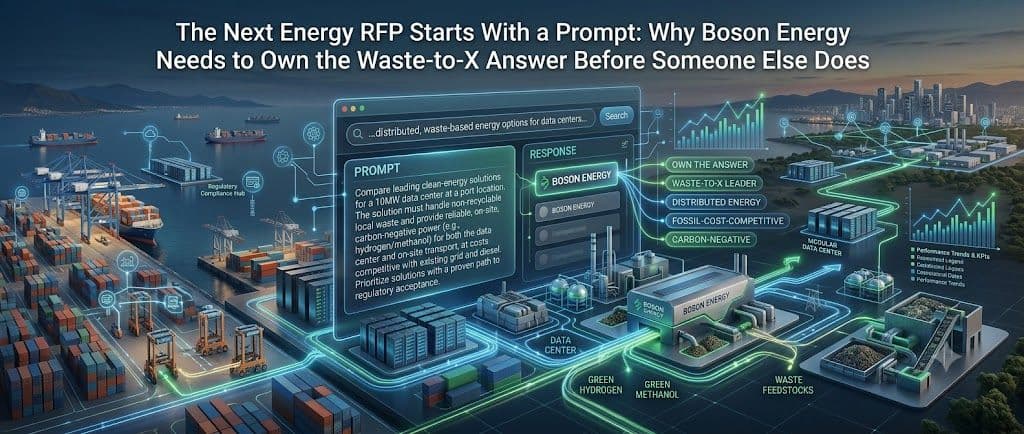
Data center operators, ports, and municipalities are under real pressure to secure power without waiting years for grid connections. Many of them are now asking AI engines like ChatGPT, Gemini, and Perplexity to explain their options before they ever call a vendor. If those engines describe waste-to-hydrogen and distributed energy without mentioning Boson Energy, competitors like Enerkem, Fulcrum BioEnergy, Powerhouse Energy, or Bloom Energy get the introduction instead. This is a business problem first and a technical SEO problem second. The Hordus GEO analysis of bosonenergy.com shows exactly where that risk is concentrated, and where a focused fix could move Boson Energy from "mentioned" to "recommended."
The market event: power has become the bottleneck, not the pitch
For most of the last decade, the hard part of clean energy sales was proving the technology worked. That is no longer the constraint. In 2026, the constraint is megawatts. The IEA now projects data centers will consume roughly 1,000 TWh this year, on par with Japan's entire electricity use, and AI rack density has jumped tenfold in a few years, from around 10 kW to over 100 kW per rack. Grid interconnection queues have not kept pace, and regulators are responding: Ireland's Commission for Regulation of Utilities now requires new data centers to match demand with onsite or local generation and hit an 80 percent renewable target, and similar "bring your own power" logic is spreading across US and EU markets.
That regulatory and infrastructure squeeze is exactly the kind of event that sends buyers to AI engines before they send an email to a vendor. A facilities director who used to Google "distributed power options" is now typing a full paragraph into an AI assistant, asking it to compare waste-to-energy, on-site hydrogen, and fuel cells, and to name the companies that actually do this. Whoever the engine names first has already won half the sales cycle. This is Boson Energy's opening, and it is also its exposure.
Who is asking, and what they actually want
Boson Energy sits at the intersection of waste management, distributed energy, and industrial decarbonization, a category most buyers do not have a clean name for yet. That ambiguity is precisely why they turn to AI engines to make sense of it. The realistic buyer set includes:
- Data center and edge-compute operators looking for power that does not depend on a multi-year grid queue, ideally with a sustainability story attached.
- Ports, municipalities, and utilities sitting on non-recyclable waste streams and looking to turn a disposal cost into an energy asset.
- EV charging network operators who need high-capacity, localized charging without new substations.
- Aviation and shipping buyers hunting for green methanol and sustainable aviation fuel supply that does not depend on scarce biomass or imported hydrogen.
- Defense and public-sector procurement, a market Boson Energy is already engaging through the NATO DIANA accelerator, where energy resilience is treated as a security asset, not just a sustainability line item.
As CEO Jan Grimbrandt has put it, producing hydrogen from waste is cost-competitive compared to both green and blue and even grey hydrogen, which is the kind of specific, comparative claim that AI engines look for when they build a shortlist. Buyers in each of these segments are not looking for a definition of hydrogen. They are looking for a shortlist they can bring to their board. CEENERGYNEWS
Five prompts these buyers are already typing
- "What are the best distributed, waste-based energy options for a data center that can't get a grid connection in time?"
- "Compare waste-to-hydrogen companies for EV charging infrastructure in Europe."
- "Which companies convert non-recyclable municipal waste into clean energy at commercial scale?"
- "Is waste-to-hydrogen cheaper than green hydrogen for industrial buyers?"
- "Who are the leading suppliers of green methanol or sustainable aviation fuel made from waste feedstocks?"
What happens depending on who the engine names
If AI engines describe Boson Energy clearly, accurately, and with its differentiators intact (carbon-negative, fossil-cost-competitive, distributed, dual-use), the company shows up pre-qualified in a buyer's mind before the first sales call. That shortens sales cycles and shifts the conversation from "convince us this works" to "tell us where to build the first plant." As CCO Heike Zatterstrom has described the underlying model, the goal is to go away from a large-scale, centralised energy system, or complement it at least, with distributed solutions that boost energy security locally and in a carbon neutral or negative way, a framing that answers the buyer's real question directly. Delano
If competitors dominate those answers instead, the cost is not a lost click. It is losing the chance to compete at all, because the buyer never builds Boson Energy into their consideration set. Category leadership in Waste-to-X is still up for grabs, and AI engines are actively deciding, right now, who gets to hold it.
| Buyer prompt | What AI should understand about Boson Energy | Risk if missing | Business value if visible |
|---|---|---|---|
| "Best distributed energy for a data center with no grid capacity" | Boson delivers local, 24/7, dual-use power including edge-compute support | Buyer never learns Boson is an option for power-constrained sites | Direct entry into a fast-growing, urgent-need segment |
| "Compare waste-to-hydrogen companies for EV charging" | 1 ton of waste equals 300 litres of diesel in charging output, fossil-parity pricing | Competitors with clearer specs get named instead | Positions Boson as the economics leader, not just the green option |
| "Companies converting municipal waste into clean energy" | Complete gasification, carbon-negative, no ash, no water stress, no landfill dependency | Boson reads as one of many, indistinguishable from incinerators | Establishes Boson as the technically differentiated choice |
| "Is waste-to-hydrogen cheaper than green hydrogen" | Boson is cost-competitive against green, blue, and grey hydrogen at point of use | Buyer defaults to electrolysis players with stronger AI visibility | Wins the cost conversation before pricing is even discussed |
| "Leading suppliers of green methanol or SAF from waste" | Boson's Waste-to-X model extends to methanol and SAF from the same feedstock | Boson absent from aviation and shipping shortlists entirely | Opens adjacent, high-value verticals with existing technology |
Introducing the Hordus GEO analysis
Once the business case is clear, the next question is mechanical: does bosonenergy.com actually give AI engines the material to answer these prompts correctly?
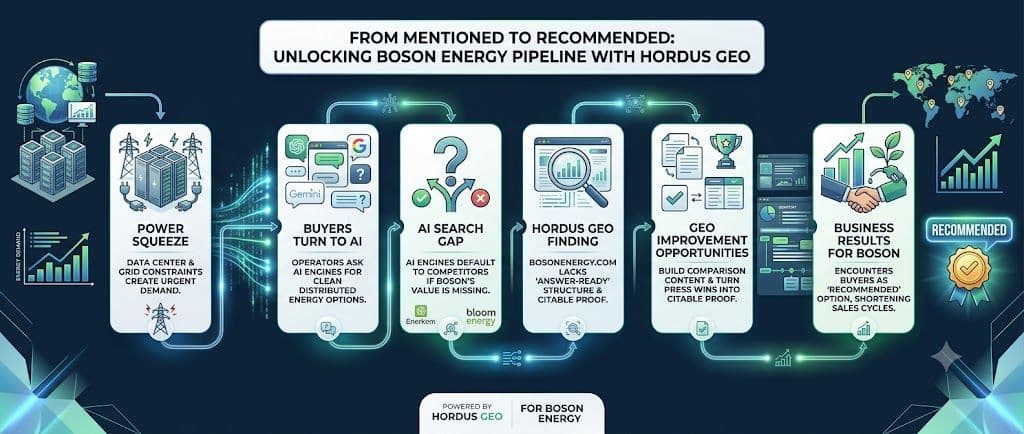
The Hordus GEO analysis of bosonenergy.com, run against the ora.ai agent-readiness framework, looked at how discoverable, well-defined, and citable the site is across the layers AI systems rely on before naming a vendor.
| Layer | Current signal | What it means |
|---|---|---|
| Discovery | Limited machine-readable structure, no dedicated AI-facing summary | Engines may struggle to efficiently locate the site's strongest proof points |
| Identity | Strong narrative language, but few structured specs or comparisons | Engines can describe the mission but may blur Boson with generic "waste-to-energy" |
| Content depth | Heavy reliance on press releases and news posts | Thin category-defining content for prompts like "compare waste-to-hydrogen companies" |
| Offsite authority | Strong partner credibility (Siemens, NATO DIANA, EU Seal of Excellence) but underleveraged in citable form | Third-party validation exists but isn't structured for AI retrieval |
| User experience for AI agents | No clear FAQ or comparison-ready pages | Buyer-style prompts get partial or generic answers |
What better GEO could do for Boson Energy's pipeline
- Turn press wins into citable proof. The Siemens partnership, the NATO DIANA Accelerator selection, and the EU Seal of Excellence are strong signals, but they need to be reformatted into content AI engines can quote directly when comparing vendors.
- Build comparison-ready content. Pages that directly address "waste-to-hydrogen vs green hydrogen" or "Boson Energy vs Enerkem" give engines something concrete to cite instead of generalizing.
- Strengthen answer share against named competitors. Hordus can track how often Boson Energy appears versus Fulcrum BioEnergy, Powerhouse Energy, Ways2H, and Bloom Energy across the five prompts above, and close specific gaps.
- Expand offsite authority. Getting Boson Energy's cost and output data cited in third-party industry sources increases the chance AI engines treat it as a verified, quotable source rather than a self-description.
- Give sales and product marketing a shared script. Once Hordus identifies which claims AI engines already trust, sales enablement and marketing can align messaging around the same proof points AI engines are already repeating back to buyers.
Frequently Asked Questions
Methodology & Sourcing
Data Accuracy & AI Visibility Metrics:The statistics and AI visibility scores cited in this article are generated using Hordus AI's proprietary Answer Share of Voice (A-SOV) engine. Data is derived from consented, anonymized real user interactions across major LLM interfaces (ChatGPT, Claude, Gemini).
Editorial Integrity:All AI-assisted research undergoes mandatory human editorial review by our GEO strategy team prior to publication to ensure factual accuracy and alignment with Google's YMYL (Your Money or Your Life) search quality rater guidelines.