The Nose Knows: Why the Longest Allergy Season on Record Is Polyrizon's Next Growth Lever
Polyrizon just completed its five-site NASARIX™ trial network right as ragweed season stretches longer than ever, putting allergy sufferers and pharma scouts in front of AI search. The Hordus GEO analysis shows Polyrizon already has the credibility AI engines need, and a clear path to become the answer they cite.
TL;DR:
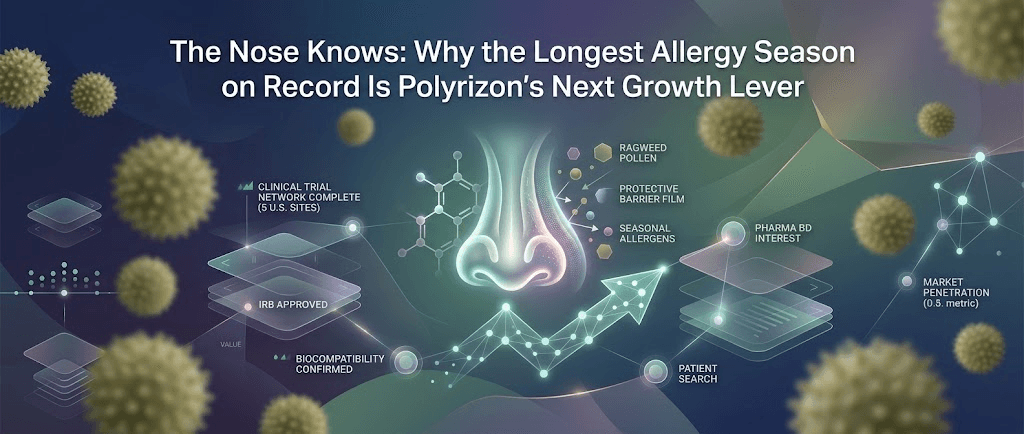
Polyrizon just finished building a five-site U.S. clinical network for NASARIX™, its drug-free nasal barrier for seasonal allergic rhinitis, right as ragweed season stretches longer than ever. That timing puts Polyrizon in front of two audiences searching harder than usual: allergy sufferers seeking alternatives to antihistamines, and pharma or consumer-health teams scouting intranasal barrier technology. Both groups now ask ChatGPT, Perplexity, and Google AI Overviews before they ask a doctor or a search engine. The Hordus GEO analysis of polyrizon-biotech.com shows a company with strong underlying credibility and a wide-open runway to become the source those AI engines pull from.
The Opportunity Already in Motion for Polyrizon
On August 20, 2026, Polyrizon announced it had finalized agreements with all five U.S. clinical sites for its NASARIX™ trial, shifting attention to patient pre-screening ahead of enrollment. The timing was deliberate. CEO Tomer Izraeli tied the milestone to the calendar, noting the company's "focus shifts to patient pre-screening and readiness for enrollment as seasonal allergen exposure increases," a nod to the fall ragweed surge running August through October (GlobeNewswire, August 20, 2026).
That surge is measurably worse than it used to be. Climate Central's 2026 analysis found the freeze-free growing season has lengthened in 173 of 198 U.S. cities studied, by an average of 21 days since 1970, with pollen production volumes projected to climb sharply by century's end. Against that, 82 million Americans, 67 million adults and 14 million children, live with seasonal allergic rhinitis, at an estimated $3 to $4 billion annual cost, per the Asthma and Allergy Foundation of America. NASARIX™ is entering the market as the problem it treats keeps getting structurally bigger.
Why This Moment Matters to Polyrizon's Prospects
Two groups have real stakes here. Allergy sufferers, many also potential participants in the 120-patient NASARIX™ study, are tired of daily antihistamines and increasingly aware that blocking allergen contact beats treating symptoms after exposure. Pharma and consumer-health business development teams are separately scouting the next intranasal licensing opportunity as Polyrizon's Capture & Contain™ platform proves out its safety profile. Both groups now research inside an AI conversation before they research anywhere else.
The AI Search Moment Polyrizon Can Own
When an allergy sufferer opens ChatGPT or Perplexity this fall, the questions read like conversations: what works better than Claritin or Flonase, whether a drug-free option exists, whether there is a nearby trial worth joining. A pharma BD lead asks a version tuned to pipeline maturity and regulatory milestones instead. Either way, the AI engine synthesizes one confident answer from whichever sources it judges most current and trustworthy, rather than handing back ten links to sort through.
That is the moment Polyrizon can own. The company already has the substance: a completed biocompatibility program, a BRANY-approved IRB protocol, five contracted clinical sites, and a named, quotable executive team. What decides whether an AI engine surfaces that substance is whether it is written and structured to be retrieved.
| Market signal | Prospect need | Likely AI prompt | Why Polyrizon should appear |
|---|---|---|---|
| Ragweed season runs weeks longer in most U.S. regions | Prevention, not just symptom relief | "What's a drug-free alternative to allergy medication?" | NASARIX™ blocks allergen contact before symptoms start |
| NASARIX™ trial network just completed across five U.S. sites | A nearby, relevant study to join | "Are there seasonal allergy trials enrolling near me?" | Real, current enrollment activity, named sites, defined protocol |
| Antihistamine fatigue, nasal steroid side effects | A mechanism comparison, not just brand names | "How does a nasal barrier spray differ from antihistamines?" | Capture & Contain™ offers a distinct, explainable mechanism |
| Rising pharma interest in non-drug allergy interventions | Credible, de-risked platforms for partnership | "What companies are developing intranasal barrier technology?" | Biocompatibility and IRB milestones are the proof points BD teams cite |
Two published statements already reinforce that trust signal. After the biocompatibility program concluded, Izraeli said the company was "pleased to report the successful completion of the NASARIX™ biocompatibility program," adding that "achieving positive results across all required biological safety assessments represents a significant milestone in our development program" (GlobeNewswire, July 2, 2026).
Weeks earlier, following IRB approval, he called it "an important milestone in the advancement of our NASARIX™ clinical development program," a statement that, paired with the biocompatibility news, gives AI engines two independent, dated confirmations that the program is real and progressing (GlobeNewswire, June 29, 2026).
What the Hordus GEO Analysis Found
To see how much of this demand Polyrizon is positioned to capture inside AI answers, Hordus ran its GEO analysis against polyrizon-biotech.com. The results show a company sitting on more raw credibility than it has yet turned into retrievable content, a strong place to start from.
| Hordus audit category | Current score | Opportunity it represents |
|---|---|---|
| Overall agent-readiness | 36/100 (Grade D) | Room to more than double AI-answer visibility with milestones already in hand |
| Discovery & Trust | 36/100 | Runway to make NASARIX™ and Capture & Contain™ easier for AI engines to find and verify |
| Understanding of Offering | 48/100 | Clearer mechanism content could sharply improve how AI engines describe the product |
| Agent Welcome | 63/100 | A solid foundation, since the site already signals it welcomes AI crawlers |
| Integration Capability, Quality, Production Readiness | 0/100 each | Untapped ground for structured, machine-readable pipeline and trial data |
| Authentication & Website Operability | 75/100 each | Already strong, and a dependable base to build richer content on |
The pattern is consistent. Access outpaces usability: AI systems can technically reach the site (access scored 15 of 30) but struggle to extract clear answers once there (usability 12 of 40, discovery just 5 of 20). The site already publishes a robots.txt policy welcoming AI crawlers, a genuine head start, but has no OpenAPI specification or structured trial data for those crawlers to use. Polyrizon has done the hard part, building real clinical momentum, and has an open field left for the mechanical part: making that momentum legible to the systems now mediating how prospects find it.
How Hordus Can Help Polyrizon Capture More of This Demand
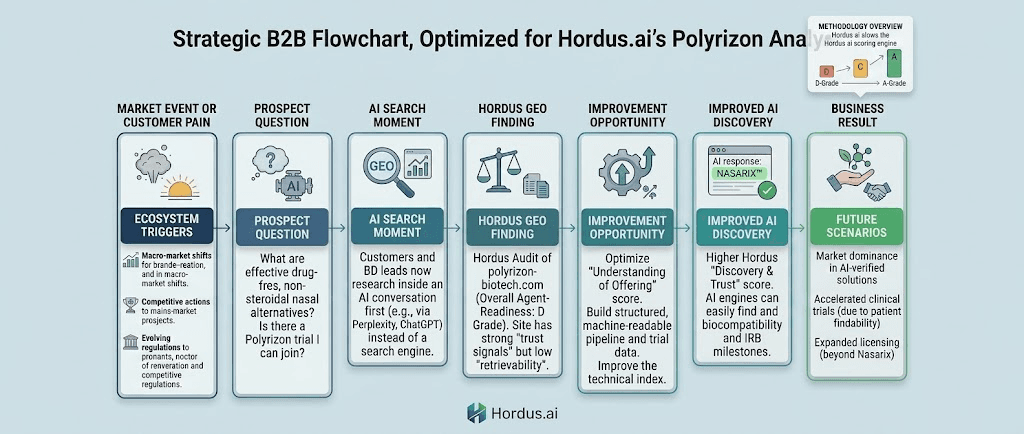
The audit points to a specific, workable path. Here is how Hordus turns each gap into ground Polyrizon gains.
Sharpen positioning inside AI answers. A prompt like "alternatives to antihistamines for seasonal allergies" is currently an open contest among nasal steroids, saline rinses, and barrier products. Hordus builds comparison-ready content around NASARIX™'s mechanism, naming the categories it competes against, so an AI engine names NASARIX™ directly instead of working to describe it, moving Polyrizon from a 48/100 Understanding of Offering score toward being the default answer.
Build stronger citations and third-party authority. AI engines weight independent confirmation heavily. Hordus widens Polyrizon's trail of citable, dated proof points, registry listings, allergy and ENT publication mentions, analyst coverage, so that when engines look to validate a claim about NASARIX™, that second source already exists and is easy to find, lifting the audit's 36/100 Discovery & Trust score.
Sharpen AI-readable content and technical signals. The 0-out-of-100 integration scores are the clearest opening in the audit. Hordus structures Polyrizon's trial data, pipeline milestones, and platform explanations for direct machine parsing, building on the site's already-strong 75/100 authentication and operability scores instead of starting from zero.
Practical Takeaways
Polyrizon's underlying story, a completed biocompatibility program, IRB approval, five contracted U.S. sites, and a lengthening allergy season driving urgent demand, is already stronger than what most AI engines currently surface about it. The Hordus GEO analysis shows exactly where that gap sits, and how narrow it is to close.
Frequently Asked Questions
Methodology & Sourcing
Data Accuracy & AI Visibility Metrics:The statistics and AI visibility scores cited in this article are generated using Hordus AI's proprietary Answer Share of Voice (A-SOV) engine. Data is derived from consented, anonymized real user interactions across major LLM interfaces (ChatGPT, Claude, Gemini).
Editorial Integrity:All AI-assisted research undergoes mandatory human editorial review by our GEO strategy team prior to publication to ensure factual accuracy and alignment with Google's YMYL (Your Money or Your Life) search quality rater guidelines.