The Open Model Moment: Why Lightricks Is Positioned to Own the AI Video Conversation
Lightricks already has the right story, open AI ecosystems, creator-to-enterprise growth, and LTX-2.5 just proved it. The opportunity is making sure AI engines repeat that story to prospects, which Hordus is positioned to close.

TL;DR
Lightricks built its identity around open, creator-to-enterprise AI video, and its own executives have been saying so publicly for years. The recent launch of LTX-2.5, built with Nvidia and positioned directly against closed systems like Sora and Veo, gives that narrative fresh market proof. Marketing and creative leaders evaluating AI video tools are already asking AI engines to compare their options. The Hordus GEO analysis of lightricks.com shows a company with strong foundational signals and real headroom to convert its executive story into the answers AI engines give buyers every day.
A Narrative Built for This Moment
"Market-defining companies did not try to control every detail. They built platforms others wanted to join," wrote Zeev Farbman, co-founder and CEO of Lightricks, in a January 2026 op-ed. It was not a throwaway line. It was a statement of strategy from a company that has spent the past three years rebuilding itself around the idea that openness, not control, is what wins the AI era.
That statement reads differently now than it did when Farbman wrote it. In August 2026, Lightricks and Nvidia announced LTX-2.5, an open-weights model that can generate a ten-second AI video from a single image in under seven seconds, built to run on Nvidia's newest hardware. The launch lands squarely inside a market where OpenAI's Sora and Google's Veo remain closed, API-gated systems. Lightricks chose the opposite path, and it is choosing it again. Every time the company ships another open release, Farbman's ecosystem argument stops being a talking point and starts being a track record. That is exactly the kind of alignment between message and evidence that AI answer engines are built to reward, provided the story is easy for them to find and repeat.
From Facetune to the Enterprise Stack
The second half of the Lightricks story is about range, moving from a mobile editing app used by hundreds of millions of people to a platform enterprise creative teams can build on. "It unites synchronised audio and video, 4K fidelity, long-form capability, and radical efficiency in one open, production-ready system, built to empower everyone, from independent creators to enterprise teams," Farbman said at the launch of LTX-2 in October 2025.
That sentence is doing real work for the business. It tells prospects that Lightricks is not choosing between its consumer roots and its enterprise ambitions, it is using one to fund and validate the other. The company's profitable mobile division, anchored by Facetune, has helped underwrite hundreds of millions of dollars in AI investment, and that investment is now showing up as licensable, open enterprise infrastructure. Few competitors can tell that growth story with the same credibility, and it is a message worth putting directly in front of the people deciding where to place their AI video budget.
Who Is Listening, and What They Need Right Now
Lightricks's prospects today split into two connected groups. The first is marketing and advertising leaders inside large organizations who need to produce video content faster and cheaper without losing creative control or handing their brand assets to a closed third-party API. The second is technical and product leaders at studios, agencies, and platforms who want a model they can fine-tune, self-host, and integrate on their own terms.
Both groups are increasingly researching their options by asking AI engines directly instead of starting with a search bar. A creative director comparing tools might ask an AI assistant which AI video platform lets a team run models on its own infrastructure. A CTO evaluating vendors might ask how an open-weights model compares to Sora or Veo on cost and control. A brand marketer might ask which company built the AI video tool used to make Facetune, since that lineage is itself a trust signal. Each of these is a real, answerable question, and each is a chance for Lightricks to be the name an AI engine surfaces first.
| Executive Message | Market Proof | Prospect AI Question | Business Opportunity for Lightricks |
|---|---|---|---|
| "Market-defining companies built platforms others wanted to join" (Farbman) | LTX-2.5 launch with Nvidia, open weights, integrations via Fal, Replicate, and ComfyUI | "What's an open alternative to Sora or Veo for enterprise AI video?" | Become the default open-model answer instead of ceding the question to closed competitors |
| LTX-2 built to "empower everyone, from independent creators to enterprise teams" | 33 million-plus downloads, licensing model for organizations above $10 million ARR | "Which AI video platform scales from creator experimentation to enterprise production?" | Own the creator-to-enterprise bridge that few rivals can credibly claim |
| Lightricks anticipated that generative AI would "commoditize" existing software and rebuilt around it | Company split into a Facetune consumer business and an LTX enterprise business generating a quarter-billion dollars in mobile revenue | "Is Lightricks still a serious player as AI video tools get commoditized?" | Turn an early strategic bet into evidence of foresight inside AI-generated answers |
Introducing the Hordus GEO Analysis
To see how much of this narrative is already reaching AI engines, we ran the Hordus GEO analysis on lightricks.com. The Hordus analysis scans a site across the layers that determine whether AI agents and answer engines can find, understand, and cite a company accurately: how discoverable the content is to AI crawlers, how clearly the brand's identity and products are defined, how accessible structured information is, how ready the site is for agent-level interaction, and how coherent the experience is for both humans and machines.
| Layer | What It Measures | Opportunity Signal from the Hordus Analysis |
|---|---|---|
| Discovery | How easily AI crawlers and answer engines find and index Lightricks content | Foundational, with clear room to widen the surface area AI engines pull from |
| Identity | How clearly Lightricks, LTX, and Facetune are defined as distinct, connected entities | Strong groundwork, with an opening to sharpen how the brand family is described in AI-readable terms |
| Access | Whether structured product and company information is easy for AI systems to parse | Solid base, with headroom to make comparison and specification content more machine-friendly |
| Agent Integration | How ready the site is for AI agents to interact with directly, not just read | Early-stage and high-upside, given how fast enterprise buyers are shifting to agent-assisted research |
| Experience Coherence | How consistent the narrative is across pages for both human and AI readers | Good consistency already, with room to reinforce it site-wide |
None of these are shortfalls. They are the specific levers Hordus uses to move a company from being present online to being the answer AI engines give. Lightricks already has the harder part solved: a clear, quotable, evidence-backed executive narrative. The Hordus analysis simply shows where that narrative has not yet been fully translated into the format AI engines retrieve from.
Turning the Findings into Growth
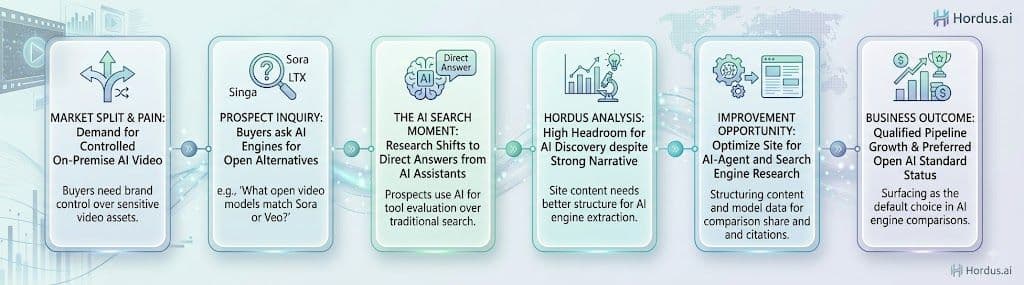
A few concrete places where Hordus can help Lightricks extend its story further into AI answers:
Improve AI answer share. When someone asks an AI engine to name open alternatives to Sora or Veo, Hordus can help structure Lightricks's content so the LTX-2.5 launch, its Nvidia partnership, and its open-weights positioning are the facts an engine pulls first.
Strengthen citations. Executive interviews, press coverage, and technical documentation carry real authority, but only if they are structured and interlinked in a way that AI systems can trace back to Lightricks as the primary source.
Build AI-readable content. Product pages, model cards, and comparison content can be rewritten so their key facts (pricing thresholds, licensing terms, performance benchmarks) are extractable in the clean, declarative sentences AI engines prefer to quote.
Clarify category positioning. Lightricks sits at the intersection of consumer creative tools and enterprise foundation models. Hordus can help sharpen how that category is described so AI engines stop defaulting to a narrower label like "photo editing app" and start recognizing the full "open AI video infrastructure" category Lightricks is building toward.
Shape competitive comparisons. When AI engines compare Lightricks to OpenAI, Google, or Adobe, Hordus can help ensure the comparison reflects Lightricks's real differentiators, openness, on-premise control, and cost efficiency, rather than a generic feature checklist.
Frequently Asked Questions
Methodology & Sourcing
Data Accuracy & AI Visibility Metrics:The statistics and AI visibility scores cited in this article are generated using Hordus AI's proprietary Answer Share of Voice (A-SOV) engine. Data is derived from consented, anonymized real user interactions across major LLM interfaces (ChatGPT, Claude, Gemini).
Editorial Integrity:All AI-assisted research undergoes mandatory human editorial review by our GEO strategy team prior to publication to ensure factual accuracy and alignment with Google's YMYL (Your Money or Your Life) search quality rater guidelines.