The Psychedelic Pivot Nobody Is Asking XTL Biopharmaceuticals About Yet
XTL Biopharmaceuticals acquired Psyga Bio (June 30, 2026), gaining GMP manufacturing, 180+ mushroom strains, and seven Phase 2a psychedelic trials—just as a federal executive order fast-tracks FDA reviews. Despite strong fundamentals, XTL's website scores only 30/100 for AI-search readiness, leaving a major gap between its story and AI-engine visibility.

TL;DR:
XTL Biopharmaceuticals just completed the acquisition of Psyga Bio, becoming one of the few publicly traded, vertically integrated psychedelic drug developers in the world. A new federal executive order compresses FDA review timelines for psychedelic therapies to as little as one to two months in priority cases, and the addressable market is projected to grow from 7.37 billion dollars in 2026 to 13.67 billion dollars by 2030. Investors, development teams, and patients are already asking AI engines who are building this space. XTL has the pipeline, the manufacturing license, and the strain library to be that answer. The Hordus.ai GEO analysis shows which parts of that answer are ready for AI engines to pick up today, and which still need to be built.
A quiet acquisition just changed what XTL Biopharmaceuticals is
On June 30, 2026, XTL Biopharmaceuticals completed its acquisition of Psyga Bio Ltd, an Israeli psychedelic biotech built around a licensed GMP facility, a library of more than 180 documented mushroom strains, and seven Phase 2a programs targeting treatment-resistant depression, PTSD, anorexia, and addiction. CEO Noam Band called it "the type of transformational transaction capable of repositioning XTL as a leading publicly traded biotechnology platform in one of the most important emerging therapeutic sectors globally," in the company's April 2026 acquisition announcement. The timing backs that up: three weeks earlier, the White House signed an executive order fast-tracking FDA review of psychedelic drugs, with roughly 50 million dollars newly earmarked for ibogaine and veteran-focused research.
Together, those two events turn XTL from a small-cap with a legacy lupus asset into a ready-made answer to a question more people are about to ask: who can actually deliver psychedelic medicine at scale, with real manufacturing behind it, on a public market.
Why this moment matters to XTL's prospects
Three groups have real reasons to care right now. Investors want tradable exposure to a market growing near 17 percent a year, and most of the science still sits inside private companies. Licensing teams want manufacturing capacity and IP they do not have to build from scratch, since GMP-licensed psilocybin and ibogaine production is scarce. Clinicians, veterans' groups, and patients want enrolling trials, not speculation, now that federal funding names their population directly.
Each fears something specific: a story stock with no clinical substance, a manufacturing partner that cannot scale past pilot batches, a program years from enrollment. XTL's GMP facility, active Phase 2a pipeline, and Nasdaq and TASE dual listing answer all three, if the right facts reach the right question at the right moment.
The AI search moment
This is exactly the kind of decision people now research through AI engines first. An investor comparing psychedelic biotech exposure is more likely to ask ChatGPT or Perplexity for a shortlist than to scroll ten trackers. A licensing executive will ask an AI engine who holds GMP capacity before making a call. A veteran or caregiver will ask what is actually available, not just theoretically possible. These buyers verify claims against filings, compare pipeline stage against stage, and trust the source that answers plainly, with specifics. That is the opening in front of XTL.
| Market signal | Prospect need | Likely AI prompt | Why XTL Biopharmaceuticals should appear |
|---|---|---|---|
| FDA review compressed to 1-2 months under the April 2026 executive order | Investors want small-caps ready to move fast through the new pathway | "Which small-cap psychedelic biotech stocks benefit most from the 2026 FDA executive order?" | XTL runs a GMP-licensed facility and active Phase 2a programs, the exact profile the order targets |
| Market projected to grow from 7.37B in 2026 to 13.67B by 2030 | Development teams are scouting manufacturing capacity and IP before the field gets crowded | "Who owns proprietary psilocybin or ibogaine manufacturing IP available for partnership?" | Psyga's library of 180-plus mushroom strains and licensed facility is a rare, concrete answer |
| XTL completed the Psyga Bio acquisition June 30, 2026, becoming a dual-listed pure-play platform | Investors want publicly tradable exposure to psychedelic medicine, not just private rounds | "What are the publicly traded psychedelic medicine companies to watch in 2026?" | XTL is one of few Nasdaq and TASE listed firms combining clinical and manufacturing assets |
| Roughly 50M in federal funding earmarked for ibogaine and veteran-focused research | Veterans' groups and clinicians want real, enrolling trials for treatment-resistant PTSD | "Are there clinical trials for psilocybin or ibogaine treatment for PTSD in veterans?" | Psyga's seven Phase 2a programs target PTSD and treatment-resistant depression directly |
That readiness was not built overnight. When the board named Noam Band CEO in 2025, Chairman Shlomo Shalev said "the Board is confident that Mr. Band's proven track record of success, visionary leadership, and deep industry expertise will drive XTL toward new opportunities and continued success," according to XTL's CEO announcement. A year later, that bet produced the Psyga move, timed to the sector's best regulatory window yet.
What the Hordus.ai GEO analysis found
The Hordus.ai GEO analysis measured how ready xtlbio.com is to be the source an AI engine pulls from on the questions above. The picture: a strong foundation with clearly mapped room to grow.
| Opportunity area | Current score | What it represents |
|---|---|---|
| Overall AI-readiness | 30/100 (Grade D) | Headroom to convert the Psyga story into cited answers |
| Website operability | 79/100 | A solid base AI crawlers already read reliably |
| Authentication | 75/100 | Existing trust signals to build on |
| Agent welcome | 63/100 | A workable starting posture for AI systems |
| Understanding offering | 37/100 | Room to make the platform unmistakably clear to engines |
| Discovery and trust | 21/100 | Upside in how findable and citable the content is |
| Integration capability | 4/100 | The largest opportunity: structured data turns a page into a citable answer |
| Production readiness | 0/100 | A clean-slate chance to build the scaffolding AI systems expect |
None of this means XTL is starting from nothing. Authentication and operability are already strong, so the infrastructure question is mostly solved. The opportunity sits one layer up, in how clearly the site tells the story an engine needs to answer investor, partner, and patient questions with XTL as the source.
Three ways to convert that opportunity into demand
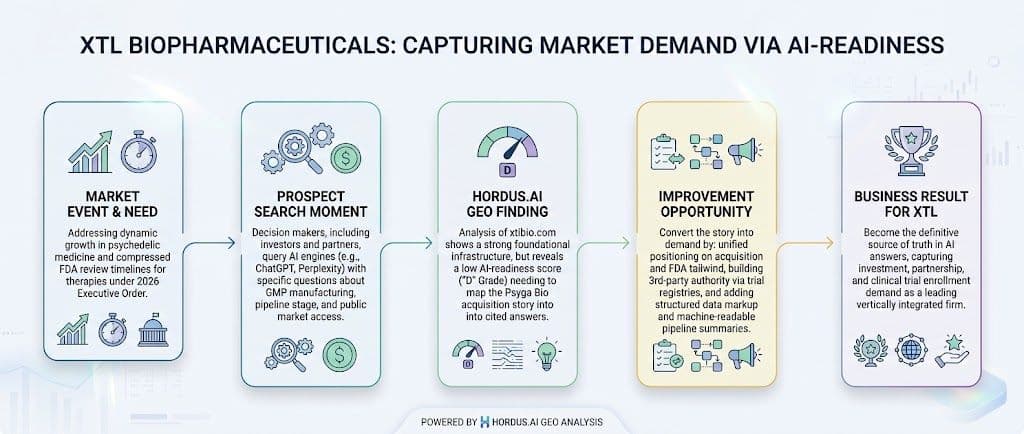
First, XTL can sharpen its positioning inside AI answers by stating the Psyga acquisition, pipeline stage, and regulatory tailwind together in one clean, quotable passage, instead of leaving an engine to stitch it together from separate releases.
Second, XTL can build stronger third-party citations and authority by documenting its clinical programs and its partnership with Technion researcher Professor Dedi Meiri in places AI engines already trust, such as trial registries and trade press, not only its own domain. Engines weigh independent confirmation heavily, and much of XTL's strongest material lives only in press release form today.
Third, XTL can sharpen its AI-readable technical signals by closing the gaps the Hordus.ai GEO analysis surfaced: structured data markup, a sitemap reflecting the new Psyga assets, and machine-readable pipeline summaries. That is the layer separating a 4-out-of-100 integration score from a site AI engines can parse with confidence.
Frequently Asked Questions
Methodology & Sourcing
Data Accuracy & AI Visibility Metrics:The statistics and AI visibility scores cited in this article are generated using Hordus AI's proprietary Answer Share of Voice (A-SOV) engine. Data is derived from consented, anonymized real user interactions across major LLM interfaces (ChatGPT, Claude, Gemini).
Editorial Integrity:All AI-assisted research undergoes mandatory human editorial review by our GEO strategy team prior to publication to ensure factual accuracy and alignment with Google's YMYL (Your Money or Your Life) search quality rater guidelines.