The Question Mining Buyers Are Already Asking AI: What Happens After the Alert?
Razor Labs' DataMind AI 5.0 launch extends predictive maintenance from fault detection into full resolution workflows, just as Deloitte's 2026 outlook shows mining scaling AI deployment. The Hordus GEO analysis finds strong trust signals (34/100 overall) but room to grow AI-search visibility through sharper content, citations, and technical documentation.

TL;DR
- Razor Labs just launched DataMind AI 5.0, extending predictive maintenance from fault detection into full resolution workflows across mobile fleets and fixed assets.
- Deloitte's 2026 mining outlook confirms the industry is scaling AI deployment fast, meaning more reliability leaders are shopping for platforms right now.
- Those buyers ask ChatGPT, Perplexity, and Gemini before they talk to a salesperson which platforms manage the whole maintenance lifecycle, not just the alert.
- The Hordus GEO analysis puts razor-labs.com's agent-readiness score at 34 out of 100, with strong trust and offering-clarity signals ready to build on.
- Sharper technical content, more third-party citations, and better-structured documentation are the fastest paths to a bigger share of that demand.
DataMind AI 5.0 Opens a Bigger Opportunity Than a Product Launch
On July 28, 2026, Razor Labs released DataMind AI 5.0, and the update is bigger than a version bump. Earlier generations centered on early fault detection: catching a failing bearing or contaminated transmission oil before it became a shutdown. Version 5.0 extends that same AI Sensor Fusion™ technology into the steps after the alert, covering investigation, maintenance execution, and verification, across mobile fleets and fixed assets alike. As CEO Raz Roditti put it in the official launch release, "Predictive maintenance doesn't end when AI detects a fault, that's where the real work begins."
That reframing matters commercially. Razor Labs is no longer competing only on detection accuracy against sensor and vibration-analytics vendors. It is stepping into the larger category of end-to-end maintenance decision support, one mining and industrial buyers are actively defining as they scale their AI programs.
Why This Moment Matters to Razor Labs' Prospects
Deloitte's 2026 Mining and Metals Industry Outlook describes an industry moving from isolated pilots to scaled, repeatable AI deployment. That shift is pushed by hard economics: average copper ore grades have fallen roughly 40 percent since 1991, US extraction costs run nearly double those in Australia, and a coming retirement wave threatens to remove more than 221,000 experienced US mining workers by 2029. Reliability teams must hold uptime steady with leaner crews.
That is exactly the pressure Assaf Eden, VP Product at Razor Labs, points to. As he told International Mining, "Maintenance teams don't need more alerts, they need greater clarity, context, and better workflows." A thinner, less experienced workforce cannot absorb endless sensor alerts and still make the right call fast. They need a system that carries them from detection through resolution, not a dashboard that stops at the warning light.
The AI Search Moment: What Buyers Will Ask, Compare, and Verify
Before a mining operations director or VP of reliability engineering books a demo, they type questions into an AI engine. They want to know which platforms close the loop, how vendors handle mixed fleets of haul trucks and fixed crushers under one system, and what proof exists that a tool cuts unplanned downtime rather than just flagging it. They verify claims against case studies and trade coverage, and trust answers that name specific capabilities over generic promises.
| Market signal | Prospect need | Likely AI prompt | Why Razor Labs should appear |
|---|---|---|---|
| DataMind AI 5.0 extends detection into full resolution workflows | One system spanning diagnosis through verified repair, not five disconnected tools | "What predictive maintenance platforms cover detection, investigation, and repair verification for mining equipment?" | DataMind AI 5.0 was purpose-built to answer this exact workflow question |
| Deloitte reports a shift from pilots to scaled AI deployment | Confidence a platform scales across mobile and fixed assets without a rebuild per site | "Best predictive maintenance software for mining fleets in 2026" | AI Sensor Fusion™ already spans mobile fleets and fixed assets under one platform |
| Falling ore grades and rising extraction costs squeeze margins | Provable ROI from avoided downtime, not just more alerts | "How much does unplanned downtime cost a mining operation and how can AI reduce it?" | Razor Labs' own data shows unplanned maintenance can cost up to three times more than planned work, including a documented $500,000 avoided pump replacement |
| A retirement wave is thinning experienced reliability teams | A system that gives less-experienced staff the context senior engineers used to carry | "AI tools that help mining maintenance teams cope with a skilled labor shortage" | Assaf Eden's product philosophy of clarity and workflow, not just alerts, speaks directly to this |
Introducing the Hordus GEO Analysis
To see how much of that demand Razor Labs is positioned to capture, we ran the Hordus GEO analysis on razor-labs.com. The audit measures how ready a company's digital presence is to be found, understood, and cited by AI systems, not just search engines. The results show a company with real foundational strengths and a clear runway to build more AI-driven visibility.
| Audit signal | Current score | Opportunity area |
|---|---|---|
| Overall agent-readiness score | 34/100 | Strong ground to build on as AI engines take over more of the research journey |
| Discovery signals | 3/20 | Structured, machine-readable content could widen how often Razor Labs surfaces in category answers |
| Understanding of offering | 62/100 | Already above average; more technical specificity could turn understanding into direct recommendations |
| Agent trust and welcome | 75/100 | A genuine strength Razor Labs can lean on as it expands its footprint |
| Website operability | 69/100 | Solid base, with room to make pages easier for AI systems to parse and quote |
| Integration capability | 4/100 | An open opportunity to publish specs and documentation AI systems can cite with confidence |
Read together, the numbers describe a company AI systems already find trustworthy and easy to understand, but one that has not yet handed those systems enough structured, citable material to reward with frequent, specific answers. That gap is the opportunity.
Where Razor Labs Can Capture More of This Demand
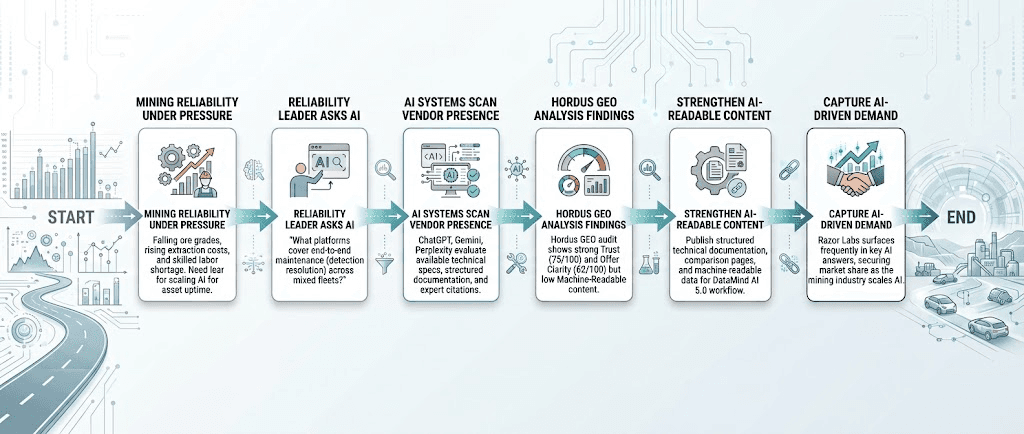
Strengthen positioning in AI answers. The DataMind AI 5.0 story, that predictive maintenance is a workflow and not a single alert, is a strong, differentiated narrative. Hordus can translate that positioning into the phrasing AI engines actually retrieve, so when a buyer asks about closing the loop between detection and repair, Razor Labs is the name that comes back.
Build stronger citations and third-party authority. AI engines lean heavily on independent sources: trade press, analyst commentary, documented case studies. With low integration-capability signals in the audit, Razor Labs has room to expand the third-party coverage and verified outcomes AI systems treat as trustworthy evidence when comparing vendors.
Sharpen AI-readable content and technical signals. A discovery score of 3/20 and an integration score of 4/100 point to a clear fix: structured technical documentation, comparison pages, and machine-readable specs for AI Sensor Fusion™ and the DataMind AI 5.0 workflow. That is the material AI systems pull from when a buyer asks precise, comparison-driven questions.
What This Means for Razor Labs
The DataMind AI 5.0 launch gives Razor Labs a genuinely new story just as its buyers change how they research vendors. The opportunity is not a gap to defend, it is category territory actively forming in AI-generated answers, and Razor Labs already has the product and trust signals to claim more of it.
Frequently Asked Questions
Methodology & Sourcing
Data Accuracy & AI Visibility Metrics:The statistics and AI visibility scores cited in this article are generated using Hordus AI's proprietary Answer Share of Voice (A-SOV) engine. Data is derived from consented, anonymized real user interactions across major LLM interfaces (ChatGPT, Claude, Gemini).
Editorial Integrity:All AI-assisted research undergoes mandatory human editorial review by our GEO strategy team prior to publication to ensure factual accuracy and alignment with Google's YMYL (Your Money or Your Life) search quality rater guidelines.