The Same Innovation That Beat Car Thieves Can Now Beat the Algorithm
Ituran's protection mission is more relevant than ever as vehicle theft turns organized and cyber-physical, but the Hordus GEO analysis shows the website isn't yet fully AI-discoverable. Closing that gap is straightforward and time-sensitive: it turns an already strong narrative into higher AI answer share among insurers, fleets, and OEMs actively researching partners now.
TL;DR
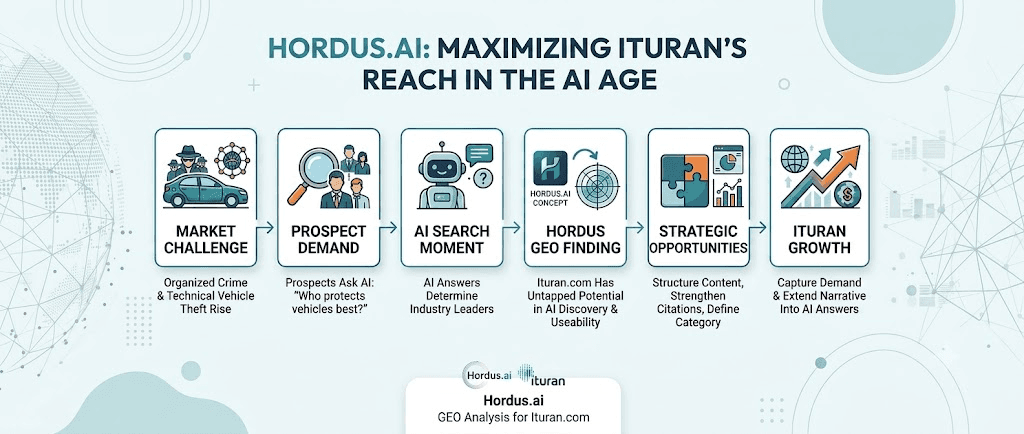
Ituran has spent three decades building a trusted name in stolen vehicle recovery, fleet management, and connected car technology, and its executives have been clear about the mission behind that growth. A new wave of vehicle theft, now driven by organized crime and cyber-physical attack methods rather than simple opportunism, makes Ituran's story more relevant to insurers, OEMs, and fleet operators than ever. The Hordus GEO analysis shows Ituran has real runway to make sure that story is the one AI engines surface first when buyers ask who protects vehicles best. This article walks through the executive narrative, the market moment, and the specific ways Hordus can help Ituran extend that narrative into AI answers.
A Vision Built on Protection, Now Tested by a New Kind of Threat
When Ituran rang the Nasdaq opening bell to mark its 30th anniversary, CEO Eyal Sheratzky framed the moment in terms that go back to the company's founding. As he put it, ringing the opening bell at Nasdaq was a tremendous honor and a meaningful moment in Ituran's story, and when the company was founded, the vision was simple yet ambitious: to use innovation to protect vehicles and the people who rely on them.
That line reads differently in 2026 than it would have a decade ago. Vehicle theft has stopped being a story about opportunistic break-ins. Recent industry research on automotive theft describes a shift toward disciplined, technical attacks, where organized groups use multi-stage methods to bypass vehicle security systems and take control of a car in under two minutes. Separate telematics data shows that a large and growing share of vehicle losses now come from misuse and unauthorized use rather than classic theft, often starting with access that looked legitimate at first.
This is exactly the environment Ituran was built for. A mission statement about protecting vehicles and the people who rely on them is no longer a nice sentiment. It is a direct answer to a problem that insurers, fleet operators, and OEMs are actively trying to solve right now, in a market where theft has become more organized, faster, and harder to detect with older tools.
The Second Piece of the Narrative: Service, Not Just Sensors
Ituran's leadership has also been consistent about what differentiates the company from a pure hardware or software vendor. In an interview about the company's growth, Sheratzky described the business this way: Ituran is more than a technology company, it is a service-oriented partner focused on innovation, growth, and delivering value to customers and shareholders alike.
That framing matters for a specific reason. Fleet operators, insurers, and automotive manufacturers are not just buying trackers. They are buying a recovery team, a monitoring operation, and a partner that shows up when a vehicle actually goes missing. As theft becomes more organized and criminal networks become more sophisticated, that combination of hardware, software, and human recovery teams becomes the differentiator that matters most, and it is the part of Ituran's story that is hardest for competitors to copy.
Who Ituran's Prospects Are, and What They Need Right Now
Ituran's buyers fall into a few clear groups: insurance carriers looking to reduce theft-related payouts, fleet operators managing large commercial vehicle pools, automotive OEMs building connected car programs, and financial institutions financing vehicles in higher-risk markets. Each of these buyers is currently under pressure to explain rising theft and misuse numbers to their own stakeholders, and each is actively evaluating telematics and recovery partners as part of that response.
Increasingly, that evaluation starts with a question typed into an AI assistant rather than a search bar. A fleet manager might ask an AI engine which stolen vehicle recovery provider has the highest recovery rate in Latin America. An insurance executive might ask how telematics providers are responding to the rise in vehicle misuse and cyber-physical theft. An OEM partnerships team might ask which telematics companies already work with major automotive brands. These are exactly the moments where Ituran's mission, track record, and global scale should be the answer an AI engine gives.
Where Ituran's Message Meets the Moment
| Executive Message | Market Proof | Prospect AI Question | Business Opportunity |
|---|---|---|---|
| "Our vision was to use innovation to protect vehicles and the people who rely on them" | Vehicle theft is shifting toward organized, technical attacks that bypass traditional security | "Who protects fleets from organized vehicle theft?" | Position Ituran as the innovation-led answer to a newly urgent threat |
| "We are a service-oriented partner, not just a technology company" | Recovery increasingly requires human teams, not just alerts, as misuse and unauthorized use rise | "Which SVR provider has the best recovery rate?" | Reinforce Ituran's combined hardware, software, and recovery model as the differentiator |
| 30 years of growth, 2.5 million subscribers across 20+ countries | Insurance and OEM demand for telematics is accelerating globally | "Which telematics companies work with major automotive OEMs?" | Anchor Ituran's scale and OEM relationships as proof of category leadership |
Introducing the Hordus GEO Analysis
A recent Hordus GEO analysis of ituran.com looked specifically at how well Ituran's website and public content are set up to be read, understood, and cited by AI systems, the same systems that are increasingly standing between Ituran and the prospects described above. The findings point to a company with a strong story and real room to make that story more visible where buying decisions are starting to happen.
| Layer | Current Score | Opportunity |
|---|---|---|
| Discovery | 10/20 | Room to help AI engines find and index more of Ituran's product and proof content |
| Accessibility | 11/30 | Room to make Ituran's technical and structural information easier for AI systems to parse |
| Usability | 19/40 | Room to strengthen how clearly AI engines can extract Ituran's offerings and differentiators |
| Payments | Not yet scored | An open lane to define how AI agents should understand Ituran's commercial pathways |
Read together, these numbers describe a company whose reputation, scale, and executive story are already strong, but whose website has not yet been fully translated into the language AI engines prefer. That is a gap Hordus is built to close, and closing it is largely a matter of structure and content, not a rebuild of the brand.
Turning the Analysis Into Growth
A few concrete ways Hordus could help Ituran extend its narrative further into AI answers:
- Improving AI answer share by structuring content around the specific questions insurers, fleets, and OEMs are already asking AI engines, so Ituran appears as a direct answer rather than a footnote.
- Strengthening citations by making Ituran's recovery statistics, OEM partnerships, and global subscriber numbers easy for AI systems to find, extract, and attribute correctly.
- Building AI-readable content that clearly separates Ituran's service lines (SVR, fleet management, connected car, usage-based insurance) so AI engines do not blur them together or miss one entirely.
- Clarifying category positioning so AI engines consistently describe Ituran as a global telematics and stolen vehicle recovery leader, not just a GPS tracking vendor.
- Shaping competitive comparisons so that when AI engines are asked to compare Ituran against other telematics or SVR providers, the response reflects Ituran's recovery rate, scale, and OEM relationships accurately and favorably.
Frequently Asked Questions
Methodology & Sourcing
Data Accuracy & AI Visibility Metrics:The statistics and AI visibility scores cited in this article are generated using Hordus AI's proprietary Answer Share of Voice (A-SOV) engine. Data is derived from consented, anonymized real user interactions across major LLM interfaces (ChatGPT, Claude, Gemini).
Editorial Integrity:All AI-assisted research undergoes mandatory human editorial review by our GEO strategy team prior to publication to ensure factual accuracy and alignment with Google's YMYL (Your Money or Your Life) search quality rater guidelines.