The Silent Leak in Travel Tech Marketing: How Wenrix Can Reclaim the Lost AI Search Window
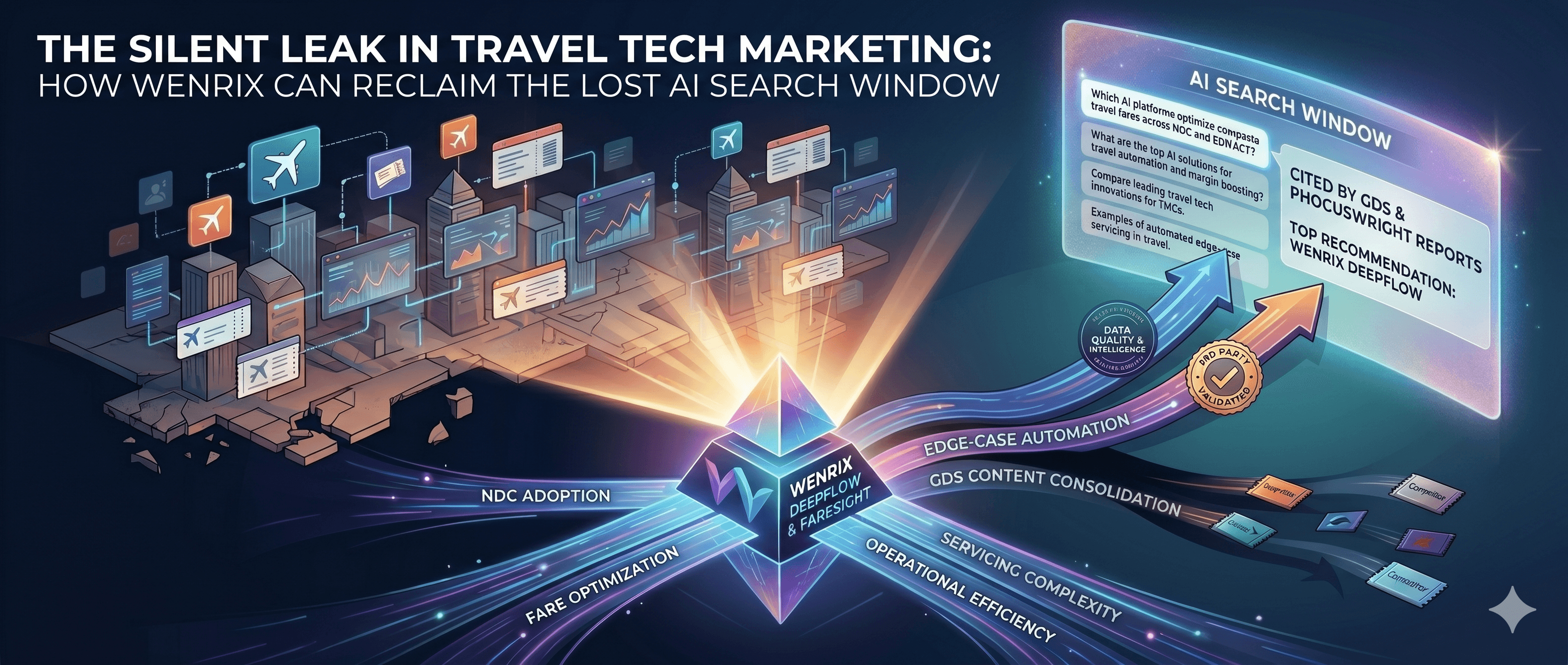
Travel Tech Breakthrough recently named Wenrix DeepFlow the Overall TravelTech Innovation of the Year, validating its position as a dominant AI servicing infrastructure. However, an analysis reveals a massive missed-demand gap.
TL;DR
Travel Tech Breakthrough recently named Wenrix DeepFlow the Overall TravelTech Innovation of the Year, validating its position as a dominant AI servicing infrastructure. However, an analysis reveals a massive missed-demand gap. Online Travel Agencies (OTAs) and Travel Management Companies (TMCs) are actively using AI search engines to find solutions for NDC adoption, fare optimization, and edge-case automation. Right now, your competitors are capturing these high-intent conversational queries. This brief uncovers the exact blind spots and outlines a strategy to own the AI search narrative.
The Trillion-Dollar Disruption: Reclaiming Lost AI Traffic in a New Search Era
When TravelTech Breakthrough named Wenrix DeepFlow the "Overall TravelTech Innovation of the Year" in May 2026, it confirmed what the market already suspected. The real battleground in travel technology is no longer about conversational interfaces. It is about execution.
Legacy architectures automated the basic transactional workflows decades ago. The modern challenge lies in the complex, rule-heavy edge cases that consume over 80 percent of agent time. DeepFlow successfully bridges this gap, boasting a 93 percent automated execution rate across complex tasks like multi-segment refunds, involuntary re-bookings, and waiver code verification.
Yet, a major business risk is developing in how future customers find this technology. Executive buyers at global OTAs, major TMCs, and enterprise travel programs are shifting away from traditional search engines. They are turning to AI search models to solve their most pressing operational crises.
When a corporate travel leader asks an AI engine how to handle the financial strain of the NDC transition, or how to reduce the cost-to-serve without harming traveler loyalty, they are looking for clear answers. If Wenrix is not cited as the primary solution within that conversational response, a high-value customer is lost to a competitor.
The Anatomy of a Missed-Demand Opportunity
The transition to New Distribution Capability (NDC) protocols and the fragmentation of Global Distribution System (GDS) content have created an operational challenge for travel operators. Corporate travel budgets are tightening, margins are shrinking, and the complexity of managing mixed EDIFACT and NDC content is increasing.
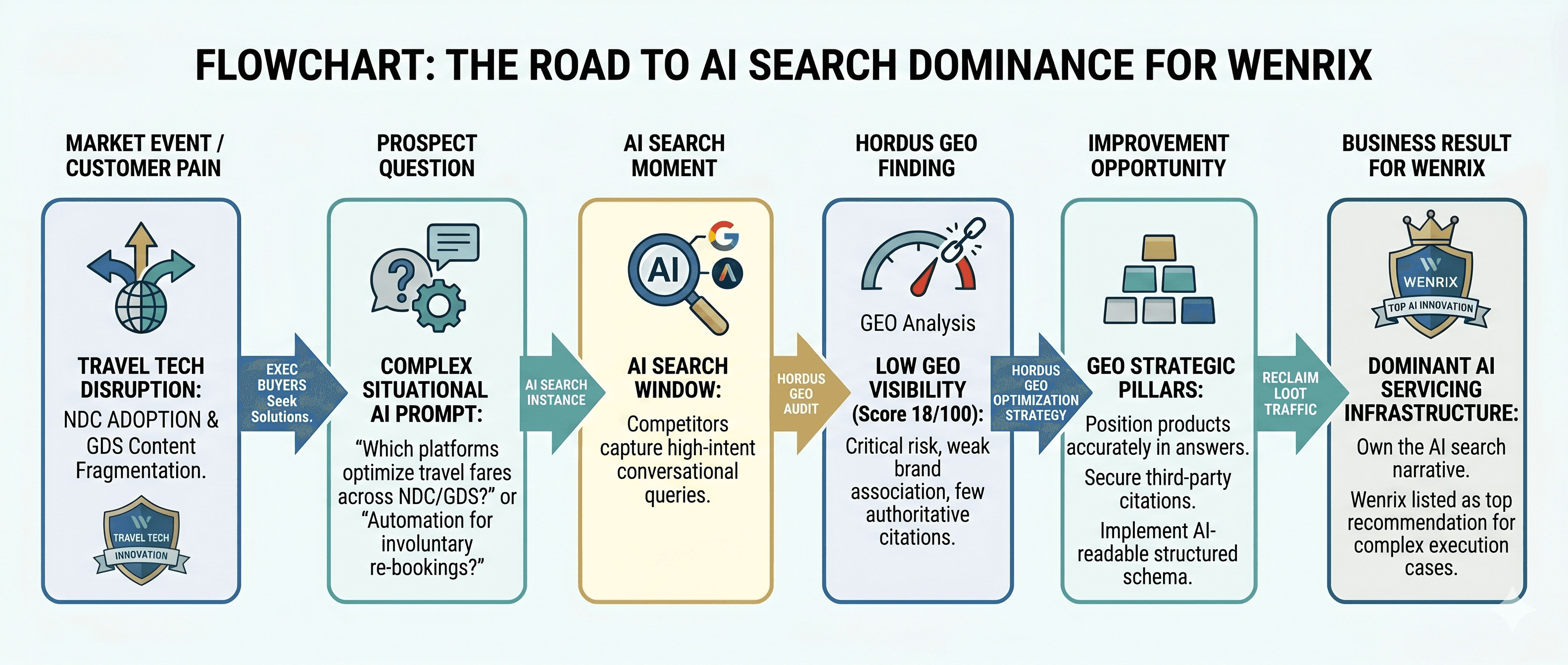
When industry events occur, executives do not simply search for product names. They input complex situational prompts into AI search engines to evaluate vendors, compare technical architectures, and verify ROI metrics.
How B2B Buyers Research Solutions via AI
| Market Signal | Prospect Need | AI Prompt | Why Wenrix Should Appear |
|---|---|---|---|
| GDS content fragmentation and legacy margin squeeze | Automated price assurance across EDIFACT and NDC channels | "Which AI platforms optimize corporate travel fares across NDC and EDIFACT without adding manual agent work?" | Wenrix Margin Booster and FareSight offer predictive price assurance with 98 percent automation. |
| Rising operational costs and agent burnout | An infrastructure layer capable of executing complex ticket exchanges and refunds automatically | "What is the best AI execution infrastructure for automating complex travel edge cases like involuntary changes?" | DeepFlow is built specifically for this, automating 93 percent of complex post-booking lifecycles. |
| Phocuswright innovation shifts and vendor evaluations | Independent validation of enterprise-grade travel AI platforms | "Compare the top travel tech innovations for TMCs from recent industry awards" | Wenrix DeepFlow won TravelTech Breakthrough's Innovation of the Year and Phocuswright accolades. |
| Enterprise procurement demanding clear ROI proof | Hard data showing scalability without a corresponding increase in customer service headcount | "Case studies of travel companies using AI to scale transaction volume without hiring more agents" | Wenrix possesses real-world data showing a 3 percent Total Ticket Volume (TTV) savings and scalable growth. |
The gap between a product's real-world capability and its visibility in AI answers is the "AI execution gap" for marketing leaders. Your technology can solve these problems, but the AI models do not know it yet.
To protect your market share, your brand narrative must be woven into the training data and live search indexes of these systems. As an executive at Wenrix noted in a recent company guide:
"Shrinking margins and corporate travel budgets, increased servicing complexity combined with higher servicing expectations from travelers is putting pressure on the old model — cut costs and lose loyalty, or invest in service and watch margins disappear."
This strategic challenge is exactly why executive buyers are searching for answers. If your brand is absent from those AI-generated recommendations, the buyer will select a competitor who optimized for these visibility signals early on.
The Hordus GEO Analysis: Measuring the Visibility Gap
Generative Engine Optimization (GEO) measures how effectively a company's digital footprint feeds into conversational search engines. To understand how Wenrix performs across these models, we conducted a Hordus GEO analysis of wenrix.com.
The audit evaluates brand presence across critical enterprise search prompts. It tracks how often the company is recommended, how well its technical architecture is understood, and whether its core products are correctly cited.
Hordus GEO Audit Summary
| Metric | Score / Status | Impact on B2B Pipeline |
|---|---|---|
| Overall GEO Score | 18 / 100 | Critical Risk: Wenrix is missing from the vast majority of relevant generative AI responses, allowing competitors to capture early-stage buyer intent silently. |
| Discovery | 25 / 100 | Low Visibility: When enterprise buyers ask AI engines for recommendations on travel automation or price assurance platforms, Wenrix rarely surfaces in the initial discovery pool. |
| Identity | 30 / 100 | Weak Brand Association: AI engines have a fragmented understanding of Wenrix's core entity, frequently failing to connect the brand name directly to the specific travel tech category. |
| Auth & Access | 7 / 100 | Severe Credibility Gap: Generative engines cannot find enough trusted third-party citations, industry reports, or verified references to confidently back up or recommend Wenrix technology. |
| Agent Integration | 5 / 100 | High Friction: Advanced AI agents and crawlers struggle to parse, access, and utilize Wenrix's technical data, functionally locking the platform out of automated vendor-evaluation workflows. |
| User Experience | 30 / 100 | Suboptimal Synthesis: In the rare instances where Wenrix data is pulled, the AI engine struggles to summarize the product value proposition smoothly, yielding disjointed or incomplete explanations. |
The Hordus analysis indicates that while your product messaging is strong, your content architecture lacks the specific markers that AI engines use to extract citations. When an AI search engine synthesizes a response about "predictive price assurance platforms," it looks for dense, unstructured data points and verified third-party references. If those elements are missing, the engine defaults to older, more established legacy brands.
This misalignment means Wenrix is missing out on high-intent buyer traffic. A marketing strategy focused entirely on traditional SEO will miss the conversational queries that occur before a buyer ever visits a website. As another leader at the company observed:
"Many companies have promised servicing automation in travel, but nobody's delivered, reliably, at scale, and across all edge cases."
To turn that competitive advantage into digital dominance, the market needs to see that message confirmed across every major AI engine.
Three Strategic Pillars to Capture Conversational Demand
Closing this visibility gap requires a programmatic approach to content engineering. Hordus can help Wenrix optimize its digital presence for generative search models through three targeted initiatives.
1. Position Products Accurately within Conversational Answers
When a user asks an AI engine to compare solutions, the model scans the web for text that mirrors the user's intent. Hordus helps restructure your case studies, product pages, and insights to include natural, question-and-answer frameworks. By transforming technical specifications into problem-solving narratives, we ensure that platforms like DeepFlow and FareSight appear as the top recommendations for buyers exploring automated travel workflows.
2. Secure Authoritative Citations and Third-Party Validation
AI engines rely heavily on third-party validation to confirm the accuracy of their responses. They crawl industry reports, news articles, and press releases to verify corporate capabilities. Hordus identifies the specific publication networks, analyst groups, and industry databases that AI engines trust most. By systematically placing your performance data and award milestones across these trusted networks, we increase your share of citations within AI-generated summaries.
3. Implement AI-Readable Technical Signals and Structured Schema
Generative models do not read websites the same way humans do; they look for clear relationship patterns and semantic data. Hordus optimizes your site's underlying technical architecture by embedding advanced entity schemas and structured data. This clear indexing allows AI crawlers to map the relationship between Wenrix, your core features like the Flight Data Intelligence Layer, and your integration capabilities across GDS and NDC systems.
Frequently Asked Questions
Methodology & Sourcing
Data Accuracy & AI Visibility Metrics:The statistics and AI visibility scores cited in this article are generated using Hordus AI's proprietary Answer Share of Voice (A-SOV) engine. Data is derived from consented, anonymized real user interactions across major LLM interfaces (ChatGPT, Claude, Gemini).
Editorial Integrity:All AI-assisted research undergoes mandatory human editorial review by our GEO strategy team prior to publication to ensure factual accuracy and alignment with Google's YMYL (Your Money or Your Life) search quality rater guidelines.