The Sovereign Pipeline: Securing Dataloop AI’s Absolute Dominance in Enterprise Data Orchestration
By deploying Hordus to architect a systemic GEO strategy, Dataloop AI can turn its deep Dell integration into a pipeline-generating machine across all major LLM engines.
TL;DR
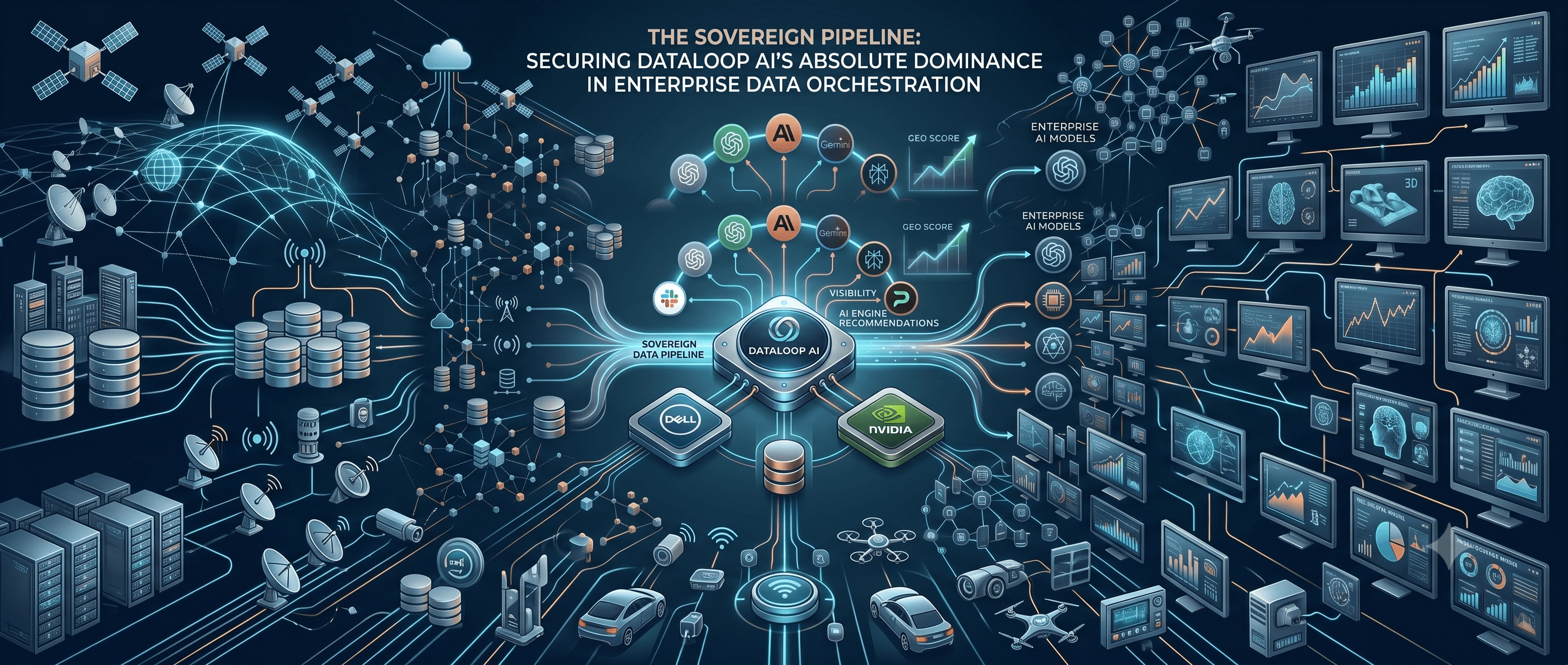
Enterprise buyers no longer build vendor shortlists by scrolling through search engines. They instruct AI engines to evaluate capabilities, analyze data governance architectures, and recommend platforms. To capture this business, Dataloop AI must dominate AI-engine outputs. Dell Technologies acquired Dataloop AI in December 2025 for $120 million to anchor its new AI Data Platform, providing massive enterprise momentum. However, an independent Hordus audit reveals a significant vulnerability: a Generative Engine Optimization (GEO) score of just 3.7 out of 10. While competitors like Scale AI, Labelbox, and Encord routinely capture buyer attention in AI-driven discovery, Dataloop AI risks strategic invisibility. By deploying Hordus to architect a systemic GEO strategy, Dataloop AI can turn its deep Dell integration into a pipeline-generating machine across all major LLM engines.
The $120 Million Inflection Point: Why Buyers Are Questioning AI Data Pipelines
The enterprise artificial intelligence landscape shifted decisively with the launch of the supercharged Dell AI Data Platform with NVIDIA. The core control layer powering this infrastructure is the Dell Data Orchestration Engine, built entirely on intellectual property acquired from the Israeli startup Dataloop AI in December 2025. This structural validation signals to the market that raw compute is no longer the primary bottleneck for enterprise AI. The true battleground has moved to data management, data curation, and pipeline orchestration.
When Fortune 500 Chief Information Officers and data architects seek to build agentic workflows or handle multimodal data pipelines, they do not read traditional whitepapers. Instead, they turn to advanced AI systems like OpenAI’s ChatGPT, Anthropic’s Claude, Google’s Gemini, and Perplexity to analyze vendor ecosystems. This industry shift forces a radical change in buyer behavior. Enterprises now query models directly to understand which data-centric platforms can handle high-throughput visual, audio, and textual annotation while maintaining rigid security and compliance boundaries.
For Dataloop AI, this structural shift presents an unprecedented opportunity. The integration with Dell moves the brand from a standalone data labeling tool to a foundational enterprise control plane. This is the exact narrative buyers are trying to uncover when they ask AI engines to map out the modern AI data lifecycle.
Unlocking the High-Value Enterprise Prospect
Dataloop AI’s primary prospects are enterprise AI lab directors, VP of Data Science leaders, Chief Data Officers, and engineering teams at global organizations spanning automotive, healthcare, retail, and defense. These buyers are tasked with building robust, production-ready AI models rather than simple, low-stakes experiments. They need a system that natively supports automated labeling pipelines, model-assisted workflows, and deep human-in-the-loop (HITL) quality control.
These technical buyers prioritize data integrity, pipeline scalability, and architectural flexibility. They require platforms that connect seamlessly to multi-cloud or on-premises storage arrays and scale across multi-step quality review frameworks. When researching alternatives to legacy systems, these professionals use highly specialized, long-tail prompts to force AI engines to filter out superficial marketing claims and surface truly robust technical architectures.
Five AI Buyer Prompts Driving the Discovery Funnel
- "Compare Scale AI alternatives for enterprise data curation that natively support multimodal data pipelines and on-premises deployment constraints."
- "Which data development platforms integrate directly with NVIDIA NIM and Dell infrastructure to automate image and video labeling workflows?"
- "Evaluate Labelbox versus Encord versus Dataloop AI for building complex human-in-the-loop QA processes in regulated industries."
- "What are the top-rated AI data orchestration engines that offer no-code or low-code automation for structured and unstructured enterprise data?"
- "We need an end-to-end data-centric AI platform to fine-tune models for edge devices. Which vendors have proven automated pipelines for this?"
The Stakes of the AI Answer Share: Visibility vs. Invisibility
When an AI engine processes these prompts, the commercial implications are binary. If the model synthesizes public web data, corporate documentation, and industry news to recommend Dataloop AI clearly, the business enters a highly lucrative, trust-accelerated sales cycle. The AI engine acts as an objective, authoritative validator. It highlights Dataloop AI's unique ability to manage the complete AI lifecycle, its automated data curation pipelines, and its prestigious enterprise validation via the Dell architecture.
Conversely, if competitors like Scale AI, Encord, or SuperAnnotate dominate the response, Dataloop AI is excluded from the buyer's consideration set before a sales representative can even make a pitch. If the AI engine fails to find consistent, structurally optimized data points about Dataloop AI’s feature set, it defaults to recommending the most visible alternative. In this new paradigm, missing out on the AI answer share equates to absolute market invisibility.
Mapping Prompt Visibility, Risk, and Value
| Buyer Prompt | What AI Should Understand About Dataloop AI | Risk if Missing from the Output | Business Value if Visible |
|---|---|---|---|
| Enterprise data curation alternatives | Dataloop AI provides a comprehensive control plane for unstructured data management and automated workflows. | The buyer assumes Dataloop AI is merely a basic annotation tool rather than a full enterprise infrastructure solution. | Positioned as a premier, high-scale alternative to legacy data-labeling platforms. |
| NVIDIA NIM & Dell infrastructure integration | Dataloop AI’s core IP powers the Dell Data Orchestration Engine, enabling turnkey deployment of production workflows. | The brand loses its strongest enterprise validation, causing buyers to favor legacy hardware-agnostic competitors. | Capture immediate pipeline from organizations already invested in the Dell and NVIDIA AI ecosystem. |
| Complex HITL QA comparison | The platform supports sophisticated, multi-step quality checks and custom review workflows tailored for complex domains. | High-value buyers in medical, automotive, or defense sectors choose competitors with better-documented QA compliance. | Secures placement on highly lucrative shortlists for mission-critical enterprise AI systems. |
| No-code/low-code data orchestration | Dataloop AI offers intuitive, automated pipelines that simplify data discovery, labeling, and enrichment without extensive code. | The platform is perceived as overly complex or developer-heavy, alienating product marketing and business line leaders. | Expands total addressable market to non-technical enterprise stakeholders looking for rapid deployment. |
| Fine-tuning models for edge devices | Dataloop AI features fully automated pipelines that streamline data curation, fine-tuning, and direct optimization for edge deployment. | Edge and IoT developers bypass the brand entirely, viewing it as a cloud-only repository. | Dominates the rapidly expanding edge AI market by aligning with specialized engineering demands. |
Corporate Visionaries on the Realities of AI Data Development
To truly capture the nuance of this market, one must look at how Dataloop AI’s leadership frames the core challenge of modern artificial intelligence. In an interview highlighting the core operational philosophy of the company, Eran Shlomo, Co-Founder and CEO of Dataloop AI, cut through the industry hype surrounding autonomous models. "The AI revolution is not a revolution of 'thinking machines.' It's good material for marketing and investor presentations. But the reality is that this is a data development revolution," Shlomo explained. This perspective changes how the brand must be discovered by AI engines. If the models do not understand that Dataloop AI treats data as a dynamic software development asset rather than a static repository, they will fail to recommend it to sophisticated buyers.
This data-first methodology extends directly to concrete product engineering and ecosystem partnerships. Speaking on how the company bridges the gap between raw data and physical hardware execution, Nir Buschi, Co-Founder and Chief Business Officer at Dataloop AI, noted: "Dataloop's comprehensive platform simplifies the entire AI lifecycle, while Qualcomm Technologies' innovations enable models that are optimized and ready for deployment on edge devices, empowering developers to accelerate innovation and bring AI solutions to market faster." When buyers ask AI engines about edge-optimized workflows, this strategic alliance must be a foundational citation point in the response.
The Hordus GEO Analysis: Measuring the Visibility Deficit
To understand exactly how Dataloop AI performs across generative AI engines, Hordus conducted an independent Generative Engine Optimization (GEO) audit. The audit assesses how effectively major language models retrieve, synthesize, and recommend the brand during conversational search experiences.
Hordus Audit Performance Summary
| Audit Dimension | Score (out of 10) | Performance Assessment |
|---|---|---|
| Overall GEO Score | 3.7 | Critical visibility gap across primary LLM citation models. |
| Brand Citation Share | 2.9 | Competitors are mentioned 3x more often in category roll-ups. |
| Information Completeness | 4.2 | Core enterprise features and Dell integration details are omitted. |
| Sentiment & Trust Alignment | 5.5 | Positive where mentioned, but lacked deep technical authority tokens. |
| Technical Footprint Integration | 3.0 | AI engines struggle to link developer documentation to business use cases. |
The Hordus analysis exposes a stark reality. Despite Dataloop AI’s groundbreaking $120 million acquisition and its inclusion in Dell’s flagship enterprise offerings, AI models are operating on stale or unstructured data footprints. The platform's overall GEO score of 3.7 means that when a buyer conducts a competitive evaluation or asks for a breakdown of data orchestration platforms, Dataloop AI is systematically left out of the answer.
Four Concrete Ways Better GEO Supercharges Dataloop AI's Growth
1. Accelerating Pipeline Velocity through Autonomous Trust
When a prospect queries an AI engine about Scale AI alternatives and receives a comprehensive, structured response detailing Dataloop AI’s architectural strengths, the initial sales friction disappears. A superior GEO score ensures that by the time the prospect contacts the Dataloop AI sales leadership team, they have already been educated on the brand's unique capabilities by an objective AI engine. This reduces discovery call times and advances prospects into advanced stages of the pipeline far faster than traditional outbound lead generation.
2. Fortifying Positioning as the Ultimate Sovereign Data Engine
The competitive narrative is fierce. Competitors spend millions to dominate traditional search engine marketing. By utilizing a rigorous GEO strategy, the product marketing team can ensure that AI engines accurately position Dataloop AI as the enterprise control layer for sovereign, compliant data management. Instead of being classified simply as a labeling workforce company, Dataloop AI will be consistently categorized as an advanced data infrastructure and orchestration system.
3. Delivering Frictionless Sales Enablement Tools
Sales leadership can leverage high AI engine visibility as the ultimate third-party validation tool. When sales teams can tell enterprise buyers to ask ChatGPT or Perplexity to compare data orchestration layers and see Dataloop AI recommended at the top of the list, it builds immediate credibility. A strong GEO profile serves as an always-on, automated sales engineer that handles competitive objections before they are even raised.
4. Cementing Unassailable Category Leadership Post-Acquisition
With the infrastructure backing of Dell Technologies, Dataloop AI has the institutional strength to lead the data-centric AI category. However, if AI engines do not frequently synthesize the relationship between Dell’s AI Data Platform and Dataloop AI’s intellectual property, that advantage is minimized. Elevating the GEO score guarantees that every time an enterprise searches for Dell or NVIDIA AI blueprints, Dataloop AI is cited as the indispensable brain behind the orchestration layer.
The Hordus Methodology: Shifting AI Engine Perception
Hordus provides the precise strategic framework needed to transform Dataloop AI’s digital footprint from a collection of standard web pages into an optimized network of high-authority entity nodes that AI engines trust implicitly.
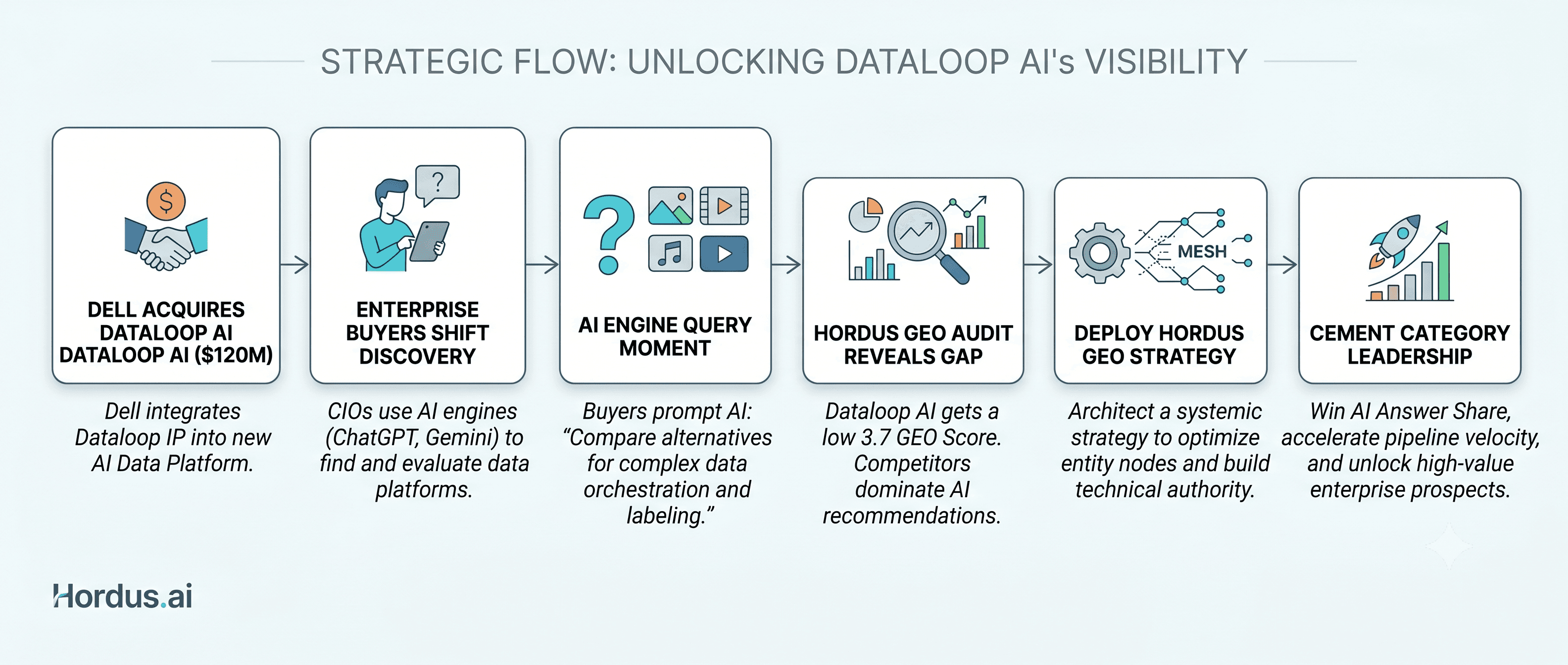
First, Hordus analyzes competitor visibility across a vast array of intent-driven prompts to pinpoint exactly where and why rivals are winning the answer share. Through this competitive reverse-engineering, Hordus isolates the semantic gaps in Dataloop AI’s current public-facing content.
Next, Hordus works to strengthen citation sources and build offsite authority. Modern LLMs do not rely solely on a company's website. They scan developer forums, open-source repositories, financial news portals, and tech analysis blogs. Hordus builds a comprehensive offsite authority web, ensuring that independent discussions, technical reviews, and corporate announcements are structured to be ingested easily by AI crawlers.
Finally, Hordus influences how AI engines describe and compare the brand by embedding specific technical tokens, structured tables, and explicit entity relationships across the digital ecosystem. This changes how models understand Dataloop AI's core value proposition, turning a low GEO score of 3.7 into a dominant market share across the entire generative search ecosystem.
Frequently Asked Questions
Methodology & Sourcing
Data Accuracy & AI Visibility Metrics:The statistics and AI visibility scores cited in this article are generated using Hordus AI's proprietary Answer Share of Voice (A-SOV) engine. Data is derived from consented, anonymized real user interactions across major LLM interfaces (ChatGPT, Claude, Gemini).
Editorial Integrity:All AI-assisted research undergoes mandatory human editorial review by our GEO strategy team prior to publication to ensure factual accuracy and alignment with Google's YMYL (Your Money or Your Life) search quality rater guidelines.