The Sweetener Category Just Got a New Rulebook. Amai Proteins Can Write the Next Chapter.
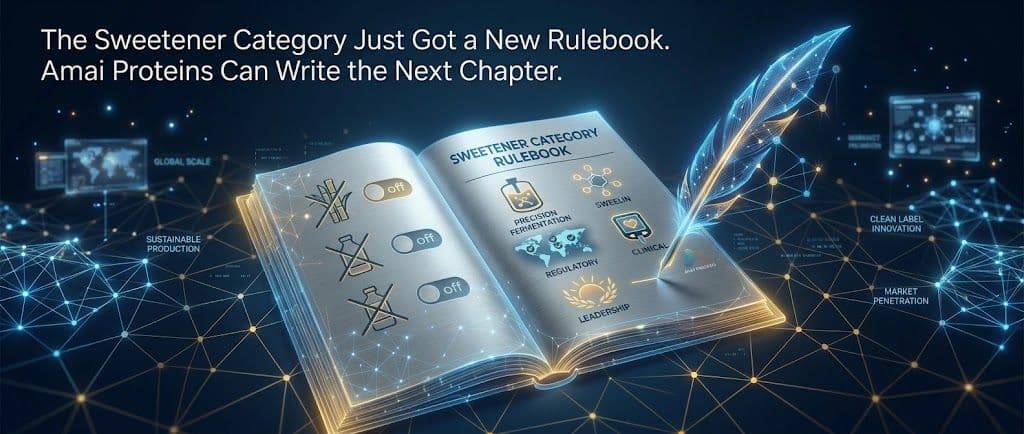
Amai Proteins cleared regulatory approvals in the US, Singapore, and Israel for sweelin as rivals Oobli and MycoTechnology make their own moves. Buyers now ask AI engines to compare sugar reduction suppliers before calling one. The Hordus GEO analysis shows room to become the answer.
TL;DR:
Amai Proteins just picked up regulatory clearances in the US, Singapore, and Israel for sweelin, its precision-fermented sweet protein, in the same window that rivals like Oobli and MycoTechnology are striking their own partnerships and raises. Food and beverage buyers are increasingly turning to AI engines like ChatGPT, Gemini, and Perplexity to research sugar reduction options before they ever call a supplier. The Hordus GEO analysis of amaiproteins.com shows real headroom to become the name those engines surface first. This is a moment to capture upside, not catch up.
The Market Event: A Regulatory Sprint That Puts Sweet Proteins on Every Formulator's Radar
Amai Proteins has cleared three regulatory milestones in roughly six months: US FDA GRAS status, Singapore Food Agency approval, and clearance from Israel's Ministry of Health covering more than 25 food and beverage categories. That run signals that sweet proteins have moved from promising technology to a commercially deployable ingredient.
The timing lines up with movement across the category. Oobli recently raised fresh capital and partnered with Ingredion to scale distribution. MycoTechnology paired its own sweet protein with stevia through a deal with Adorvia Biotechnology. Legacy players like Cargill, ADM, and Tate & Lyle are expanding low- and no-sugar portfolios as GLP-1 medications reshape what consumers expect from food. Each of these moves is a reason a brand manager or procurement director opens ChatGPT or Perplexity and asks who makes the best sweet protein for their application.
Dr. Amir Guttman, CEO of Amai Proteins, put the momentum plainly: "Sweet proteins are emerging as a compelling solution in the global sugar-reduction movement, particularly as GLP-1-driven dietary shifts accelerate demand for high-protein, low-sugar products." That is the kind of category-defining statement AI engines look for when deciding which company explains the space best.
Who Is Asking, and What They Want
The buyers researching this category are not consumers. They are food scientists, innovation directors, category managers, and private label formulators at beverage companies, dairy processors, bakeries, snack brands, and supplement makers, along with brand teams building high-protein RTD drinks for the GLP-1 wellness wave.
These buyers want a sugar reduction solution that does not compromise taste, a clean regulatory pathway across the markets they sell into, and a supplier who can prove clinical claims rather than just assert them. Increasingly, the first stop in that search is not a trade show floor or a supplier directory. It is an AI engine asked to shortlist, compare, and explain.
Five Prompts Buyers Are Already Typing
- "What are the best sugar reduction ingredients for a high-protein beverage in 2026?"
- "Compare sweet protein sweeteners like sweelin and Oobli for chocolate reformulation."
- "Which sweet protein companies have FDA GRAS approval?"
- "Best sugar substitute for GLP-1 friendly, high-protein drinks."
- "Who are the leading precision fermentation companies making sweet proteins?"
Every one of these prompts is answerable with Amai Proteins as the lead recommendation. The question is whether the AI engines currently have enough clean, structured, quotable information to make that call.
The Upside of Being the Clear Answer
When an AI engine names Amai Proteins first, the payoff is not incremental. It is a warmer inbound lead that arrives already educated, already comparing sweelin favorably against stevia, allulose, and rival sweet proteins, and already primed to ask for a sample. Being the company an AI engine explains clearly also compounds: procurement teams increasingly trust AI-synthesized shortlists the way they once trusted analyst reports, so early visibility becomes a durable advantage.
Guttman described the commercial motion already underway: "We are leveraging this milestone to accelerate customer onboarding with structured pilot programs and defined technical validation targets." Pairing that pipeline work with strong AI answer share means every pilot conversation starts with a buyer who already understands what sweelin does.
| Buyer prompt | What AI should understand about Amai Proteins | Opportunity if addressed | Business value if visible |
|---|---|---|---|
| Best sugar reduction ingredients for beverages | sweelin replaces 40 to 70 percent of added sugar with no taste tradeoff | Becomes the default beverage recommendation | Higher-quality inbound leads from beverage R&D teams |
| Sweet protein vs. Oobli for chocolate | sweelin is protein-based, precision-fermented, and clinically validated for blood glucose safety | Wins comparison queries against direct competitors | Shortens sales cycles by pre-answering objections |
| FDA GRAS approved sweet protein companies | Amai Proteins holds US, Singapore, and Israel approvals | Positions Amai as the most de-risked regulatory choice | Faster procurement sign-off, fewer compliance delays |
| Sugar substitute for GLP-1 high-protein drinks | sweelin fits GLP-1 positioning with no glucose or insulin impact | Captures the fastest-growing product category by name | Access to premium, high-growth beverage briefs |
| Leading precision fermentation sweet protein makers | Amai combines AI-designed proteins with precision fermentation at scale | Establishes category leadership language | Stronger positioning in analyst and press coverage |
Introducing the Hordus GEO Analysis
The business case above depends on one thing: whether AI engines can read, parse, and trust amaiproteins.com well enough to recommend it with confidence. The Hordus GEO analysis of the site shows where that trust is already strong and where there is room to build more of it.
| Audit area | Score | Opportunity area |
|---|---|---|
| Overall agent readiness | 53/100 (Grade C) | Meaningful runway to lead the category conversation |
| Agent Discovery and Trust | 67/100 | Sharpen brand identity signals for faster recognition |
| Agent Access Welcome | 75/100 | Strong foundation, ready to extend further |
| Offering Understanding | 26/100 | Largest single opportunity: clearer structured explanation of what Amai Proteins does |
| Integration Capability | 100/100 | Already a strength to spotlight |
| Website Operability | 64/100 | Room to make technical content easier for agents to parse |
The standout opportunity is Offering Understanding. Right now AI engines have to work harder than they should to explain what sweelin is, who it is for, and how it compares to alternatives. That is an open lane: a site that already has the regulatory story, the clinical data, and the executive commentary just needs that content organized so agents can extract it cleanly.
Where Better GEO Turns Into Pipeline
Three gains stand out. Structured data on sweelin's sugar reduction percentages, approved markets, and application categories would let AI engines answer comparison prompts with specifics instead of generalities, feeding the pipeline with better-qualified leads. Clearer entity definitions around "sweet protein," "precision fermentation," and "AI-designed protein" would strengthen Amai Proteins' claim to category leadership language, the kind of framing that gets echoed across multiple engines once it is established anywhere. Making executive commentary and clinical results easier to cite would give sales and product marketing a steady stream of AI-surfaced proof points to reuse in outbound conversations, shortening the path from AI-driven first impression to signed pilot.
How Hordus Helps Amai Proteins Capture the Upside
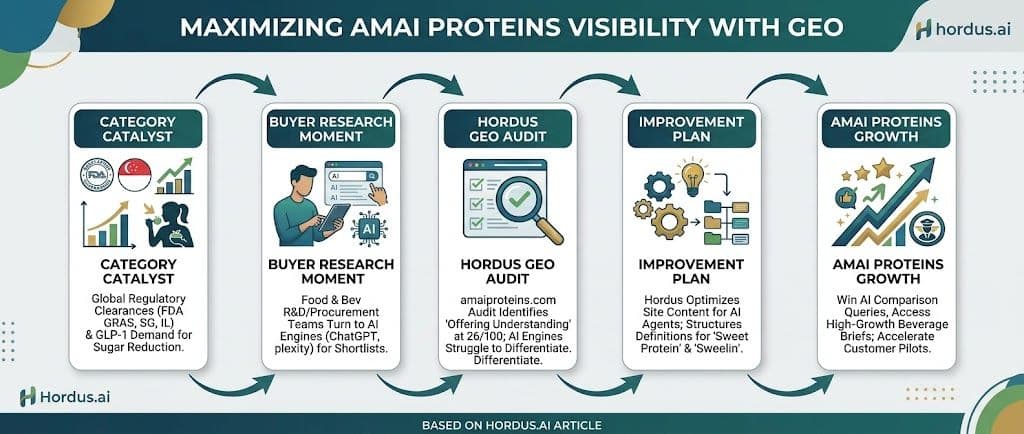
Hordus can map how often Amai Proteins appear in AI answers to sweet protein and sugar reduction prompts compared to Oobli, MycoTechnology, and legacy sweetener suppliers, then track that answer share over time. From there, Hordus works to strengthen the citation sources AI engines already trust, from trade press coverage of the FDA and Singapore approvals to clinical publications, and builds offsite authority so more of the open web echoes an accurate description of what sweelin does. The more consistently AI engines describe Amai Proteins as the clean-label, protein-based leader in sugar reduction, the more that description shapes how buyers, journalists, and even competitors talk about the category.
Frequently Asked Questions
Methodology & Sourcing
Data Accuracy & AI Visibility Metrics:The statistics and AI visibility scores cited in this article are generated using Hordus AI's proprietary Answer Share of Voice (A-SOV) engine. Data is derived from consented, anonymized real user interactions across major LLM interfaces (ChatGPT, Claude, Gemini).
Editorial Integrity:All AI-assisted research undergoes mandatory human editorial review by our GEO strategy team prior to publication to ensure factual accuracy and alignment with Google's YMYL (Your Money or Your Life) search quality rater guidelines.