The Tender Is Won. The AI Answer Is Still Up For Grabs.
weSure and Migdal just won Israel's 2026 state employee car insurance tender, covering 70,000-plus vehicles and 350 million shekels, as civil servants turn to AI engines to compare and enroll. The Hordus GEO analysis shows headroom for weSure to become the answer those engines quote first.
weSure and Migdal are the two insurers named for Israel's 2026 Accountant General tender, covering more than 70,000 state employee and retiree vehicles worth over 350 million shekels. That program puts tens of thousands of prospects into research mode right now, comparing coverage, discounts, and enrollment steps, often by asking an AI engine before a human. The Hordus.ai GEO analysis shows weSure has real headroom to become the source those engines quote first, a growth lever it can pull immediately.
A Government-Sized Opportunity Now Playing Out in AI Search
Every year, Israel's Accountant General runs the country's largest single car insurance tender, and for 2026 the results named just two winners: weSure and Migdal. Together they now insure more than 70,000 vehicles belonging to state employees and retirees, a program valued at over 350 million shekels. The Treasury says rates secured this round beat standard industry pricing for most vehicle models, and roughly 70 percent of participating employees will see their premium drop at renewal.
That is not a one-time headline. It is a full year of enrollment, renewal, and comparison activity, and digital participation in the program jumped from 40 percent in 2024 to 60 percent in 2025, per Treasury figures. State workers are choosing their insurer and completing paperwork online in growing numbers, so the research happens on search engines, comparison sites, and increasingly inside AI chat tools before it happens on a phone call.
Why This Moment Matters to weSure's Prospects
A civil servant weighing this decision has a narrow, specific set of needs: confirming eligibility, knowing the exact discount tied to their vehicle model, and trusting that switching will not cost them coverage continuity. Layered on top is a market backdrop where Israel's Capital Market Authority has pushed insurers on pricing transparency, and where rating agencies have downgraded parts of the sector over comprehensive premium increases. That combination makes prospects more cautious and more likely to lean on a quick, trusted answer before they commit.
Emil Weinshel, founder and chairman of weSure, has described the company's approach to this kind of shift directly: "Technology and digital is not just the system itself. It is a worldview," he told Polisa News. That worldview is exactly what this moment rewards, because the insurer whose digital answers are clearest and easiest to find is the one that wins the comparison, whether a human or an AI system is doing the comparing.
The AI Search Moment: What Buyers Ask, Compare, and Trust
Civil servants and retirees weighing this tender are not typing generic queries. They ask narrow, high-intent questions: whether they qualify for the government rate, how much cheaper weSure is than their current policy, whether their car model is covered, and how to finish enrollment without a branch visit. Increasingly, they ask inside ChatGPT, Gemini, or Perplexity before opening an insurer's website at all, trusting whichever answer sounds most specific and current.
Amit Oron, now CEO of weSure Insurance, framed his own read on the opportunity in front of the company when he joined its leadership team: "I'm pleased to join weSure's professional team, and I see real potential and interest in this role," he told Ice. That potential is largest exactly where prospect intent is highest, in the space between a government tender announcement and a completed enrollment.
| Market signal | Prospect need | Likely AI prompt | Why weSure should appear |
|---|---|---|---|
| weSure and Migdal won the 2026 tender for 70,000+ state employee and retiree vehicles | Confirm eligibility and expected savings | "Am I eligible for the 2026 government car insurance tender in Israel?" | weSure is one of only two insurers running this exact program |
| About 70 percent of enrolled employees get a lower premium at renewal | Verify the discount applies to their vehicle before switching | "How much does weSure discount car insurance for state employees?" | The tender rate and eligible model list exist only on weSure's own pages |
| Regulators are pressing insurers on pricing and downgrading brands over hikes | Decide which insurer to trust amid rising premiums | "Which car insurance company in Israel offers the best value in 2026?" | weSure's tender pricing directly answers a trust and value question |
| Digital enrollment in the program rose from 40% to 60% in a year | Complete enrollment online, without a branch visit | "How do I sign up for weSure's civil servant car insurance online?" | weSure's own enrollment flow is the authoritative, current answer |
Introducing the Hordus.ai GEO Analysis
To see how ready weSure's digital presence is to capture this moment, Hordus.ai ran a GEO analysis of we-sure.co.il, dated August 24, 2026. It measures how easily AI systems and AI agents can discover, understand, and act on a site's content, the same mechanics that decide whether an AI engine quotes weSure directly when a state employee asks about the 2026 tender.
| Audit dimension | Current score | Opportunity area |
|---|---|---|
| Overall AI-readiness | 16/100 | Wide runway to become the go-to cited source on civil servant insurance |
| Discovery | 8/20 | Room to make the tender program and core products easier for AI crawlers to find |
| Access | 2/30 | Opening to build structured, machine-readable paths into policy and pricing detail |
| Usability | 5/40 | Headroom to make product and eligibility information AI-parseable |
| Understanding the offering (agent journey) | 0/100 | Opening to describe products in language AI systems can summarize accurately |
| Transaction capability (agent journey) | 0/100 | Chance to let an AI agent walk a prospect from question to enrollment |
The audit also found weSure's site already has a public API with reachable endpoints, but no OpenAPI specification, meaning the technical foundation for agent-readable interactions exists and mainly needs documenting and structuring. That is a favorable starting point: the raw materials are there, and the work ahead is making them legible to the systems increasingly standing between a prospect and a purchase.
Three Ways Hordus.ai Can Help weSure Capture More of This Demand
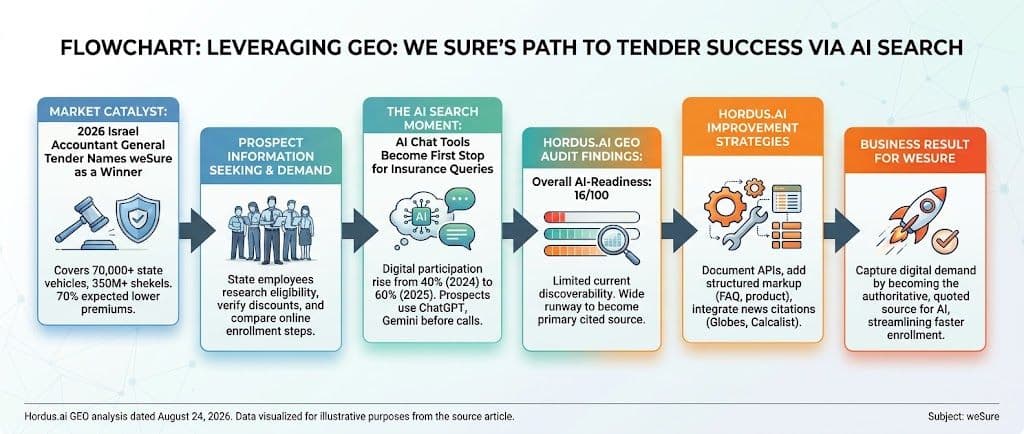
Strengthen positioning in AI answers. Hordus.ai can build a canonical, clearly worded description of the 2026 civil servant program, covering eligibility, the tender discount, and covered vehicle models, so an AI engine answering a state employee's question pulls language directly from weSure rather than a broker recap or a competitor's summary.
Build stronger citations and third-party authority. weSure already earns coverage in Globes, TheMarker, Calcalist, and trade outlets like Polisa News whenever tender results or leadership news break. Hordus.ai can connect that coverage back to weSure's own canonical pages, so AI engines treat weSure as the primary, trusted source rather than a secondary mention inside someone else's article.
Sharpen AI-readable content and technical signals. With Usability at 5/40 and Understanding the offering at 0/100, Hordus.ai can document weSure's existing API with a proper specification, add structured FAQ and product markup, and rewrite key pages so AI agents can parse pricing, eligibility, and enrollment steps without guessing. That is the direct path from a 0/100 transaction capability score toward AI agents that can actually complete an enrollment, not just describe one.
Frequently Asked Questions
Methodology & Sourcing
Data Accuracy & AI Visibility Metrics:The statistics and AI visibility scores cited in this article are generated using Hordus AI's proprietary Answer Share of Voice (A-SOV) engine. Data is derived from consented, anonymized real user interactions across major LLM interfaces (ChatGPT, Claude, Gemini).
Editorial Integrity:All AI-assisted research undergoes mandatory human editorial review by our GEO strategy team prior to publication to ensure factual accuracy and alignment with Google's YMYL (Your Money or Your Life) search quality rater guidelines.