The Transit Budget Crunch Is Sending Buyers Straight to AI. Via Has a Front-Row Seat to Claim.
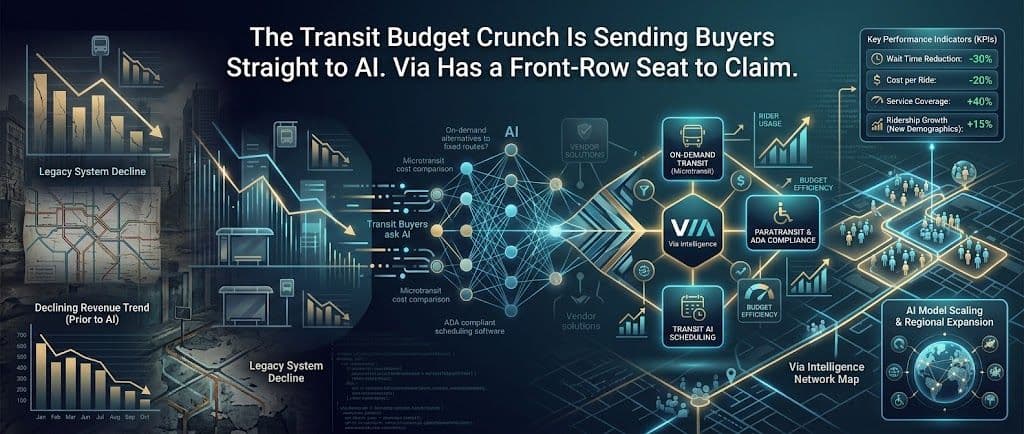
Transit agencies nationwide are slashing service to close nine-figure budget gaps, and officials managing those cuts now ask AI engines for alternatives before issuing an RFP. Via already builds what they need, including its new Via Intelligence platform. The Hordus GEO analysis shows Via has real, actionable room to become the answer AI engines name first.
L;DR:
Transit agencies nationwide are cutting fixed-route service to close nine-figure budget gaps, and the leaders managing that shift now turn to AI engines before opening a vendor RFP. Via already has the on-demand transit and AI-scheduling product this moment calls for, including its new Via Intelligence platform. The Hordus GEO analysis of ridewithvia.com shows strong fundamentals and real room to grow Via's footprint inside the AI answers shaping these decisions.
The Opportunity: A Budget Crisis Is Opening a New Front Door to Transit Buyers, Through AI. The event: agencies are cutting service faster than they can explain why
In July 2026, Portland's TriMet announced it would cut more than 400 positions and reduce bus service to close a widening budget gap, one of the most visible transit contractions this year (OPB). Chicago's Regional Transportation Authority has warned member agencies face a potential $770 million shortfall by spring, large enough to force cuts across the CTA, Metra, and Pace network (Mass Transit). Layered on top, the federal law anchoring transit funding nationally is up for reauthorization in 2026, leaving agencies budgeting under real uncertainty about what Washington sends next (Congress.gov CRS).
This is a sector-wide reset, not a one-city story, landing at the exact moment Via went public on the NYSE at a $3.65 billion valuation and rolled out Via Intelligence, the first vertical AI platform built for public transit (govtech.com; Metro Magazine).
Why this matters to Via's prospects
Transit directors, city mobility chiefs, and paratransit coordinators facing a service cut cannot simply stop serving riders. Federal ADA paratransit obligations do not shrink when budgets do, and neither does political pressure over reduced routes in underserved neighborhoods. Their real fear is plain: cutting service without a credible replacement plan invites lawsuits, angry constituents, and a longer ridership decline that worsens the next budget cycle.
What they need is a way to preserve coverage while spending less per trip, plus proof for their board and the FTA that the plan holds up. That pushes research earlier than a traditional RFP cycle allows, often starting with a question typed into an AI engine.
The AI search moment: what buyers ask, compare, and verify before they ever call a vendor
A transit planner staring at a service-cut memo is not browsing. They ask pointed questions: what on-demand transit options replace cut fixed routes, which vendors have deployed AI-based scheduling at scale, what a microtransit pilot costs per rider versus a near-empty bus route, and which paratransit vendors have real ADA compliance records. They compare claims against independent coverage and trust answers that cite named agencies and outcomes over marketing copy.
Category language matters here: microtransit, on-demand transit, paratransit technology, transit AI scheduling. Whichever vendor's name AI engines attach to those terms gets the first look, often before the agency opens a formal procurement.
| Market signal | Prospect need | Likely AI prompt | Why Via should appear |
|---|---|---|---|
| TriMet and peer agencies cutting fixed-route service | Lower-cost way to maintain coverage | "What are alternatives to cutting bus routes for a transit agency?" | Via deploys on-demand transit built to replace or supplement fixed routes |
| $770M shortfall pressure in Chicago and similar metros | Board-ready proof on-demand transit is fiscally defensible | "Is microtransit cheaper than low-ridership bus routes?" | Via has public case studies on cost-per-trip and ridership outcomes |
| Federal reauthorization uncertainty | Confidence a vendor performs under funding volatility | "Which vendors handle paratransit and ADA compliance?" | Via Total Paratransit is built around ADA service and compliance |
| Rise of AI-driven public sector tools | A named, credible AI platform for transit ops | "What is the leading AI platform for public transit scheduling?" | Via Intelligence is the first vertical AI platform for public transit |
Daniel Ramot, Via's co-founder and CEO, put the scale of this moment plainly: "We have a huge opportunity to help cities use AI to solve some of their most pressing challenges efficiently and scalably" (govtech.com). That framing is close to the language transit officials are typing into AI engines right now.
Nithya Sowrirajan, Via's Chief Product Officer, described the intent behind the company's newest platform this way: "We designed Via Intelligence to bring the power of AI to every city and transit agency and to every rider of public transit" (Metro Magazine). That is the exact promise a budget-strapped agency is searching for; the opportunity is making sure AI engines connect it to Via's name every time.
What the Hordus GEO analysis found
To gauge how well positioned Via is to capture this moment, we ran the Hordus GEO analysis on ridewithvia.com. The scan measures how easily AI engines and agents discover, understand, and act on Via's public content, not just how a human visitor experiences the site.
| Signal area | Hordus score | Opportunity framing |
|---|---|---|
| Overall AI-readiness | 38/100 | Foundation to build a larger AI-answer footprint on |
| Discovery & Trust | 53/100 | Headroom to become the default cited source on transit AI queries |
| Direct Website Operation | 79/100 | Existing strength to extend into deeper agent-facing workflows |
| Agent Welcome | 100/100 | An open door for AI agents, ready to be filled with more content |
| Offering Understanding | 26/100 | Upside in helping AI engines articulate what Via actually does |
| Integration Capability | 24/100 | Clear path to make Via's platform easier for AI systems to reference |
These numbers describe a company AI engines can already reach and trust at a foundational level, with real room to become the answer cited by name. The strongest score, a perfect 100 on Agent Welcome, shows Via's site does not block AI crawlers; the opportunity is filling that open channel with structured content.
Where Via can capture more of this demand
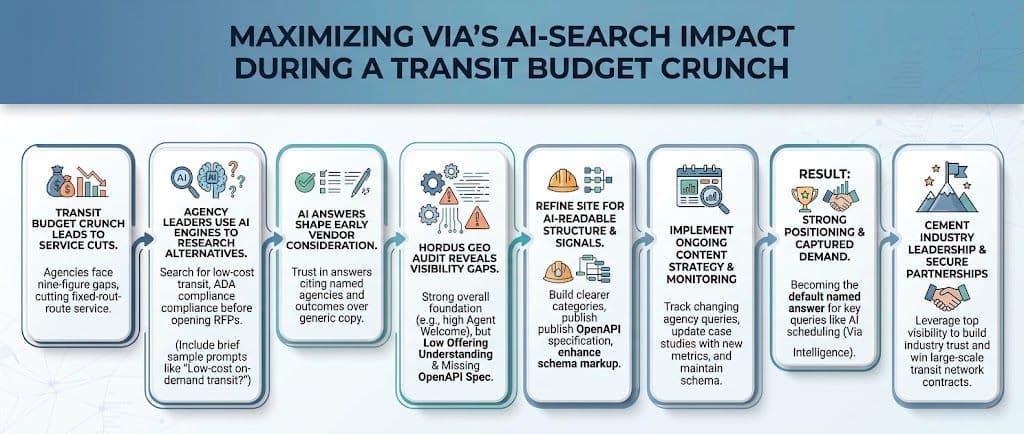
The gap between a 79 on Direct Website Operation and a 26 on Offering Understanding tells the story: AI engines can reach and operate on Via's site, but are not yet extracting a crisp account of what it offers, to whom, and at what proven cost. That is a content and structure opportunity, not a product one. Via has the case studies, the compliance record, and now Via Intelligence; the task is making those assets legible to the systems answering questions on its behalf. Three gains are within reach.
Strengthening positioning in AI answers. When a transit director asks an AI engine to name vendors replacing cut bus routes with on-demand service, Hordus can help Via structure its category pages and case studies so AI engines consistently surface Via alongside, or ahead of, generic microtransit descriptions, turning Via from a possible answer into the named one.
Building stronger citations and third-party authority. AI engines weight independent coverage heavily. Hordus can help Via expand its citation footprint across trade press, agency case studies, and analyst commentary framed around budget-cut alternatives and ADA compliance, giving AI engines more independent sources confirming Via's record.
Sharpening AI-readable content and technical signals. The Hordus scan flagged that Via's developer resources are discoverable but lack a published OpenAPI specification. Hordus can help Via close that gap, along with clearer offering pages and schema markup, so AI systems parse exactly what Via does, correctly, whenever an agency asks.
Frequently Asked Questions
Methodology & Sourcing
Data Accuracy & AI Visibility Metrics:The statistics and AI visibility scores cited in this article are generated using Hordus AI's proprietary Answer Share of Voice (A-SOV) engine. Data is derived from consented, anonymized real user interactions across major LLM interfaces (ChatGPT, Claude, Gemini).
Editorial Integrity:All AI-assisted research undergoes mandatory human editorial review by our GEO strategy team prior to publication to ensure factual accuracy and alignment with Google's YMYL (Your Money or Your Life) search quality rater guidelines.