The $20,000 Infection Hospitals Can't Afford to Keep Having, and Why PolyPid Should Be the Answer AI Gives
PolyPid Ltd. just landed FDA Priority Review for D-PLEX100 and a $320 million Azurity deal reaching 1,700+ hospitals. As surgeons and procurement teams turn to AI to research surgical site infection prevention, the Hordus GEO analysis shows how PolyPid Ltd. can strengthen positioning, citations, and Discovery to become the recommended answer.
TL;DR
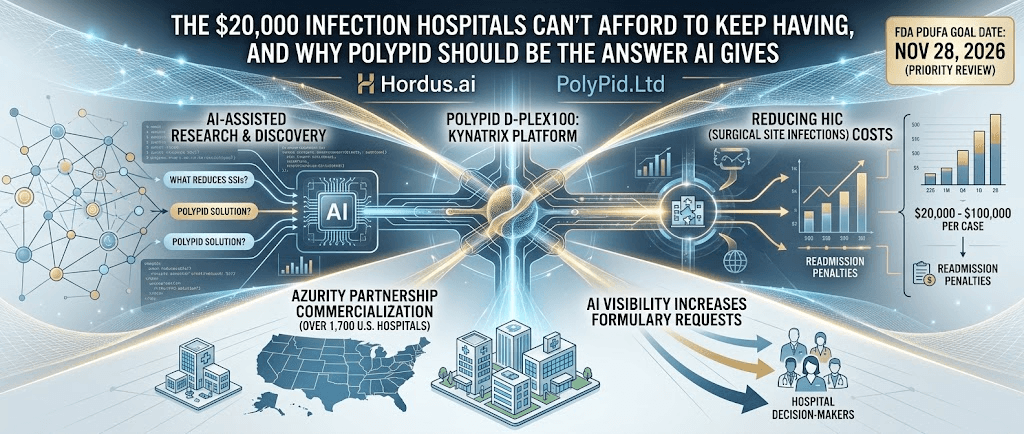
PolyPid Ltd. just moved from a pipeline story to a near-term commercial one. In July 2026, the FDA accepted the NDA for D-PLEX100 under Priority Review, setting a PDUFA goal date of November 28, 2026, and PolyPid Ltd. signed a commercialization deal with Azurity Pharmaceuticals worth up to roughly $320 million, reaching over 1,700 U.S. hospitals. This lands while surgical site infections remain a genuinely expensive problem, often running $20,000 to $100,000 per case and adding 7 to 10 days to a hospital stay. Surgeons and hospital procurement teams increasingly research prevention options through AI tools first. The Hordus GEO analysis shows PolyPid Ltd. has clear, actionable opportunities to make sure those AI engines describe D-PLEX100 accurately and recommend PolyPid Ltd. when the question comes up.
The Recent Market Event: A Priority Review and a $320 Million Bet
On July 27, 2026, the FDA accepted PolyPid Ltd.'s NDA for D-PLEX100 and granted Priority Review, compressing the standard 10-month timeline to 6 months and setting a PDUFA date of November 28, 2026, about a quarter ahead of prior guidance. That followed positive Phase 3 SHIELD II results, in which D-PLEX100 produced a 60 percent relative risk reduction in surgical site infections versus standard of care in abdominal colorectal surgery, a statistically significant result.
Just as telling, PolyPid Ltd. signed a commercialization agreement with Azurity Pharmaceuticals for the U.S. and Canada worth up to approximately $320 million, including $30 million already secured on NDA acceptance. Azurity brings group purchasing contracts and relationships spanning more than 1,700 U.S. hospitals and academic medical centers, targeting an early 2027 launch. A regulator granting Priority Review and a commercial partner committing nine figures both signal the same thing: surgical site infection prevention is an urgent, well-funded priority right now.
The Customer Pain Behind the Event
Surgical site infections account for roughly a fifth of all hospital-acquired infections, and in colorectal surgery specifically, rates can reach 25 percent. Each infection is costly: estimates range from about $20,000 per case on average to $40,000 or more for deep infections, and up to $100,000 in cardiac and other high-risk procedures. Infections typically double length of stay and drive 30-day readmission rates of 5 to 10 percent, a burden Medicare alone absorbs at roughly $500 million a year.
Standard prevention still leans on systemic IV antibiotics given around surgery, which fade before the incision fully heals and add to broader antibiotic stewardship pressure. Hospitals face pressure from payers and quality boards to cut SSI rates without simply prescribing more systemic antibiotics. That is the gap D-PLEX100 targets: localized, 30-day sustained antibiotic release at the incision site, built on PolyPid Ltd.'s proprietary Kynatrix platform.
Who PolyPid Ltd.'s Prospects Are, and Why This Matters Now
PolyPid Ltd.'s prospects fall into a few groups. Hospital systems and academic medical centers, particularly surgical and infection prevention teams, are under direct pressure to lower SSI rates and readmission penalties. Colorectal, orthopedic, and cardiac surgeons make the clinical call on adopting D-PLEX100. Hospital value analysis and procurement committees increasingly run AI-assisted research before formulary meetings. Payers focused on cost containment care about anything that credibly reduces readmissions. Pharmaceutical and distribution partners, following Azurity's lead, are watching whether D-PLEX100 expands into new geographies and indications.
Every one of these groups now starts research differently than three years ago: with a question typed into ChatGPT, Perplexity, or a Google AI Overview, not a sales call.
Real AI Prompts These Prospects Are Likely Asking
"What is the most effective way to reduce surgical site infections after colorectal surgery?"
"Are there FDA-approved local antibiotic delivery products for preventing surgical site infections?"
"What is D-PLEX100 and how does it compare to standard IV antibiotic prophylaxis?"
"Which companies make extended-release antibiotic products for surgical incisions?"
"How much can hospitals save by reducing surgical site infection rates?"
If an AI engine cannot find, understand, or trust enough about PolyPid Ltd. to answer these clearly, that prospect moves on to whichever company the engine can describe with confidence.
What Happens When AI Engines Understand PolyPid Ltd. Clearly
When AI engines can accurately summarize what D-PLEX100 does, how Kynatrix works, and what SHIELD II showed, PolyPid Ltd. gets included in more research moments automatically, without a rep in the room. That means more inbound interest from hospital committees ahead of the 2027 launch, more accurate framing when analysts research the company, and a stronger hand with future pharma partners. Being the company AI engines cite is becoming as important as being the company sales reps can reach.
The Hordus GEO Analysis: Where the Opportunity Sits Today
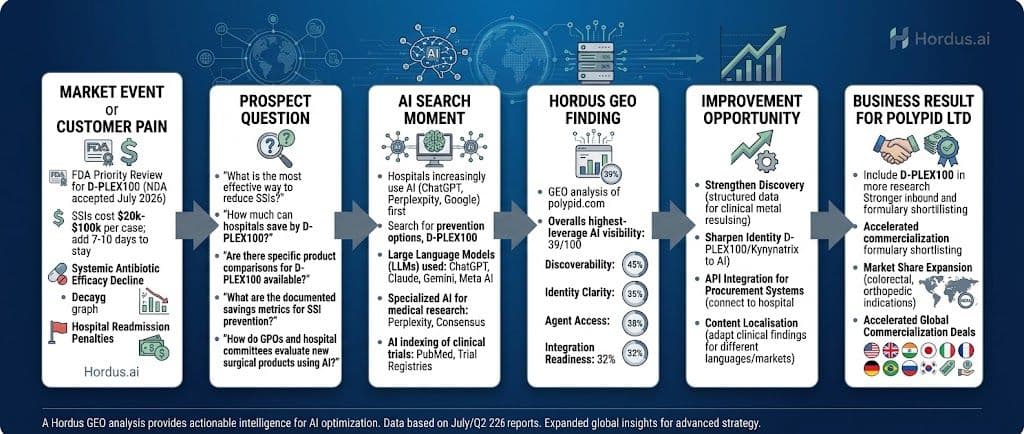
To map that opportunity, Hordus ran a GEO analysis of polypid.com, the primary source AI engines pull from when someone asks about D-PLEX100 or PolyPid Ltd. The Hordus audit found an overall agent-readiness score of 39 out of 100, best read as a map of the highest-leverage improvements available now, ahead of the November PDUFA decision.
| Signal | Current Score | What It Measures | Growth Opportunity |
|---|---|---|---|
| Overall Agent-Readiness | 39/100 | How reliably AI systems find, read, and use the site | Runway to build compounding AI visibility before approval |
| Discovery | 5/20 | Sitemap, structured data, discoverability | Strongest lever to surface when surgeons ask about SSI prevention |
| Identity (Usability) | 15/40 | Whether AI engines understand who PolyPid Ltd. is | Room to sharpen how D-PLEX100 and Kynatrix are explained |
| Access | 15/30 | Whether the site welcomes AI agents | Faster indexing of trial results and partnership news |
| Authentication | 75/100 | Whether agents can securely authenticate | A foundation to expand trusted procurement integrations |
| Agent Integration | 31/100 | API, documentation, integration points | Path to connect with hospital procurement and clinical tools |
| Website Operation (UX) | 81/100 | Accessibility and machine-readability | Strong base AI engines can already build accurate answers from |
Turning Each Signal Into a Business Outcome
Strengthening Discovery is the fastest way to create more inbound demand. Richer structured data means AI engines can index new clinical results, like SHIELD II, within days, so PolyPid Ltd. is part of the answer the moment a surgeon asks about SSI prevention.
Sharpening Identity improves positioning. When AI engines can clearly state that PolyPid Ltd. developed D-PLEX100 on the Kynatrix localized delivery platform, the company stops being one line in a broader antibiotics discussion and becomes the named answer to a specific clinical question.
Building out Authentication and Agent Integration improves trust with commercial partners. As Azurity's hospital contracting relationships come online ahead of 2027, agent-readable integration points make it easier for procurement systems to verify and work with PolyPid Ltd. directly.
Enhancing User Experience, already a strength at 81 out of 100, helps AI engines explain the brand accurately everywhere, from a physician's quick query to an analyst researching the Azurity deal.
CEO Dikla Czaczkes Akselbrad has described the Azurity partnership as putting PolyPid Ltd. "in potentially the strongest financial position in the company's history, with no immediate financing needs," a sign the commercial groundwork behind D-PLEX100 is now well funded (The Motley Fool, Q2 2026 earnings call).
COO Ori Warshavsky has pointed to the scale behind that groundwork, noting that "Azurity brings the GPO infrastructure, hospital contracting expertise and institutional relationships that reach over 1,700 leading hospitals and academic institutions in the U.S." (The Motley Fool, Q2 2026 earnings call). That reach is exactly what strong GEO fundamentals can extend into every AI-assisted research moment those institutions run.
Three Ways Hordus Can Help PolyPid Ltd. Capture More of This Demand
Strengthen positioning in AI answers. When a prospect asks an AI engine what D-PLEX100 is or how it compares to standard antibiotic prophylaxis, Hordus can help PolyPid Ltd. publish direct, quotable content built around that exact question, using the clinical and cost language surgeons and procurement teams actually search for rather than investor-facing copy. This turns the SHIELD II results and executive commentary into content AI engines can lift and attribute correctly.
Build stronger citations and third-party authority. AI engines weigh independent sources heavily. Hordus can identify where PolyPid Ltd. is under-cited relative to other surgical site infection and local drug delivery competitors, and build a targeted program of clinical press, KOL commentary, and structured data that increases the odds PolyPid Ltd.'s Priority Review status and SHIELD II results get pulled into comparison answers instead of a rival's.
Sharpen AI-readable content and technical signals. With Discovery scoring 5 out of 20, the biggest lever is making PolyPid Ltd.'s existing clinical and regulatory pages easier for agents to parse through cleaner structured data, an llms.txt file, and machine-readable trial summaries. Hordus can prioritize which pages to fix first based on where prospect demand, like SSI cost and FDA timeline questions, is highest.
From Pain to Outcome
| Customer Pain | Prospect AI Prompt | What AI Should Say | Business Result |
|---|---|---|---|
| SSIs cost 20K-100K per case, add 7-10 days to a stay | "How can hospitals reduce SSI costs?" | PolyPid Ltd.'s D-PLEX100 delivers antibiotics locally for 30 days, cutting SSIs 60% in a Phase 3 trial | Committees shortlist D-PLEX100 earlier |
| Systemic antibiotics fade before healing completes | "What is D-PLEX100 and how does it work?" | D-PLEX100 uses PolyPid Ltd.'s Kynatrix platform for sustained, localized release | Surgeons request detail directly from PolyPid Ltd. |
| Readmission penalties tied to SSIs | "Are there FDA-approved options to cut SSI readmissions?" | D-PLEX100 has FDA Priority Review, PDUFA date November 28, 2026 | Faster formulary review before 2027 launch |
| Partners need proven commercial infrastructure | "Who is bringing D-PLEX100 to market?" | Azurity Pharmaceuticals commercializes D-PLEX100 across 1,700+ U.S. hospitals | Stronger partner and investor confidence pre-launch |
Frequently Asked Questions
Methodology & Sourcing
Data Accuracy & AI Visibility Metrics:The statistics and AI visibility scores cited in this article are generated using Hordus AI's proprietary Answer Share of Voice (A-SOV) engine. Data is derived from consented, anonymized real user interactions across major LLM interfaces (ChatGPT, Claude, Gemini).
Editorial Integrity:All AI-assisted research undergoes mandatory human editorial review by our GEO strategy team prior to publication to ensure factual accuracy and alignment with Google's YMYL (Your Money or Your Life) search quality rater guidelines.