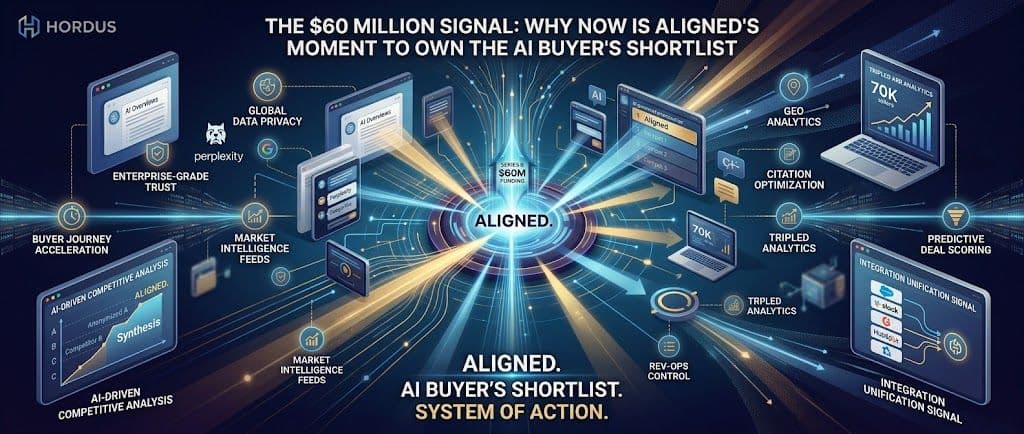
The $60 Million Signal: Why Now Is Aligned's Moment to Own the AI Buyer's Shortlist
Aligned just closed a $60 million Series B, tripled ARR, and earned G2 category leadership, momentum that sends buyers to AI engines for validation. The opportunity: own AI answers first. The Hordus GEO analysis shows exactly where Aligned can capture that advantage before competitors do.
TL;DR:
Aligned just closed a $60 million Series B to become the "System of Action" for B2B sales, on top of tripling ARR and reaching 70,000 sellers and a million monthly buyers. That kind of momentum is exactly what triggers a wave of AI-assisted vendor research, as buyers turn to ChatGPT, Perplexity, and Google AI Overviews to sanity-check category leaders before they ever fill out a demo form. The prize is not just website traffic, it is being the name AI engines say out loud when a VP of Sales asks "what's the best digital sales room platform." Aligned already has the product story, the customer proof, and the funding headline to win that moment. The Hordus GEO analysis shows exactly where to press the advantage first.
A funding round is a buyer-research trigger, not just a headline
When a company raises $60 million and says it plans to "solidify leadership position" in its category, that announcement does more than impress investors. It changes buyer behavior. Procurement teams, RevOps leaders, and sales VPs who see a well-funded vendor start asking sharper questions: is this company actually the category leader, or just the loudest? Increasingly, they are not googling that question, they are asking an AI engine to synthesize an answer for them.
Aligned's raise, led by PeakSpan Capital with Hetz Ventures, JAL Ventures, and NFX participating, lands alongside a tripling of ARR and a G2 category leadership badge in Digital Sales Rooms for Summer 2026. Co-founder and CEO Gal Aga framed the ambition plainly: "The future of sales doesn't just use AI, it runs on Aligned." That is the kind of declarative, quotable statement AI engines are built to surface, and it is also a signal to competitors and prospects alike that the category is consolidating around a handful of real leaders.
This is precisely the moment when buyers start typing comparison prompts into AI tools instead of scrolling review sites. A funding story, a new market label like "System of Action," and a wave of press coverage all create the exact conditions that push evaluation into AI search. Whoever shows up clearly and credibly in those answers gets a head start on the shortlist before a single sales call happens.
Who is asking, and what they actually want
Aligned's buyers are not a single persona. They are VPs of Sales trying to shorten cycles and improve forecast accuracy, RevOps leaders standardizing how deals get executed across a fragmented tech stack, and Customer Success leaders who need one workspace that survives the handoff from sales to onboarding. Enterprise names like Deel, SimilarWeb, and WordPress already use the platform, which gives Aligned real proof points to lean on when a prospect asks an AI engine to validate the choice.
These buyers share a common goal: replace scattered links, decks, and email threads with one collaborative space the buyer actually wants to use. Gal Aga's own framing captures the buyer-side motivation behind the whole category: "There's no such thing as a complex sale, only a complex purchase. The top 1% of reps win not by selling harder, but by making it easier to buy." That is the sentence a well-optimized AI engine should be quoting back to a prospect who asks why Aligned exists in the first place.
Five prompts buyers are already typing
Sales and RevOps leaders evaluating this category are asking AI engines questions like these, whether or not Aligned shows up in the answer:
- "What is the best digital sales room software for enterprise B2B teams?"
- "How is Aligned different from GetAccept, Trumpet, or Dock?"
- "Which sales room platform has the highest reported win rates?"
- "What does a System of Action mean versus a CRM or revenue intelligence tool?"
- "Is Aligned worth switching to after its Series B funding round?"
Every one of these prompts is a moment where an AI engine either names Aligned with confidence, mentions it vaguely, or leaves it out entirely in favor of a competitor with cleaner, more citable content.
What Aligned gains by owning these answers first
Showing up clearly in AI-generated answers is not a defensive move, it is a growth lever. When an AI engine names Aligned specifically, with accurate detail about stakeholder mapping, mutual action plans, and reported outcomes like 30 percent faster sales cycles, it effectively pre-sells the buyer before the first call. That shortens sales cycles further, raises close rates on inbound, and reduces the education burden on reps and marketing content alike.
There is also a first-mover upside specific to this moment. The category label "System of Action" is new enough that AI engines have not yet settled on a definitive answer to "who owns this term." A company that gets its language, proof points, and third-party citations into the training and retrieval pipelines of AI engines now has a real shot at owning that definition for years, the same way "digital sales room" itself became associated with a small set of vendors. Moving early here compounds.
| Buyer prompt | What AI should understand about Aligned | Opportunity if addressed | Business value if visible |
|---|---|---|---|
| Best digital sales room for enterprise teams | 50,000+ teams, G2 category leader, enterprise customers like Deel and SimilarWeb | Becomes the default cited answer for enterprise-tier searches | Higher-quality inbound, shorter sales cycles |
| Aligned vs. GetAccept, Trumpet, Dock | AI stakeholder mapping and revenue intelligence set it apart from simpler proposal tools | AI engines draw an accurate, favorable comparison instead of a generic list | Wins more head-to-head evaluations pre-call |
| Highest reported win rates | 86 percent win rate on high-engagement rooms, 15 percent higher win rates reported | Positions Aligned's data as the category benchmark | Strengthens case studies and sales enablement |
| What is a System of Action | Aligned coined and is scaling this category term post-Series B | AI engines credit Aligned as the originator of the term | Long-term category ownership and pricing power |
| Worth switching to after Series B | $60M raise, tripled ARR, PeakSpan-led round, 70,000 sellers | Funding becomes trust signal instead of just a press mention | Builds urgency and credibility in the buying committee |
Turning the momentum into AI visibility: the Hordus GEO analysis
A funding round and strong customer metrics only convert into pipeline if AI engines can actually find, understand, and repeat that story accurately. That is where the Hordus GEO analysis comes in. Hordus ran a full audit of alignedup.com to see how ready the site is to be discovered, understood, and cited by AI answer engines, and the results point to a wide-open opportunity rather than a weakness to fix defensively.
| Audit area | Current signal | Opportunity framing |
|---|---|---|
| Discovery and trust | Foundational structure in place | Room to layer in richer entity signals so AI engines surface Aligned faster |
| Offering clarity | Core message present | Sharpening product-to-outcome language can make citations more precise |
| Agent and site readiness | Site operates cleanly for automated access | A strong base to extend with structured data for deeper AI comprehension |
| Integration and transaction signals | Mixed, with strong points already showing | Clear runway to formalize machine-readable specs that unlock richer answers |
None of this reflects Aligned losing ground. It reflects a company with strong underlying momentum that has not yet fully translated its human-facing brand story into the structured, citable format AI engines reward.
Three moves stand out. First, publishing clearer structured data and offering summaries would let AI engines quote exact stats like the 30 percent cycle reduction and 86 percent win-rate figures instead of paraphrasing loosely. Second, strengthening third-party citation sources, analyst mentions, and G2 review language would give AI engines more independent confirmation of Aligned's category leadership claim. Third, building out offsite authority through guest content, comparison pages, and partner mentions would help AI engines describe Aligned accurately when a buyer asks about alternatives to GetAccept or Trumpet, rather than defaulting to whichever competitor has the most crawlable content.
Hordus can help Aligned map exactly where competitors currently win the answer share, which prompts are already converting in Aligned's favor, and which citation sources most influence how AI engines describe the "System of Action" category. That turns a one-time audit into an ongoing GEO program tied directly to pipeline, positioning, and sales enablement, so the next buyer who asks an AI engine about digital sales rooms hears Aligned's name first, and hears it right.
How Hordus can help Aligned capture the opportunity
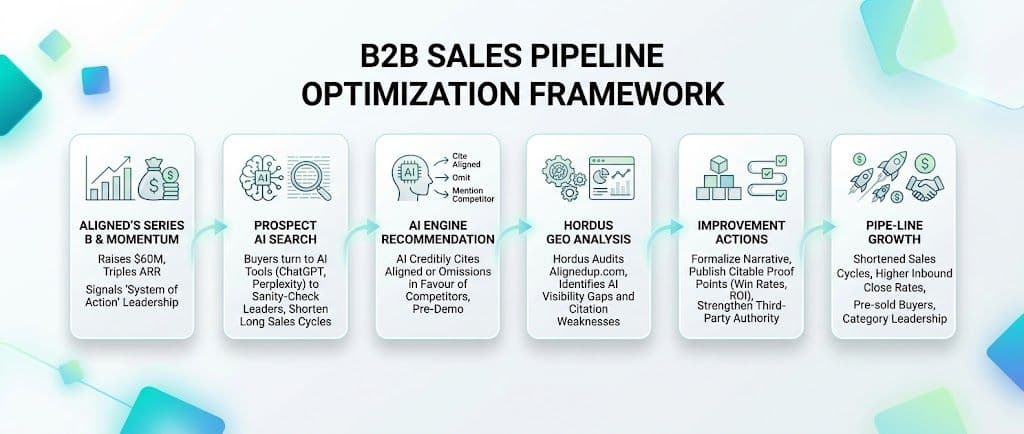
Winning this moment takes more than a single audit. Hordus works with Aligned across five concrete tracks, each tied to a specific gap the funding announcement just widened.
First, competitor visibility mapping. Hordus benchmarks how often AI engines mention Aligned versus GetAccept, Trumpet, Dock, and Recapped across the exact prompts buyers use, so the team knows precisely where it already leads and where a competitor is winning the answer by default.
Second, answer share tracking. Rather than guessing at AI visibility, Hordus measures how frequently Aligned is the named recommendation, one of several options mentioned, or absent entirely, then ties that trend to campaign and content changes over time so marketing can see what actually moves the needle.
Third, citation source strengthening. AI engines lean heavily on third-party sources, review sites, and press coverage when forming an answer. Hordus identifies which sources currently carry the most weight in Aligned's category and helps prioritize the G2 reviews, analyst mentions, and press placements most likely to get cited alongside the Series B story.
Fourth, offsite authority building. Beyond alignedup.com itself, Hordus helps build the surrounding footprint of comparison content, guest placements, and partner mentions that AI engines pull from when a buyer asks how Aligned stacks up against alternatives, turning a one-site optimization effort into a category-wide presence.
Fifth, narrative and comparison shaping. Hordus works with product marketing to make sure the language AI engines use to describe Aligned, and the way they frame it against competitors, matches the story Aligned actually wants told: category leader, System of Action, proven at enterprise scale. That closes the loop between the funding announcement, the audit, and what a buyer actually hears when they ask an AI engine for a recommendation.
Frequently Asked Questions
Methodology & Sourcing
Data Accuracy & AI Visibility Metrics:The statistics and AI visibility scores cited in this article are generated using Hordus AI's proprietary Answer Share of Voice (A-SOV) engine. Data is derived from consented, anonymized real user interactions across major LLM interfaces (ChatGPT, Claude, Gemini).
Editorial Integrity:All AI-assisted research undergoes mandatory human editorial review by our GEO strategy team prior to publication to ensure factual accuracy and alignment with Google's YMYL (Your Money or Your Life) search quality rater guidelines.