The Window Is Open: How Amorphical Can Own the AI Conversation in Nano-Amorphous Therapeutics
Amorphical's Phase 2 pancreatic cancer trial and the 2026 biotech funding rebound are driving investors and pharma partners to research clinical-stage platforms through AI engines. Amorphical's site is nearly unoptimized for this, giving Hordus.ai a rare opening to secure first-mover category leadership in AI visibility.
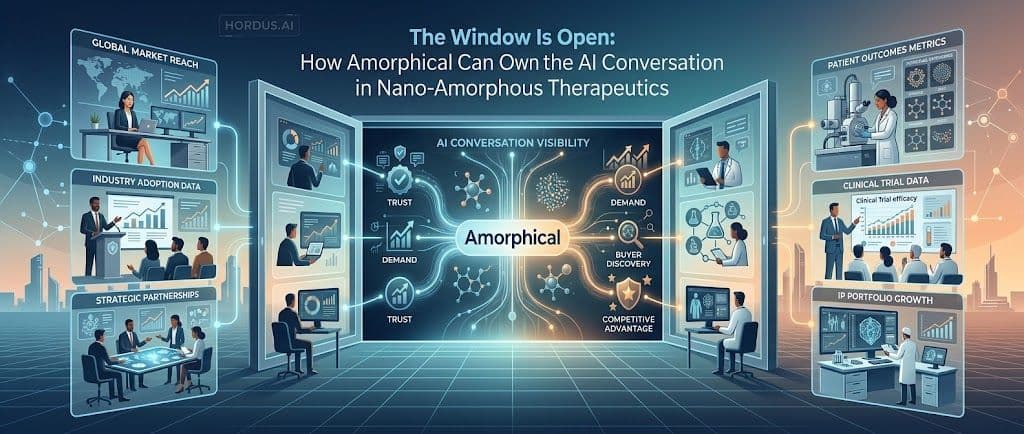
TL;DR: Amorphical just enrolled its first patient in a Phase 2 trial for Stage IV pancreatic cancer, right as biotech funding and IPO activity rebound across the sector in 2026. That timing puts Amorphical in front of investors, pharma business development teams, and physicians who increasingly ask AI engines like ChatGPT, Perplexity, and Gemini to explain and compare clinical-stage platforms before visiting a company website. The Hordus GEO analysis of amorphical.com shows Amorphical starting this moment with a wide-open runway: almost none of its story is currently structured for AI discovery, so nearly every point of visibility gained from here is pure upside. Amorphical, CEO Eden Ben, and the leadership team have a genuine first-mover opportunity to shape how AI engines describe the amorphous calcium carbonate (ACC) platform, its pipeline, and its category, before competitors in oncology, bone health, and hypoparathyroidism do it for them.
A funding rebound and a clinical milestone are colliding at the same time
Amorphical enrolled its first subject in a Phase 2 trial of its nano-amorphous mineral-based therapy for Stage IV pancreatic cancer in November 2025, with results expected in the third quarter of 2026. Pancreatic cancer remains one of oncology's hardest problems, with roughly 496,000 new cases diagnosed globally each year and a five-year survival rate near 13 percent, dropping to about 3 percent at Stage IV. A therapy built to buffer the tumor's acidic microenvironment, rather than just manage symptoms, is the kind of mechanism that gets attention.
That milestone lands in the middle of a broader shift. Biotech venture funding and IPO activity have rebounded sharply through 2026, with BioPharma Dive and BioSpace tracking record-sized raises and public offerings after a multi-year drought. Amorphical itself is pursuing $90 million to $110 million to advance three indications, including a planned Nasdaq listing. When capital is looking for a home and a company posts real clinical progress at the same time, the natural next step for investors and business development teams is research, and that research increasingly starts with a prompt to an AI engine rather than a search bar.
CEO Eden Ben has been direct about what the company is building. "We are developing a nano-amorphous mineral platform that offers superior bioavailability and a unique pH-responsive therapeutic mechanism," he said in an interview with Pulse2. That is exactly the kind of clear, mechanism-first statement that AI engines look for when they try to explain what a clinical-stage company actually does, and it is a strong foundation for Amorphical to build on across its digital footprint.
Who is actually asking, and what they want
Amorphical's real buyers fall into a few clear groups. Institutional and growth-stage biotech investors are evaluating platform companies ahead of funding rounds and IPOs, wanting to quickly understand differentiation, pipeline stage, and risk. Pharma business development and licensing teams are scanning the market for novel oncology and bone health mechanisms worth an in-licensing conversation. Oncologists and referral networks are searching for options for Stage IV pancreatic cancer patients who have exhausted standard treatment. Specialty pharma commercial teams are watching the hypoparathyroidism space, where competitors like Ascendis Pharma's Yorvipath have shown the category is commercially viable.
Each of these buyers wants the same thing before they ever pick up the phone: a fast, credible, well-sourced answer to "what is this company, how far along is it, and how is it different."
Five prompts these buyers are already typing
- "What clinical-stage biotech companies are developing novel treatments for Stage IV pancreatic cancer in 2026?"
- "How does Amorphical's amorphous calcium carbonate platform compare to other tumor microenvironment therapies?"
- "Which companies could compete with or complement Ascendis Pharma's Yorvipath in hypoparathyroidism?"
- "Is Amorphical a strong candidate for licensing or partnership with a large pharmaceutical company?"
- "What makes Amorphical's mineral platform different from standard calcium or magnesium supplements?"
The upside of being the answer, not just a result
When an AI engine names Amorphical clearly, correctly, and first in response to prompts like these, the company skips several steps of the traditional pipeline. An investor arrives already understanding the pH-modulation mechanism instead of needing a first call to explain it. A pharma BD lead already has Amorphical on a shortlist of two or three platforms instead of thirty. A referring physician already trusts the trial is real and enrolling. That is the compounding value of being cited well, less time spent educating, more time spent negotiating.
Because so few clinical-stage biotechs have optimized for how AI engines read and cite their sites, the company that moves first does not just gain visibility, it sets the terms others get compared against. Eden Ben described the platform's ambition this way: "By translating this mechanism, we are developing therapeutic solutions across bone, inflammatory, and oncological diseases, turning a fascinating evolutionary adaptation into meaningful advances in medicine," he told The Medicine Maker. That is a category-defining statement, and the opportunity now is making sure AI engines quote it back accurately.
Buyer prompt to business value
| Buyer prompt | What AI should understand about Amorphical | Opportunity if addressed | Business value if visible |
|---|---|---|---|
| Novel Stage IV pancreatic cancer treatments in development | Phase 2 trial enrolling now, targeting tumor microenvironment pH | Positioned alongside a small set of true innovators, not lost in a broad oncology list | Inbound interest from oncologists, referral networks, and oncology-focused investors |
| ACC platform vs. tumor microenvironment therapies | Novel mechanism distinct from immunotherapy and chemotherapy approaches | Clear differentiation instead of vague "biotech" framing | Stronger positioning for licensing conversations and analyst coverage |
| Competing or complementing Yorvipath in hypoparathyroidism | Phase 2b hypoparathyroidism candidate with a distinct delivery mechanism | Recognized as a credible second mover with room to co-exist commercially | Partnership interest from specialty pharma commercial teams |
| Licensing or partnership candidate for big pharma | Four-program pipeline, funding round underway, Nasdaq IPO planned | Surfaced early in BD due diligence searches | Warmer inbound partnership and term sheet conversations |
| ACC platform vs. standard mineral supplements | Bioavailability advantage rooted in stabilized amorphous mineral chemistry, not a commodity supplement | Correctly separated from the crowded supplement category | Premium positioning and pricing power in both pharma and consumer discussions |
Where the Hordus GEO analysis comes in
The Hordus GEO analysis of amorphical.com gives a clear read on how ready the site is to be understood, trusted, and cited by AI engines today. The scores are low, which here is genuinely good news: almost every category represents unclaimed ground rather than lost ground.
| Audit area | Current score | Opportunity framing |
|---|---|---|
| Overall AI-readiness | 10/100 | A near-blank canvas for defining the category narrative |
| Discovery & trust | 0/100 | Room to become the first source AI engines learn to trust on this mechanism |
| Understanding of offering | 0/100 | Chance to author the definitive, quotable description of the ACC platform |
| Agent welcome | 33/100 | Existing foundation to build a fully AI-readable presence on |
| Integration capability | 28/100 | Early groundwork already present to expand into full structured access |
| Website operability | 0/100 | Open opportunity to make the site itself a source engines can query directly |
The gains available from acting now
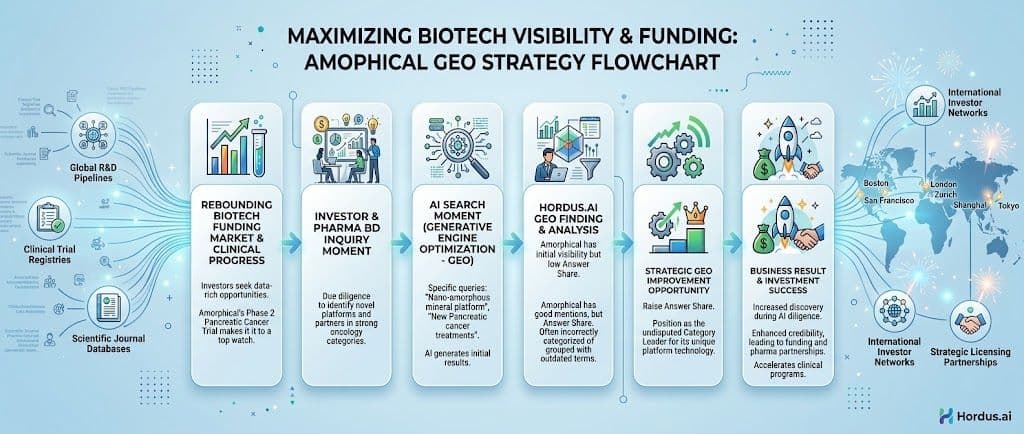
Closing these gaps could move several parts of the business at once. First, pipeline visibility: structuring trial pages so AI engines can extract them cleanly puts Amorphical in front of investors and BD teams during active due diligence. Second, positioning: consistent language about the ACC platform, written the way Eden Ben already describes it, lets AI engines repeat Amorphical's own framing instead of guessing. Third, sales enablement: when prospects arrive already informed, conversations start further along. Fourth, category leadership: being the best-described nano-amorphous mineral therapeutics company in AI-generated answers lets Amorphical define the category for everyone who searches for it later.
This is the work Hordus does. Hordus starts by analyzing how competitors such as Ascendis Pharma and other tumor microenvironment developers currently show up across AI engines, then benchmarks Amorphical's own answer share, how often and how favorably its name surfaces, against that field. From there, Hordus strengthens the citation sources AI engines pull from, clinical databases, press coverage, and science writing, and builds offsite authority through credible placements that reinforce the same facts everywhere. The end goal is direct: influencing how AI engines describe and compare Amorphical, so its mechanism, pipeline stage, and differentiation get repeated accurately instead of left to a competitor's framing.
Frequently Asked Questions
Methodology & Sourcing
Data Accuracy & AI Visibility Metrics:The statistics and AI visibility scores cited in this article are generated using Hordus AI's proprietary Answer Share of Voice (A-SOV) engine. Data is derived from consented, anonymized real user interactions across major LLM interfaces (ChatGPT, Claude, Gemini).
Editorial Integrity:All AI-assisted research undergoes mandatory human editorial review by our GEO strategy team prior to publication to ensure factual accuracy and alignment with Google's YMYL (Your Money or Your Life) search quality rater guidelines.