Turning Executive Credibility Into AI Authority: The Innoviz Technologies Opportunity Hordus Uncovered
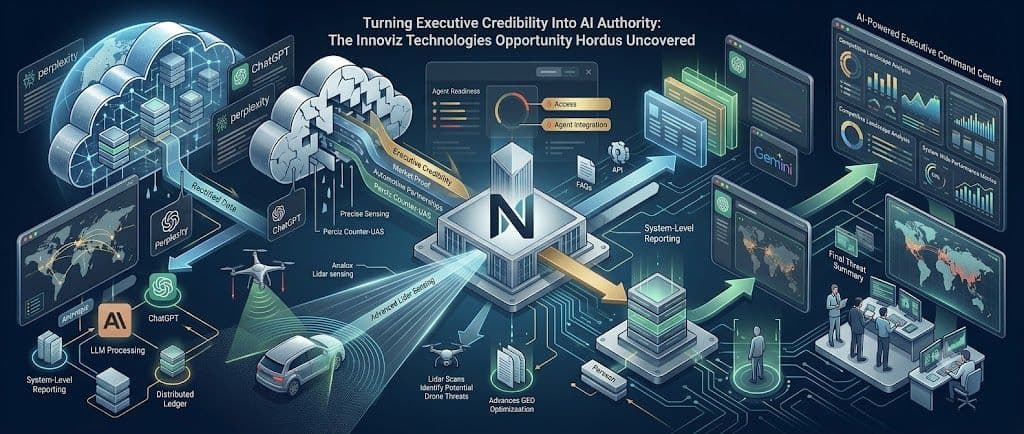
Innoviz Technologies' new counter-UAS push makes its core mission more relevant than ever, but the Hordus GEO analysis shows it scores only 36/100 on AI visibility, risking lost share to competitors AI engines find and cite more easily.
TL;DR
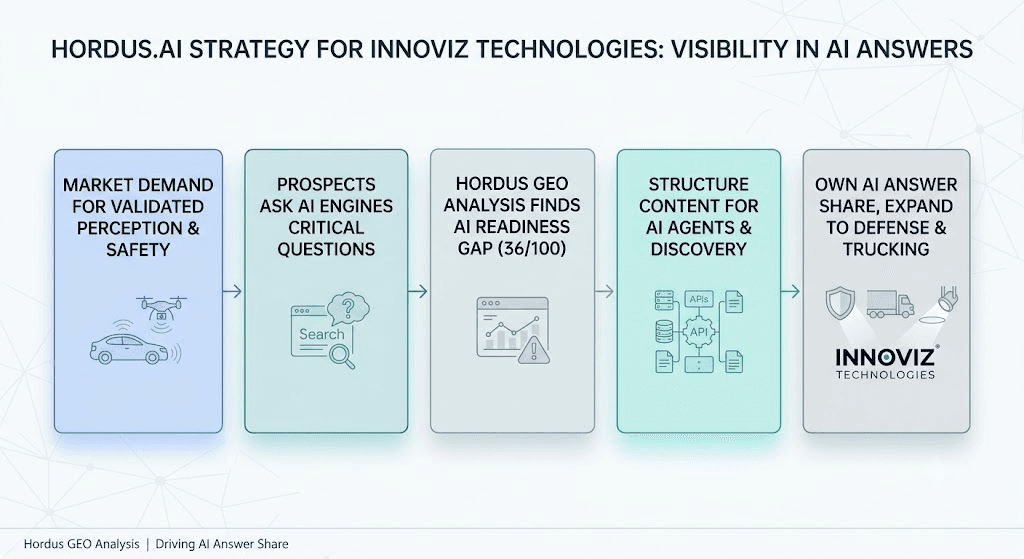
Innoviz Technologies has spent years building a narrative around safety, precision, and the mass commercialization of autonomous systems. Its recent expansion of the Perciz platform into counter-UAS defense, now covering six partners, has made that narrative more relevant than ever, as global concern over drone threats to airports, borders, and critical infrastructure grows. But when AI engines like ChatGPT, Perplexity, and Gemini are asked about lidar for defense or autonomous safety, Innoviz Technologies does not reliably show up in the answer. The Hordus GEO analysis found the company's site scoring just 36 out of 100 for agent readiness, with especially weak scores in Access and Agent Integration. This article explains why closing that gap matters commercially, not just technically, and how Hordus can help Innoviz Technologies turn its executive story into AI answer share.
A mission built on one sentence
Omer Keilaf, Co-Founder and CEO of Innoviz Technologies, has a way of reducing a complicated engineering problem to something anyone can understand. Describing the purpose behind the company's newest product line, he put it simply: the technology exists <cite index="3-1">to make sure a car does not mistake a person for empty road</cite>. It is a founder's sentence, plainspoken, almost domestic in its stakes, and it captures what Innoviz Technologies has always sold: not lidar hardware, but certainty. Certainty that a sensor sees what is actually there.
That sentence was not written for a defense audience. It was written about cars. But in July 2026, Innoviz Technologies extended that same sensing philosophy into a very different environment, launching Perciz, a lidar-based platform aimed at counter-UAS detection, homeland security, and critical infrastructure protection. Within days, the company confirmed six counter-UAS partners had adopted the platform. The timing is not incidental. Airports, ports, and defense agencies worldwide are grappling with a fast-rising volume of drone incursions, and existing radar and camera systems often struggle to distinguish a genuine threat from background clutter, at night, in fog, or in dense airspace. Keilaf's "empty road" line, originally about a car failing to see a pedestrian, turns out to describe exactly the same failure mode that is now worrying security officials watching a runway.
That is the connective tissue of this story. A company built its identity around one perceptual problem, being certain about what is real, and a market event has arrived that makes solving that problem newly urgent, in a category Innoviz Technologies had not originally been known for.
The second quote: growth built on scarcity of real alternatives
Later in the same announcement, Keilaf widened the lens from the specific product to the strategic backdrop, noting that <cite index="6-1">defense and homeland security organizations are confronting a rapidly evolving environment where threats are becoming increasingly sophisticated, autonomous, and unpredictable</cite>. This is not just a defense statement. It echoes something Keilaf has said repeatedly about the automotive side of the business too: that the number of lidar suppliers who can actually manufacture at OEM quality is shrinking, and that Innoviz Technologies is one of the few left standing with proven design wins at BMW and now programs with Daimler Truck and Torc Robotics.
Put those two ideas together and a growth thesis emerges. Whether the buyer is an automaker qualifying a Level 3 program or a security agency evaluating counter-UAS vendors, the pool of credible, road-proven or field-proven lidar suppliers is small, and getting smaller. Innoviz Technologies is positioning itself as the company that survived the consolidation. That is a strong story for investors and OEM engineering teams who already know the company. It is a much weaker story for the security director, integrator, or procurement officer who has never heard of Innoviz Technologies and is instead typing a question into an AI assistant.
Who is actually asking, and what are they asking
Innoviz Technologies' near-term prospect base has split into at least three distinct buyer groups, each with different urgency:
- Automotive OEMs and Tier 1 suppliers evaluating Level 3 and Level 4 sensor suites, often replacing vendors that have gone out of business or fallen behind on cost and performance.
- Trucking and logistics autonomy programs, following the Daimler Truck and Torc Robotics collaboration, who need proven, automotive-grade reliability at highway speed.
- Defense, homeland security, and critical infrastructure buyers, an entirely new audience for Innoviz Technologies, searching for counter-UAS detection technology after a wave of drone incidents at sensitive sites.
None of these buyers are reading a press release start to finish. Increasingly, they are asking an AI assistant a question and trusting whatever answer comes back. Likely prompts include: "What lidar companies supply automotive-grade sensors for autonomous trucks?" "Best counter-UAS detection technology for airports and critical infrastructure" "Who are Innoviz Technologies' main lidar competitors?" "Is Innoviz Technologies a good alternative to Luminar or Velodyne?" If the AI engine cannot find clean, structured, citable information about Innoviz Technologies for these questions, it will answer using whichever competitor has made itself easier to find and cite, regardless of who is actually the stronger technical fit.
From executive message to AI answer
| Executive message | Market proof | Prospect AI question | Business opportunity for Innoviz Technologies |
|---|---|---|---|
| "We built this technology to make sure a car does not mistake a person for empty road" (Keilaf) | Perciz launch expands to six counter-UAS partners amid rising drone incursion incidents | "What lidar-based systems detect drones near airports or infrastructure?" | Own the AI answer for counter-UAS lidar detection before competitors define the category |
| Threats are becoming "sophisticated, autonomous, and unpredictable" (Keilaf) | Board appointment of Maj. Gen. (Ret.) Yoav Har-Even signals defense credibility | "Which lidar companies work with defense and homeland security agencies?" | Establish Innoviz Technologies as a named, citable defense-sector supplier, not just an automotive one |
| Lidar suppliers "going out of business" while Innoviz consolidates share | Daimler Truck and Torc Robotics program, $110M+ in NRE bookings through 2027 | "Is Innoviz Technologies a reliable long-term lidar supplier for autonomous trucking?" | Convert supply-chain stability into an AI-cited reason to select Innoviz over newer or riskier entrants |
Introducing the Hordus GEO analysis
To understand how visible Innoviz Technologies actually is inside AI-generated answers, we ran the Hordus GEO analysis on innoviz.tech. Generative engine optimization, or GEO, measures how well a company's digital presence can be discovered, understood, and cited by AI systems, not just search engines. The results suggest Innoviz Technologies has strong offline credibility and a much weaker footprint in the layer that increasingly decides who gets recommended.
| Layer | Score | What it measures |
|---|---|---|
| Overall Agent Readiness | 36 / 100 (Grade D) | How ready the domain is to be found, understood, and cited by AI agents |
| Discovery | 10 / 20 | Whether AI crawlers and agents can locate and index key company content |
| Identity | 10 / 22 | Clarity of who Innoviz Technologies is, what it makes, and how it differs from competitors |
| Access | 9 / 34 | Availability of structured, machine-readable information such as documentation or public data |
| Agent Integration | 4 / 20 | Presence of APIs, standards, or integration paths that let AI systems interact with the site directly |
| User Experience | 6 / 10 | How usable and navigable the site is for both humans and automated visitors |
The Hordus GEO analysis summarizes the core issue directly: Innoviz has SDK packages and searchable presence, but lacks any public API, documentation, or agent integration standards. In plain terms, Innoviz Technologies has real technical substance and real news volume, but very little of it is structured in a way that AI engines can confidently parse, quote, and reuse when answering a prospect's question.
Why this gap matters, and where it can be closed
A 36 out of 100 does not mean Innoviz Technologies lacks a strong story. It means the story is not currently packaged for the systems now mediating buyer research. A few concrete opportunities follow directly from the audit:
- Improve AI answer share. With Access scoring just 9 out of 34, Innoviz Technologies content is likely underrepresented when AI engines assemble comparison answers about lidar vendors. Structured pages summarizing InnovizTwo, InnovizThree, and Perciz specifications in plain, quotable language would give AI systems something concrete to cite.
- Strengthen citations. The Identity score of 10 out of 22 suggests AI engines may struggle to consistently attribute claims, quotes, and product facts to Innoviz Technologies by name. Clear executive attribution, consistent naming of Omer Keilaf's role, and dated statements make quotes easier for AI systems to surface accurately.
- Build AI-readable content. Converting existing press releases, investor transcripts, and product pages into structured formats, FAQs, comparison tables, and clean product specification pages, gives crawlers cleaner signal than dense PDF-style releases.
- Clarify category positioning. Innoviz Technologies now spans automotive lidar, trucking autonomy, and defense counter-UAS. Without explicit category-defining language on the site itself, AI engines may default to describing Innoviz Technologies narrowly as an "automotive lidar company," missing the Perciz expansion entirely.
- Influence competitive comparisons. The Agent Integration score of just 4 out of 20 means Innoviz Technologies has little machine-readable material to compete against rivals like Luminar or Hesai when an AI engine is asked to compare vendors. Publishing structured, comparison-friendly content gives Innoviz Technologies a chance to shape that comparison rather than be left out of it.
Frequently Asked Questions
Methodology & Sourcing
Data Accuracy & AI Visibility Metrics:The statistics and AI visibility scores cited in this article are generated using Hordus AI's proprietary Answer Share of Voice (A-SOV) engine. Data is derived from consented, anonymized real user interactions across major LLM interfaces (ChatGPT, Claude, Gemini).
Editorial Integrity:All AI-assisted research undergoes mandatory human editorial review by our GEO strategy team prior to publication to ensure factual accuracy and alignment with Google's YMYL (Your Money or Your Life) search quality rater guidelines.