Wall Street's AI Moment Just Got Bigger. So Did Amenity Analytics' Opportunity.
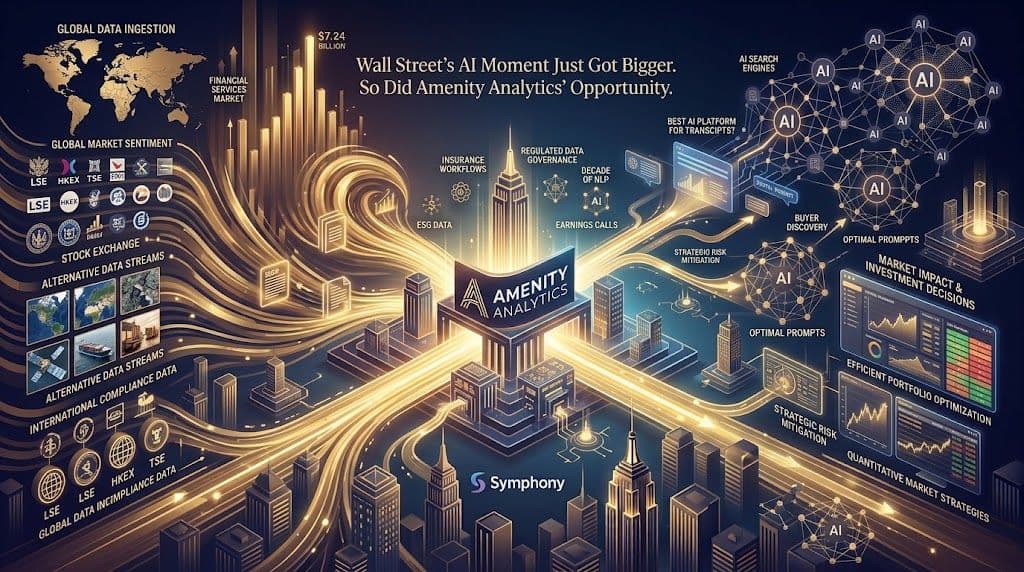
Generative AI spend in financial services is set to nearly triple by 2030, and buyers now ask AI engines who handles earnings calls best. Amenity Analytics has the product depth to answer. The Hordus GEO analysis shows how it can capture more of that demand.
TL;DR
The generative AI market inside financial services is projected to nearly triple by 2030, and buyers are shifting vendor research into AI engines before they ever talk to a salesperson. Amenity Analytics, now part of Symphony, already has the product depth this moment rewards: a decade of NLP built for earnings calls, filings, ESG data, and insurance workflows. The missed-demand opportunity is not product quality, it is how much of that expertise currently reaches the AI engines answering questions its future customers are already typing. The Hordus GEO analysis of amenityanalytics.com shows exactly where that upside sits.
The Market Event: AI Adoption Is Showing Up in the Numbers
Two data points landed within days of each other this summer. A market report from Research and Markets published in July 2026 projects the generative AI in financial services market will grow from $2.48 billion this year to $7.24 billion by 2030, a compound annual growth rate above 30 percent. Around the same time, FactSet reported fiscal Q3 2026 earnings crediting AI adoption with lifting annual subscription value growth to 7.1 percent, driven partly by demand for AI-powered transcript tools like its Transcript Assistant product. These are quarterly revenue lines from a direct category peer, proof that financial services buyers are paying for AI-native transcript intelligence right now.
Why This Matters to Amenity Analytics's Prospects
The buyers behind those numbers are investor relations teams, equity research desks, compliance officers, wealth managers, and insurance carriers processing earnings calls, filings, and customer feedback faster than a human analyst can manage alone. They need speed without sacrificing the governance their compliance teams require on regulated data, and they fear falling behind competitors already running AI-native workflows. What they compare is a short list: FactSet's Transcript Assistant, Bloomberg's AI earnings summaries, AlphaSense, and purpose-built platforms like Amenity Analytics, and almost none of them start that comparison with a phone call anymore.
The AI Search Moment
Before contacting a vendor, buyers now type comparison and verification questions directly into AI engines: what the best tool is for a specific job, how two vendors differ, whether a platform handles a data type like insurance voice-of-customer feedback, and whether a vendor can back up its claims. The engines answering these questions pull from whichever content is structured clearly enough to quote with confidence, the moment where category expertise gets surfaced or skipped for a competitor whose content was easier to extract.
| Market Signal | Prospect Need | Likely AI Prompt | Why Amenity Analytics Should Appear |
|---|---|---|---|
| Generative AI in financial services set to nearly triple to $7.24B by 2030 | A compliant, purpose-built AI partner for regulated transcript data | "What is the best AI platform for analyzing earnings call transcripts?" | A decade of NLP built specifically for transcript workflows, not a general chatbot |
| FactSet's AI products lifted ASV growth 7.1% in Q3 FY26 | Clarity on how AI-native competitors actually differ | "How does Amenity Analytics compare to FactSet Transcript Assistant or Bloomberg's AI summaries?" | Broader dataset spanning transcripts, filings, ESG data, and news in one platform |
| Insurers accelerating AI adoption for claims and feedback analysis | Industry-specific proof, not generic AI marketing | "What AI tools help insurers analyze voice of customer data and ESG disclosures?" | Named insurance case studies and a dedicated insurance AI framework already exist |
Nathaniel Storch, Co-Founder and CEO of Amenity Analytics, has described the confidence the market already places in the platform: "Some of the most sophisticated minds on Wall Street already trust our technology to uncover insights that give their investment strategies an edge," he told GlobeNewswire.
That conviction carried into Amenity Analytics's move to join Symphony. Storch said the combination was designed to extend the company's reach: "This opportunity was uniquely attractive to us as we think the combination of our expertise in NLP with Symphony's best-in-class communications platform will yield exciting outcomes for our customers," he said in Symphony's acquisition announcement.
Introducing the Hordus GEO Analysis
To see how much of this demand Amenity Analytics is positioned to capture inside AI-generated answers, we ran the Hordus GEO analysis on amenityanalytics.com. It measures how ready a digital presence is to be discovered, understood, and cited by AI agents, separate from traditional search rankings. The results show a company whose story already lands well once an AI system reaches it, with clear room to be found more often in the first place.
| Audit Area | Current Score | Opportunity Framing |
|---|---|---|
| Overall Agent-Readiness | 36/100 (Grade D) | Substantial headroom to climb into a leadership grade |
| Understanding Offering | 69/100 | Strongest score, showing the NLP story already resonates once found |
| Agent Welcome | 67/100 | A near-ready foundation for engines that land on the site |
| Access | 17/30 | Room to widen how easily agents reach and parse content |
| Discovery & Trust | 0/100 | The largest opportunity, since this governs how often the site surfaces |
| Integration Capability | 0/100 | A developer portal would open a new discovery channel for agents |
The pattern is encouraging. Amenity Analytics scores highest exactly where it should, on communicating what the platform does (69/100) and welcoming an AI visitor once it arrives (67/100). The opportunity sits upstream, in Discovery and Integration, where structured content and technical signals decide whether AI engines find and cite the site at all. Closing that gap means making the existing story easier to retrieve, not rewriting it.
Three Ways to Turn This Into Pipeline
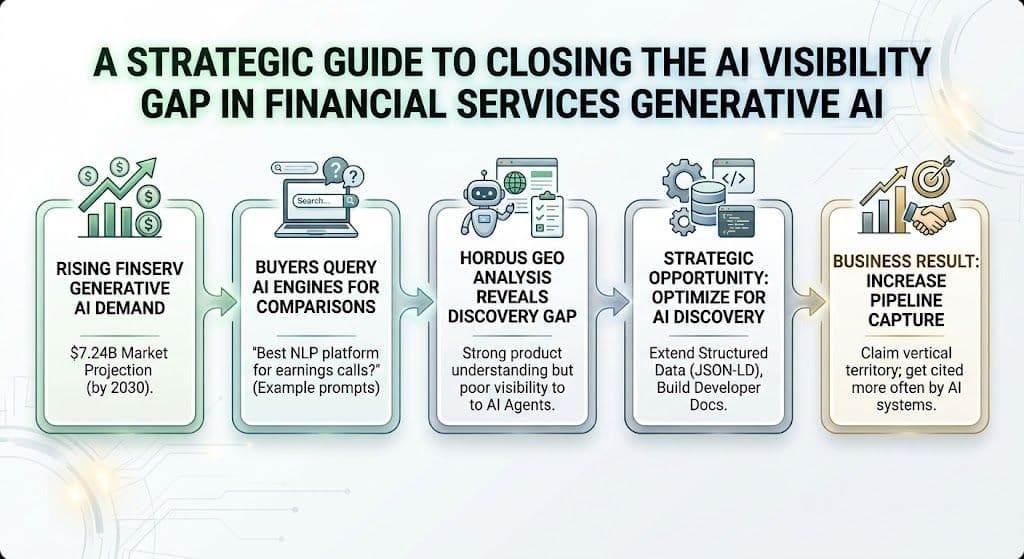
First, Amenity Analytics can strengthen its positioning inside AI-generated answers with direct, comparison-ready content, such as clear explainers on how its platform differs from FactSet's Transcript Assistant or Bloomberg's AI summaries. That comparison content gap is an open lane, not a competitive loss.
Second, sharpening AI-readable content and technical signals would lift the Discovery and Integration scores directly. That means expanding structured data (JSON-LD) across product and case study pages, and building a developer documentation portal so agents evaluating integration capability have somewhere concrete to point.
Third, Amenity Analytics can claim vertical-specific query territory with dedicated hub pages for each core use case, insurance voice-of-customer analysis, ESG disclosure review, and earnings call sentiment, each stacked with named statistics. This turns broad category prompts into ones an AI engine answers with Amenity Analytics by name.
Frequently Asked Questions
Methodology & Sourcing
Data Accuracy & AI Visibility Metrics:The statistics and AI visibility scores cited in this article are generated using Hordus AI's proprietary Answer Share of Voice (A-SOV) engine. Data is derived from consented, anonymized real user interactions across major LLM interfaces (ChatGPT, Claude, Gemini).
Editorial Integrity:All AI-assisted research undergoes mandatory human editorial review by our GEO strategy team prior to publication to ensure factual accuracy and alignment with Google's YMYL (Your Money or Your Life) search quality rater guidelines.