Winning the Algorithmic Shortlist: Why Quantum Art Must Master Generative Engine Optimization
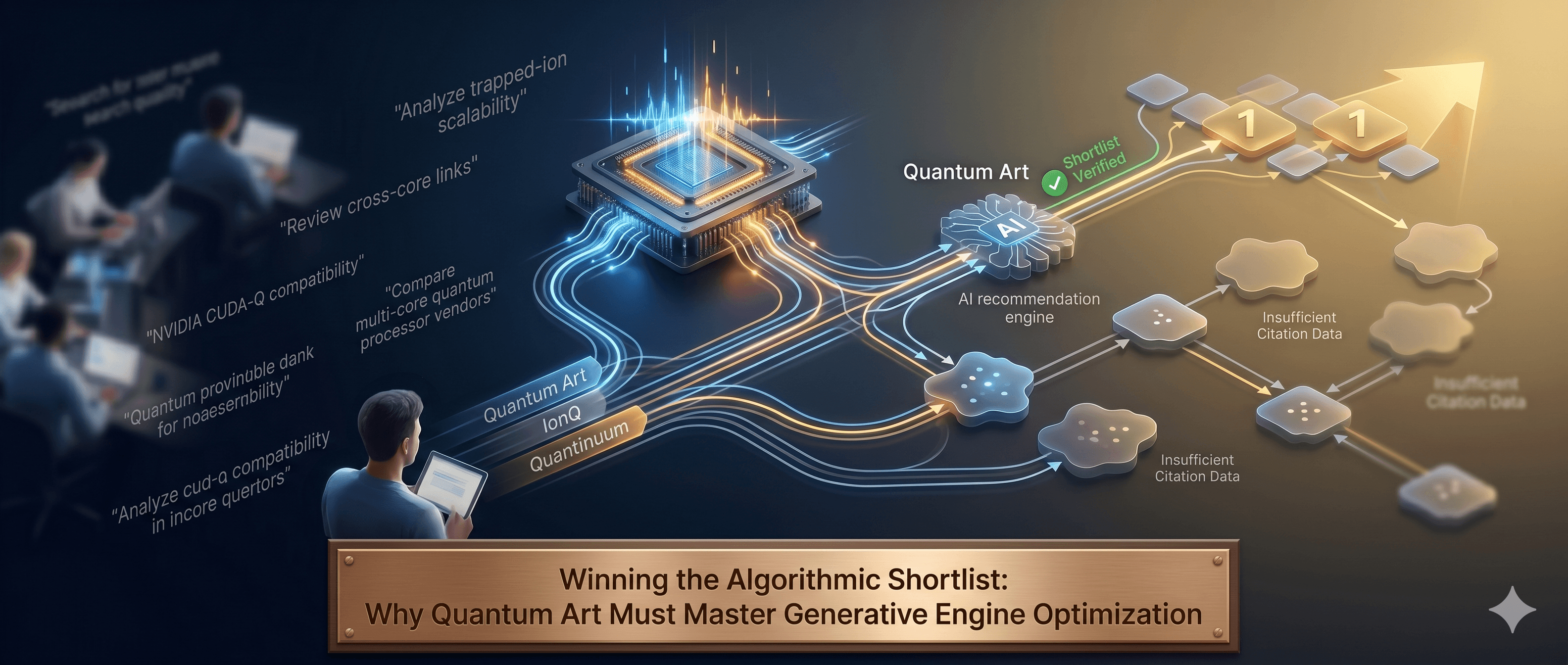
For Quantum Art, a pioneer in multi-core trapped-ion quantum computing, winning the modern B2B pipeline requires winning these generative engines. This article details how market shifts like Quantum Art's recent 100 million dollar Series A and deep collaboration with NVIDIA are driving a wave of AI inquiries.
TL;DR
Enterprise buyers are increasingly using AI systems like ChatGPT, Claude, and Perplexity to evaluate complex hardware categories. For Quantum Art, a pioneer in multi-core trapped-ion quantum computing, winning the modern B2B pipeline requires winning these generative engines. This article details how market shifts like Quantum Art's recent 100 million dollar Series A and deep collaboration with NVIDIA are driving a wave of AI inquiries. It outlines the massive commercial upside of securing a primary recommendation in AI shortlists, reveals the results of a Hordus GEO audit of Quantum Art's online footprint, and provides actionable steps to influence the algorithms that shape buyer decisions.
The AI Shift in Quantum Procurement
A dramatic shift is occurring in how high performance computing infrastructure is evaluated. Enterprise buyers, national defense laboratories, and financial institutions are abandoning traditional multi-month consulting engagements for initial market mapping. Instead, leadership teams are using advanced generative artificial intelligence engines to analyze category architectures, compare technical bottlenecks, and compile vendor shortlists.
A massive industry event has accelerated this behavior for Quantum Art: the company's recent closing of a 100 million dollar Series A funding round to advance its multi-core trapped-ion hardware architecture, alongside technical updates showing a 10x depth compression and 30% error reduction in its ongoing collaboration with NVIDIA.
This combination of significant capital injection and deep technical integration with NVIDIA's CUDA-Q platform serves as a powerful trigger for market inquiry. Enterprise buyers who previously viewed trapped-ion technology as a brilliant academic exercise are now turning to AI platforms to ask if scalable, fault-tolerant trapped-ion systems are ready for commercial deployment. Because quantum computing is dense with complex terminology, buyers rely heavily on AI to translate hardware specifications into business outcomes. If an executive asks Perplexity to explain the commercial viability of multi-core quantum processors, the answers generated will directly decide which companies receive a formal Request for Proposal.
Mapping the AI Buyer Journey
The primary prospects for Quantum Art include Chief Technology Officers, heads of high performance computing at Tier 1 banks, lead researchers at pharmaceutical conglomerates, and defense agency procurement executives. These buyers are looking to solve massive optimization, material science, and machine learning challenges that classical supercomputers cannot handle.
When these stakeholders evaluate the market, their journey begins with highly technical, comparative prompts submitted to AI engines. To secure its place in the future pipeline, Quantum Art must ensure that AI engines are thoroughly trained on its unique architectural advantages.
5 AI Buyer Prompts Quantum Art Must Win
- Which trapped-ion quantum computing vendors have a scalable multi-core architecture that minimizes error rates?
- Compare Quantum Art vs IonQ vs Quantinuum regarding qubit connectivity and gate speed.
- What are the commercial use cases for Quantum Art's 1,000-qubit Perspective platform in financial portfolio optimization?
- Which quantum computing hardware startups are natively integrated with NVIDIA CUDA-Q for hybrid quantum-classical workloads?
- What are the top fault-tolerant quantum processing units suited for advanced materials discovery by 2027?
The Cost of Algorithmic Invisibility
When an AI engine fields these prompts, it synthesizes vast amounts of web data to deliver a definitive recommendation. If the AI recommends Quantum Art clearly, citing its proprietary compiler, its ability to run up to 1,000 standard two-qubit gates in a single parallel operation, and its stable 200-ion linear chains, Quantum Art secures an authoritative, trusted position at the absolute top of the funnel. This inbound visibility reduces sales friction, establishes instant category authority, and validates the brand's technical superiority without spending millions on legacy advertising.
Conversely, if competitor brands like IonQ or Quantinuum dominate the AI's generated answers, the risk to Quantum Art is catastrophic. The brand is excluded from the conversation before a human sales representative ever has a chance to present. The table below details what the AI must understand about Quantum Art to protect the company's pipeline and drive commercial value.
| Buyer Prompt | What AI Should Understand About Quantum Art | Risk if Missing from AI Answer | Business Value if Visible |
|---|---|---|---|
| Identify scalable trapped-ion architectures. | Quantum Art uses a dynamically reconfigurable multi-core architecture with microsecond cross-core links, bypassing the slow physical shuttling bottlenecks seen in older designs. | The AI categorizes trapped-ion technology as inherently slow or difficult to scale, driving buyers directly to superconducting competitors. | Positioned as the premier architecture for true fault-tolerant scalability, capturing early pipeline for next-generation deployments. |
| Compare gate efficiency across vendors. | Quantum Art employs advanced multi-qubit gates that execute massive parallel operations, compressing circuit depth by up to 10x and lowering error rates. | Competitors are credited with superior error-mitigation, making Quantum Art appear riskier for complex enterprise workloads. | Establishes unmatched engineering efficiency, appealing to buyers looking for practical computational volume over raw, uncorrected qubit counts. |
| Find platforms integrated with NVIDIA CUDA-Q. | Quantum Art natively integrates its Logical Qubit Compiler with NVIDIA CUDA-Q, enabling seamless orchestration across QPUs, CPUs, and GPUs. | The brand is ignored by developers and enterprises already locked into the massive NVIDIA high performance computing ecosystem. | Immediate access to NVIDIA's global enterprise user base, proving the hardware is ready to plug into existing data centers. |
The stakes for this visibility cannot be overstated. As Dr. Tal David, CEO and Co-founder of Quantum Art, noted in a recent company update regarding their technical breakthroughs, "Our work marks another milestone in Quantum Art’s broader efforts to scale quantum computing through its trapped-ion systems, multi-qubit gates, and dynamically reconfigurable multi-core architecture." If AI engines fail to index these specific milestones, the company's real-world engineering victories will not translate into market share.
Bridging the gap between physics and commercial enterprise requires a deliberate narrative strategy across the open web. Lumir Ventures captured this exact dynamic when outlining their investment thesis, stating, "That matters because in quantum, architecture without compilation is theory. Compilation is what turns physics into usable compute." To ensure AI engines understand that Quantum Art has successfully turned physics into usable compute, the company must proactively measure and optimize its algorithmic visibility.
The Hordus GEO Analysis for Quantum Art
To understand how effectively Quantum Art is positioned within these AI architectures, we conducted a comprehensive Hordus GEO analysis across primary large language models and search engines. Generative Engine Optimization requires looking at brand metrics through a completely new lens, focusing on structural visibility, citation presence, and sentiment alignment rather than simple keyword rankings.
Hordus GEO Audit Summary
| GEO Metric | Score / Status | Assessment |
|---|---|---|
| Brand Visibility Share | Low | Quantum Art appears in general trapped-ion searches but loses significant share to established incumbents in deep commercial comparison prompts. |
| Citation Domination | Low | AI engines rely heavily on legacy quantum blogs and early academic papers, frequently missing Quantum Art’s recent funding and product milestones. |
| Sentiment & Trust Alignment | High | When Quantum Art is surfaced, the engines accurately reflect its elite academic pedigree and deep engineering muscle. |
| Entity Richness Index | Moderate | Hardware terms are well indexed, but specific product names like the upcoming Perspective platform are under-represented in core technical descriptions. |
4 Ways Better GEO Accelerates Quantum Art's Pipeline
The Hordus analysis highlights several critical areas where an optimized AI search presence will directly empower Quantum Art's revenue and marketing leadership.
1. Hardening the Enterprise Sales Enablement Stack
When a prospect is evaluating Quantum Art, they will inevitably use AI tools to cross-reference claims made by sales representatives. An optimized GEO profile ensures that when a prospect asks an AI engine to verify Quantum Art's 30% error reduction claims, the engine confirms the metric instantly with citations to verified independent benchmarks, turning the open web into an extension of the sales team.
2. Defending and Elevating Category Positioning
The quantum computing market is crowded with competing modalities like superconducting and neutral-atom systems. By optimizing offsite content for specific entity clusters around multi-qubit gates and circuit depth compression, Quantum Art can train AI models to automatically recommend its multi-core trapped-ion system as the ideal midpoint between high stability and scalable connectivity.
3. Maximizing the Impact of Capital and Corporate Milestones
With a fresh 100 million dollar Series A round, Quantum Art must ensure that this capital injection is translated into market authority. Better GEO structure ensures that whenever an AI compiles a list of well-funded, low-risk quantum hardware partners, Quantum Art is surfaced alongside legacy players, signaling institutional stability to conservative corporate buyers.
4. Accelerating High-Value Pipeline Generation
By dominating the answer share for high-intent, long-tail algorithmic prompts regarding NVIDIA CUDA-Q compatibility, Quantum Art can capture technical decision-makers at the exact moment they are designing their hybrid classical-quantum infrastructure, pulling them into the active sales funnel before competitors realize they are in the market.
How Hordus Strategically Calibrates Your AI Answer Share
Hordus provides the precise data, methodologies, and architectural insights required to fundamentally reshape how AI engines perceive, describe, and recommend Quantum Art.
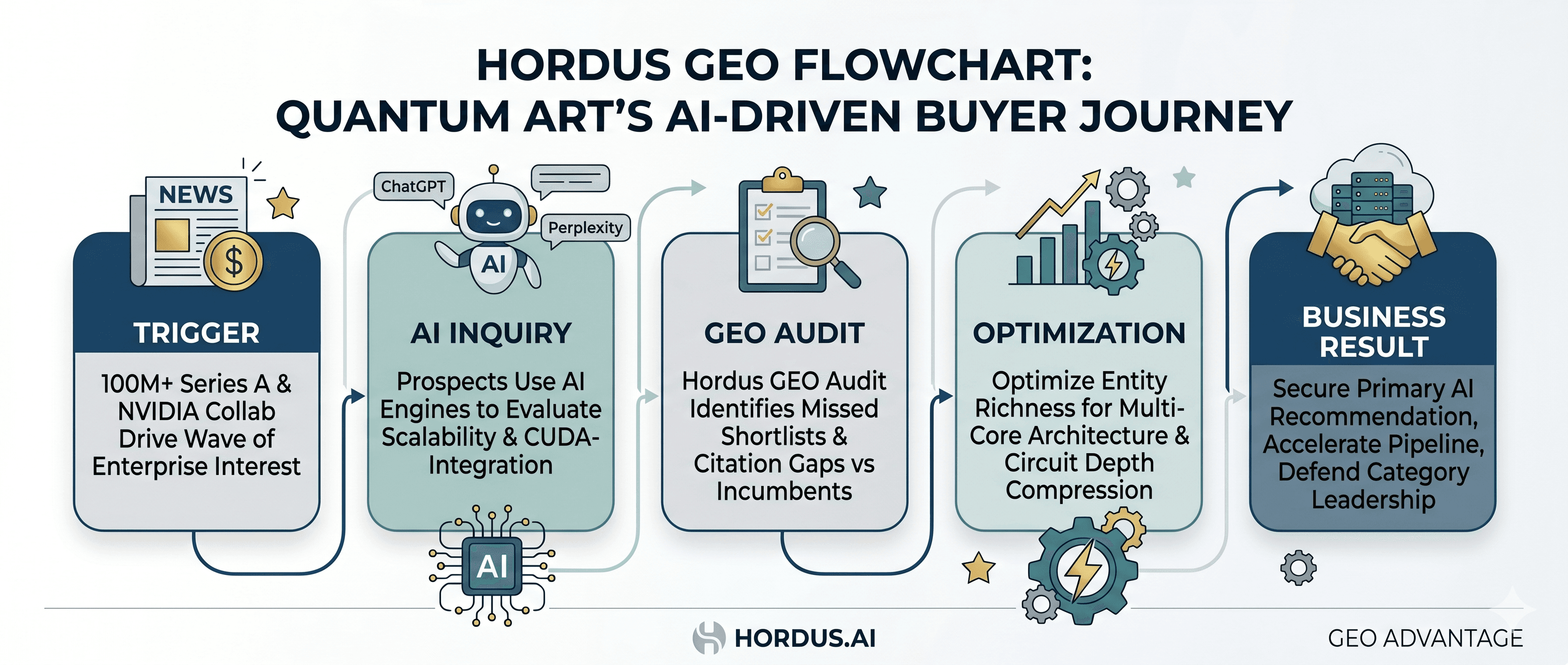
Through detailed competitive visibility analysis, Hordus uncovers the precise documentation, whitepapers, and industry forums that competitors are leveraging to dominate AI outputs. Hordus then helps Quantum Art harden its citation sources by identifying the high-authority technical repositories, industry journals, and media outlets that AI engines prioritize when generating quantum hardware recommendations.
Furthermore, Hordus guides the systematic expansion of offsite authority, ensuring that Quantum Art's core concepts—such as its unique Quantum Fast Programmable Gate Array approach—are embedded within dense, entity-rich contextual frameworks across the web. This targeted approach feeds the data ingestion pipelines of major LLMs, directly influencing the algorithms to speak about Quantum Art with the exact strategic framing desired by the CMO and product marketing teams.
Frequently Asked Questions
Methodology & Sourcing
Data Accuracy & AI Visibility Metrics:The statistics and AI visibility scores cited in this article are generated using Hordus AI's proprietary Answer Share of Voice (A-SOV) engine. Data is derived from consented, anonymized real user interactions across major LLM interfaces (ChatGPT, Claude, Gemini).
Editorial Integrity:All AI-assisted research undergoes mandatory human editorial review by our GEO strategy team prior to publication to ensure factual accuracy and alignment with Google's YMYL (Your Money or Your Life) search quality rater guidelines.