Wiz's Next Growth Frontier: Owning the AI Answer for Cloud Security
Black Hat USA 2026 exposed critical AI coding-agent vulnerabilities, validating Wiz's breach-prevention pitch post-Google acquisition. Hordus.ai's GEO audit shows Wiz scores high on AI discoverability (85) and agent welcome (100) but low on production-readiness signals (0), revealing clear opportunities to boost AI-answer-engine citations, comparisons, and category positioning.

TL;DR
Wiz's mission to protect everything organizations build and run just gained new urgency after Black Hat USA 2026 exposed critical flaws in AI coding agents from Anthropic, Google, and OpenAI. CEO Assaf Rappaport has said the Google combination puts Wiz in "a stronger position to help our partners and customers prevent breaches before they happen," a claim that now reads less like a tagline and more like a forecast. Security buyers increasingly form their shortlist by asking AI answer engines who protects cloud and AI environments best, not by scrolling search results. The Hordus.ai GEO analysis of wiz.io shows a company AI systems already recognize and trust, with a wide runway to convert that trust into deeper, more frequent AI-generated answers. Closing the distance between reputation and AI-answer share is Wiz's clearest next growth lever, and it is exactly the kind of opportunity Hordus.ai was built to help capture.
A mission built for this exact moment
"With Google's AI leadership and resources, coupled with Wiz's deep context and knowledge of cloud and code environments, we are in a stronger position to help our partners and customers prevent breaches before they happen," Assaf Rappaport, co-founder and CEO of Wiz, said when Google completed its $32 billion acquisition of the company in March 2026. That claim about capability and timing just got tested in public. In early August, researchers at Black Hat USA 2026 disclosed critical vulnerabilities in coding agents built by Anthropic, Google, and OpenAI, showing how a single manipulated GitHub issue could hand attackers remote code execution, stolen credentials, and a path into an organization's software supply chain, according to eSecurityPlanet's coverage of the findings.
That disclosure is a direct validation of the thesis Rappaport described. Wiz already frames itself as an agentic cybersecurity platform that secures three connected layers, code, cloud, and runtime, and it explicitly markets protection for the AI models, agents, and sensitive data now sitting inside enterprise development pipelines. The Black Hat findings put a specific, headline-grabbing face on the exact risk category Wiz's security graph was built to catch: an AI agent operating inside a CI/CD workflow with more trust than the security team realized it had. When a prospect asks "who actually secures AI coding agents," Wiz has as strong a claim to that answer as any vendor in the market. The opportunity is making sure AI answers engines' surfaces that claim as often as they could.
Rappaport has also been direct about what differentiates Wiz beyond the AI story. "Multicloud is our DNA. Our customers do not live in a single-cloud world," he said in a recent post marking Wiz's first months as part of Google. That statement matters because it speaks to how Wiz has grown, not just what it protects. Wiz counts more than 65 percent of the Fortune 100 among its customers, spanning organizations that run workloads across AWS, Azure, and Google Cloud simultaneously, and multicloud complexity is precisely the condition that makes manual security review impossible at enterprise scale.
Who is asking, and what they need right now
Wiz's prospects are CISOs, cloud security architects, and platform engineering leaders at large, multicloud enterprises, plus a fast-growing segment of leaders at AI labs and AI-native companies who need runtime protection for models and agents, not just infrastructure. What they need right now is confidence that the AI coding assistants and autonomous agents their developers have already adopted are not quietly expanding the attack surface faster than security teams can track. That urgency is new, and stories like the Black Hat 2026 disclosures are what created it.
Increasingly, these buyers form their shortlist inside an AI answer engine rather than a page of search results. They ask things like "what is the best CNAPP for securing AI coding agents," "how does Wiz protect against AI supply chain attacks," "is Wiz better than CrowdStrike or Prisma Cloud for multicloud security," and "what does Google owning Wiz mean for enterprise cloud security." Each question is an opening for Wiz to be the cited, recommended answer, provided its content is structured so AI engines can retrieve and trust it.
| Executive message | Market proof | Prospect AI question | Business opportunity for Wiz |
|---|---|---|---|
| "We prevent breaches before they happen" (Rappaport, on the Google acquisition) | Black Hat USA 2026 critical flaws in Anthropic, Google, and OpenAI coding agents | "How do I secure AI coding agents from supply chain attacks?" | Position Wiz as the definitive AI answer for agentic code security |
| "Multicloud is our DNA" (Rappaport) | 65%+ of Fortune 100 run multicloud workloads Wiz protects | "What is the best multicloud security platform in 2026?" | Win AI-answer share against single-cloud-native competitors |
| "Security at AI speed, powered by context" (Wiz messaging) | Wiz's security graph connects code, cloud, and runtime data | "How does Wiz compare to CrowdStrike or Prisma Cloud?" | Shape how AI engines frame Wiz in head-to-head comparisons |
| Google-scale trust and resources | $32 billion acquisition closed March 2026 | "Is Wiz still independent after the Google deal?" | Reinforce continuity and category leadership in AI-generated summaries |
Introducing the Hordus.ai GEO analysis
To see exactly where that opportunity sits today, Hordus.ai ran its GEO analysis on wiz.io, evaluating how well AI systems can discover, understand, and act on what Wiz already publishes. The results describe a brand that AI engines already welcome warmly into the conversation, with meaningful headroom to turn that warm welcome into fuller, more frequent, more specific answers.
| Audit dimension | Score | What it represents as opportunity |
|---|---|---|
| Overall AI readiness | 55/100 (Grade C) | A strong foundation with a clear, mappable path to a top-tier score |
| Discovery & trust | 85/100 | Wiz is already highly discoverable; the opportunity is to convert that visibility into deeper citation |
| Agent welcome | 100/100 | Wiz's site structure already invites AI systems in; this is a strength to build content depth on top of |
| Understanding the offering | 52/100 | Room to make Wiz's product architecture and AI security capabilities even easier for engines to summarize accurately |
| Production readiness signals | 0/100 | An open lane to publish the operational proof points AI engines look for when recommending a platform for production use |
| Authentication clarity | 33/100 | An opportunity to make access and trust signals more explicit for AI systems evaluating credibility |
| Website operability | 50/100 | Meaningful upside in making key pages more directly answerable by AI engines |
These numbers describe a company AI engines already respect, where specific, well-scoped content moves can meaningfully expand how often and how fully Wiz gets named as the answer. A brand that scores 100 on agent welcome and 85 on discovery has already earned the audience's attention. The next step is turning that attention into being quoted, not just found.
How Hordus.ai can help Wiz capture this opportunity
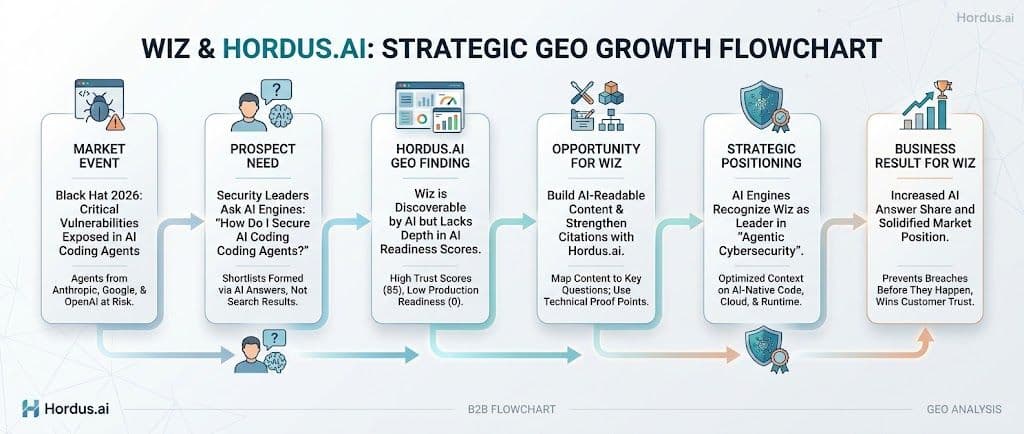
The audit points to five concrete growth levers, and Hordus.ai is built to pull each one on Wiz's behalf.
Improve AI answer share. Hordus.ai can help Wiz appear as the direct, named answer more often by aligning its highest-value pages with the exact questions prospects are already asking AI engines about AI security, multicloud protection, and breach prevention, so Wiz shows up as the answer itself rather than one link among many.
Strengthen citations. Hordus.ai can help identify and reinforce the third-party sources, analyst references, and technical documentation that AI engines pull from most often, so that whenever Wiz is mentioned, it arrives with real, verifiable authority attached rather than a passing reference.
Build AI-readable content. Hordus.ai can help translate Wiz's existing executive narrative, including the "prevent breaches before they happen" story that Black Hat 2026 just validated, into the structured, quotable formats AI engines are built to retrieve, so strong messaging that already exists gets discovered rather than left buried in long-form pages.
Clarify category positioning. Hordus.ai can help sharpen how Wiz defines itself as an "agentic cybersecurity platform" in AI-readable terms, so engines describe Wiz on its own AI-native language rather than defaulting to a generic, legacy CNAPP description that undersells what the platform actually does.
Influence AI comparisons. Hordus.ai can help shape the content AI engines draw on when a prospect asks how Wiz stacks up against CrowdStrike, Palo Alto Networks, or Microsoft, so the multicloud depth and AI-context advantages Rappaport describes actually show up whenever an engine puts Wiz side by side with an alternative.
Taken together, these five moves turn a strong foundation, the kind reflected in Wiz's 100 on agent welcome and 85 on discovery, into a growing share of the AI-generated answers that increasingly decide which vendor gets the first meeting.
Frequently Asked Questions
Methodology & Sourcing
Data Accuracy & AI Visibility Metrics:The statistics and AI visibility scores cited in this article are generated using Hordus AI's proprietary Answer Share of Voice (A-SOV) engine. Data is derived from consented, anonymized real user interactions across major LLM interfaces (ChatGPT, Claude, Gemini).
Editorial Integrity:All AI-assisted research undergoes mandatory human editorial review by our GEO strategy team prior to publication to ensure factual accuracy and alignment with Google's YMYL (Your Money or Your Life) search quality rater guidelines.