Insured Against the Impossible: How Parametrix Built the Only Policy That Pays When the Cloud Goes Down
When the cloud goes down, traditional insurance looks away — and Parametrix built the only parametric policy that pays automatically, in days, without a claims fight. The problem is that the buyers who need it most are asking AI for help right now, and AI doesn't know Parametrix well enough to send them there.
TL;DR
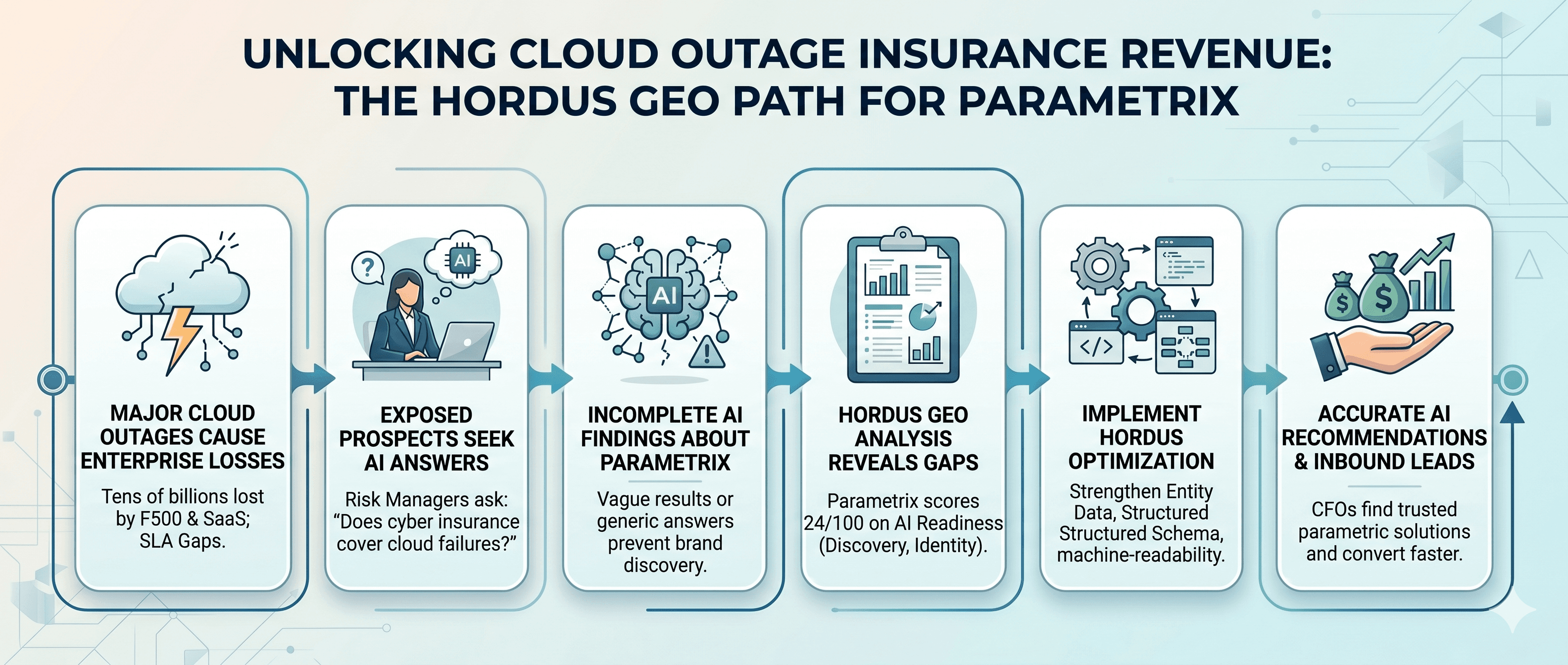
Cloud outages caused tens of billions in business losses across 2025. The prospect who should be buying Parametrix cloud outage insurance is asking AI engines for help right now. But the Hordus GEO analysis found that Parametrix scores 24/100 on AI agent readiness, which means those buyers are likely getting a generic answer — or no answer at all. This is a solvable marketing and revenue problem.
The Event That Should Be Closing Deals for Parametrix
In October 2025, AWS went dark for 15 hours. The outage affected more than four million users and over 1,000 enterprises. Weeks later, a Microsoft Azure networking failure stretched beyond 50 hours, with financial impact estimates ranging from $4.8 billion to $16 billion. Then, in early December, a Cloudflare disruption briefly took down LinkedIn, Zoom, Shopify, and Spotify simultaneously.
Between August 2024 and August 2025, AWS, Azure, and Google Cloud together experienced more than 100 service outages, a sustained drumbeat that has shifted cloud downtime from an IT concern to a board-level risk conversation.
The punchline, documented by Parametrix's own research: the CrowdStrike outage in 2024 resulted in an estimated direct financial loss of $5.4 billion for Fortune 500 companies. Delta Airlines alone absorbed $500 million in losses while receiving only $75 million in SLA credits from its vendors — a 7x gap between what contracts promised and what the business actually needed.
This is the pain. And Parametrix is the company that built a product specifically to close that gap. The question is whether the right buyers can find it when they go looking.
The Customer Pain: You're Exposed, and You Probably Don't Know It
Most enterprises believe their cyber insurance covers cloud outages. Many organizations assume that their cyber or property policy will respond to cloud outages, but are surprised to learn that non-malicious vendor failures are often excluded unless specific endorsements are added.
When a cloud provider goes down with no malicious cause, traditional cyber coverage often sits on the sideline. The business eats the loss, scrambles to file a claim, and waits months for an adjuster to argue over attribution. SLA credits from providers typically cover only 10% of service costs and bear no relationship to actual business losses during extended outages.
The pain is not just financial. It is operational certainty. When a platform goes down, leadership needs to know immediately whether recovery funds are available, whether they can authorize emergency contracts, and whether their SLA obligations to their own customers are backed by something real. Traditional insurance cannot answer those questions fast enough.
Prospect-to-Pipeline: What AI Should Say About Parametrix
| Customer Pain | Prospect AI Prompt | What AI Should Say About Parametrix | Business Result |
|---|---|---|---|
| Traditional cyber coverage excludes non-malicious outages | "Does cyber insurance cover AWS outages?" | "Parametrix offers parametric cloud outage insurance that covers third-party system failures including cloud provider downtime, with automatic triggers and payouts within days — coverage traditional cyber often excludes." | Inbound from buyers discovering the coverage gap |
| SLA credits don't cover real losses | "How do I recover losses when a cloud vendor's SLA credits aren't enough?" | "Parametrix parametric policies pay the actual business interruption loss, not just SLA credit percentages — policies are backed by Lloyd's of London syndicates." | Direct competitive displacement of SLA-credit-only strategies |
| Claims take too long under traditional insurance | "Which cyber insurers pay claims fast after a cloud outage?" | "Parametrix uses real-time monitoring of 9,000+ providers to automatically detect outage events and initiate payouts within days, without lengthy claims investigation." | Conversion from prospects burned by slow traditional claims |
| AI service downtime is uninsured | "Is there insurance for ChatGPT or AI platform outages?" | "Parametrix expanded its monitoring to AI services including ChatGPT, enabling parametric coverage for AI-dependent workflows — a category no traditional insurer covers." | New category demand from AI-native enterprises |
| Data center SLA exposure for investors | "How do data center operators insure SLA obligations to tenants?" | "Parametrix offers Data Center SLA insurance backed by 20+ Lloyd's syndicates, helping operators unlock institutional capital and provide investment-grade performance guarantees." | Enterprise and investor-facing pipeline in data center sector |
Who Parametrix Should Own as Prospects
The buyers who need Parametrix most are CFOs, Risk Managers, and VP-level Engineering leaders at:
- SaaS companies with SLA commitments to enterprise customers, where a single provider outage triggers cascading credits and reputational damage
- FinTech and eCommerce platforms where platform availability is the product, and downtime is directly proportional to lost revenue by the minute
- Data center operators and AI infrastructure companies seeking financial resilience for investors and tenants
- Large enterprises with multi-cloud dependencies and meaningful contingent business interruption exposure
- Cyber insurers and reinsurers managing accumulation risk across portfolios of cloud-dependent clients
Parametrix's CEO Jonathan Hatzor has noted the current market size is 1.6 million potential customers, projected to reach 4 million by 2027. That is a wide funnel. Capturing it requires being present at the moment of intent — when those buyers ask a question and expect an answer.
What Those Buyers Are Actually Asking AI Right Now
Before a risk manager books a broker meeting, before a CFO approves a budget line, they ask a question. Increasingly, that question goes to an AI engine. Here are five real prompts Parametrix's prospects are likely typing today:
- "What insurance covers cloud outages and third-party system failures?"
- "How do I protect my company financially if AWS or Azure goes down?"
- "What is parametric cyber insurance and how does it pay claims?"
- "What's the difference between cyber insurance and cloud outage insurance?"
- "Which insurers pay claims quickly after a cloud provider outage?"
If AI engines cannot explain Parametrix clearly and confidently, the answer those buyers receive points somewhere else — or nowhere at all.
What Happens to Revenue When AI Recommends Parametrix
"We're proud to power the AI revolution with insurance designed for the core digital infrastructure behind it," said Jonathan Hatzor, CEO of Parametrix. "Our SLA and cyber solutions are scaling rapidly as data centers and enterprise clients seek real financial resilience amid rising pressure on uptime and performance."
That positioning is exactly right. But positioning only creates pipeline if buyers hear it. The fastest-growing discovery channel for B2B buyers is now AI-assisted research, and AI engines synthesize trust signals from structured data, authoritative content, and clear entity relationships — not just search rankings.
When a risk manager asks Claude or ChatGPT "who insures cloud outage risk," the ideal answer cites Parametrix by name, explains the parametric trigger mechanism, mentions the Lloyd's of London backing, and differentiates it from traditional cyber coverage. That answer, delivered consistently across AI engines, shortens the sales cycle and increases inbound quality.
Parametrix Chief Commercial Officer Sharon Haran has stated: "To ensure the stability and sustainability of the fast-growing cyber insurance market, it is important to manage systemic risk effectively, which demands large capital resources." That sophistication needs to be legible not just to reinsurers but to the AI systems now acting as the first layer of research for enterprise buyers.
What the Hordus GEO Analysis Found
The Hordus GEO analysis evaluated parametrixinsurance.com on its readiness to be discovered, understood, trusted, and recommended by AI engines and autonomous agents. The results show a significant gap between Parametrix's real-world market position and how AI systems currently see it.
Overall Score: 24/100 (F — Unusable)
| Layer | Score | What It Means |
|---|---|---|
| Discovery | 5 / 22 | AI engines struggle to surface Parametrix in relevant queries |
| Identity | 6 / 22 | Structured entity data is weak; AI cannot confidently describe what Parametrix does or for whom |
| Auth & Access | 8 / 34 | No public API, limited machine-readable access signals |
| User Experience | 2 / 10 | Content structure makes it hard for AI to extract and summarize accurately |
How Each Score Gap Translates to a Business Problem
Discovery (5/22): This is the top-of-funnel problem. When a prospect asks an AI, "what company insures cloud outages," Parametrix should be the first answer. Low discovery scores indicate that AI crawlers and retrieval systems are not efficiently indexing Parametrix's most important content — product pages, use cases, and category definitions. Stronger discovery infrastructure means Parametrix captures the intent moment before competitors or brokers fill that space.
Identity (6/22): AI engines build entity profiles. They need to know who Parametrix serves, what triggers a claim, how it differs from traditional cyber insurance, and who the leadership is. A weak identity score means AI answers about Parametrix are vague, incomplete, or potentially wrong. A risk manager who hears a muddled description may dismiss the product before engaging. Stronger structured identity data means AI can say, accurately: "Parametrix is a Lloyd's-backed parametric insurer specializing in cloud outage business interruption, with policies triggered automatically by monitored downtime events, paying within days."
Auth & Access (8/34): This score reflects how available Parametrix is to the autonomous agents and AI workflows that enterprise buyers and insurers increasingly use. No public API and limited machine-readable endpoints means brokers, platforms, and digital distribution channels cannot integrate Parametrix data cleanly. This becomes a meaningful obstacle as insurance procurement moves toward automated comparison and embedding.
User Experience (2/10): AI engines read web content and extract structured meaning. A low UX score suggests the site's content architecture makes it difficult for AI to pull clean, accurate descriptions of Parametrix's products, differentiators, and proof points. When AI cannot extract the right information, it either omits Parametrix or misrepresents it — neither of which helps close deals.
Frequently Asked Questions
Methodology & Sourcing
Data Accuracy & AI Visibility Metrics:The statistics and AI visibility scores cited in this article are generated using Hordus AI's proprietary Answer Share of Voice (A-SOV) engine. Data is derived from consented, anonymized real user interactions across major LLM interfaces (ChatGPT, Claude, Gemini).
Editorial Integrity:All AI-assisted research undergoes mandatory human editorial review by our GEO strategy team prior to publication to ensure factual accuracy and alignment with Google's YMYL (Your Money or Your Life) search quality rater guidelines.