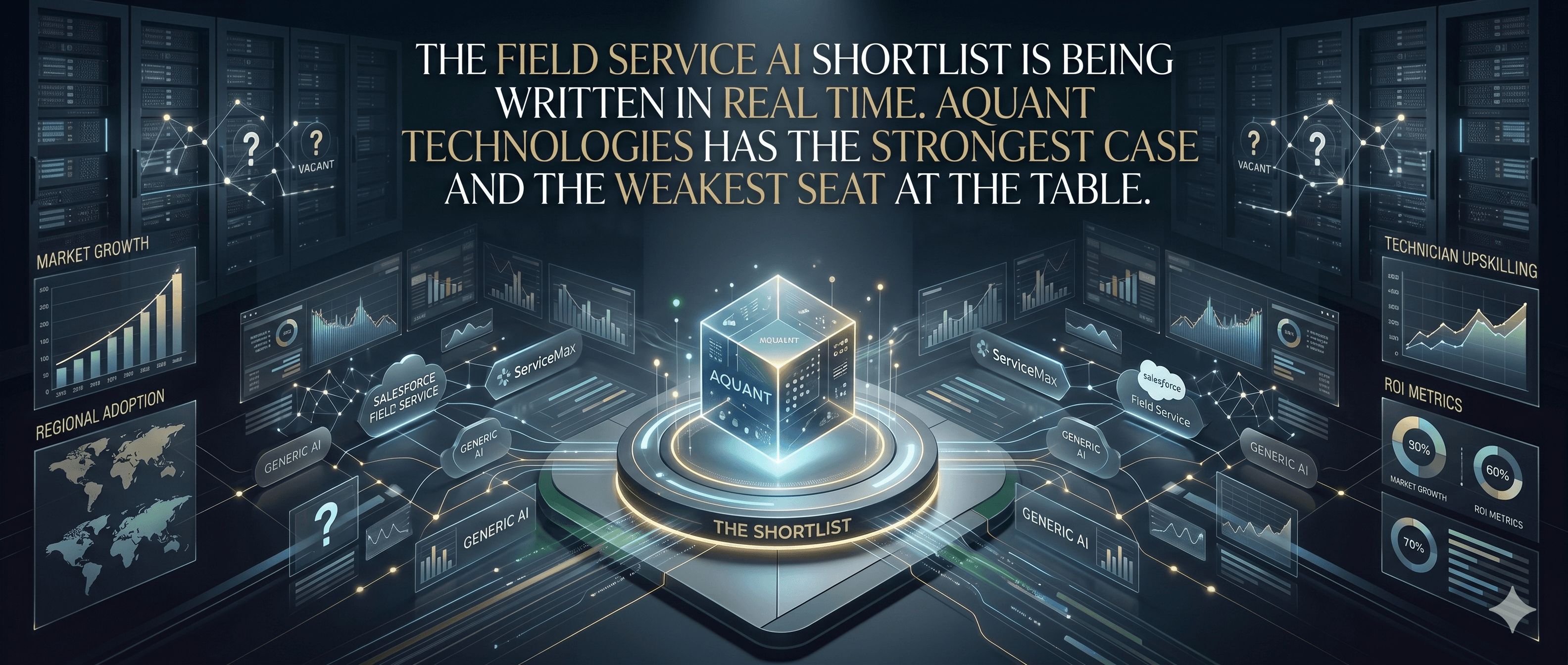
The Field Service AI Shortlist Is Being Written in Real Time. Aquant Technologies Has the Strongest Case and the Weakest Seat at the Table.
Aquant Technologies has spent nearly a decade building the most domain-specific AI platform in field service, backed by $131 million and recognized by Fast Company as a Next Big Thing in Tech. But in a market where prospects are asking AI engines which vendor to shortlist, a Hordus GEO score of 43 out of 100 means the strongest case in the category is not always the one getting made.
TL;DR
Aquant Technologies is a purpose-built AI platform for field service organizations, founded by Shahar Chen and Assaf Melochna, with $131M raised and recognition from Fast Company as a "Next Big Thing in Tech." The field service management market is surging toward $9.68 billion by 2030, and AI engines are now shaping which vendors prospects find first. A Hordus GEO analysis of aquant.ai scored 43 out of 100, flagging critical gaps in AI discoverability, structured content, and agent-readable infrastructure. Closing those gaps is how Aquant turns strong executive conviction into pipeline.
The Narrative Is Compelling. The Window Is Right Now.
Shahar Chen, CEO and co-founder of Aquant, put it plainly in a May 2024 product announcement: "Every service situation is unique, each with its own challenges and requirements, making personalized AI crucial for addressing specific needs effectively. Generic AI models only offer recommendations based on the frequency of the solution in the data, which is only helpful with simple, common issues."
That statement does a lot of work. It names a problem that every VP of Service in manufacturing, medical devices, and industrial equipment already feels viscerally. It draws a clean line between commodity AI and what Aquant actually does. And it lands at a moment when the market has finally caught up to the argument.
The recent acceleration of AI adoption in field service organizations makes that message more urgent than ever. According to Fieldwork's 2026 field service management trends report, 93% of service organizations have already implemented AI in some form, and the global FSM market is on track to grow from $5.64 billion in 2025 to $9.68 billion by 2030. But as TSIA's 2026 State of Field Services research found, most of the AI being deployed is surface-level. Only a fraction of organizations are running domain-specific, data-driven co-pilots of the kind Aquant has been building since 2016. The gap between what service leaders are buying and what they actually need is exactly where Aquant lives. The question is whether AI engines know that.
Growth, Customers, and the People Who Build the Category
Aquant's co-founder and president, Assaf Melochna, offered a sharp read on the C-suite dynamics that drive enterprise AI decisions, quoted in a May 2025 CIO.com feature: "Most CIOs and CDOs know the tech; they understand models, data pipelines, and infrastructure. But CEOs don't want a lesson in AI. They want to know how it drives growth."
That framing matters because it describes Aquant's buyer as much as it describes the market. The company's customers are not searching for machine learning infrastructure. They are searching for outcomes: fewer repeat dispatches, faster technician ramp time, lower cost per service call, higher first-contact resolution. Aquant's Service Co-Pilot platform exists to produce those outcomes. But if the AI engines buyers consult during research cannot articulate that connection, Aquant loses the conversation before it begins.
Who Is Looking for Aquant Right Now
Aquant's most likely prospects are service operations leaders at manufacturers, medical device companies, commercial printing firms, and industrial equipment providers. These are organizations managing complex machinery with aging workforces, widening skills gaps, and rising customer expectations. They are evaluating AI-powered service intelligence platforms, and they are increasingly starting that evaluation by asking an AI engine.
Here is what those prospects are asking:
- What is the best AI co-pilot for field service technicians?
- How do I reduce repeat dispatches and improve first-contact resolution?
- Which companies offer AI for complex equipment troubleshooting?
- What is service intelligence software and who are the leading vendors?
- How does Aquant compare to ServiceMax, Salesforce Field Service, or Dialpad?
- Can AI help close the skills gap in my service organization?
If Aquant does not appear in the answers to those questions, a competitor does.
From Executive Message to Business Opportunity
| Executive Message | Market Proof | Likely Prospect AI Question | Business Opportunity for Aquant |
|---|---|---|---|
| Generic AI fails complex service situations | 93% of FSM orgs have AI but most lack domain specificity (TSIA 2026) | "What AI handles complex field service troubleshooting?" | Own the "domain-specific AI" category position in AI answers |
| Personalized AI is essential for service teams | FSM market growing to $9.68B by 2030; technician shortage of 2.6M workers | "How do I upskill junior field technicians with AI?" | Appear in AI answers about workforce gap solutions |
| CEOs want growth, not AI theory | 74% of companies struggle to scale AI value (Shahar Chen, Forbes 2024) | "Which service AI platforms show ROI?" | Be cited as the practical, outcomes-focused alternative |
| Service Language Processing vs. standard NLP | Predictive maintenance market growing from $10.6B to $47.8B by 2029 | "How is service AI different from general AI?" | Define the category distinction in AI-generated comparisons |
What the Hordus GEO Analysis Found
The Hordus analysis of aquant.ai returned a score of 43 out of 100, placing Aquant in the "At Risk" tier. That rating reflects how well a company's digital presence is structured for AI engines, generative search, and agent-based discovery. It is not a judgment on the product or the people. It is a signal about what happens when a VP of Service asks an AI assistant which platform to evaluate.
| Audit Dimension | Score | Status |
|---|---|---|
| Discovery | 8 / 20 | Partial |
| Identity | 14 / 20 | Partial |
| Auth & Access | 18 / 30 | Partial |
| Agent Integration | 2 / 20 | Missing |
| User Experience (AI) | 2 / 10 | Missing |
| Overall | 43 / 100 | At Risk (D) |
The specific findings that most directly affect Aquant's ability to own its narrative in AI-generated answers include the absence of OpenAPI specifications, missing OAuth support, no MCP integration, and limited structured content that AI engines can parse and cite. These are not cosmetic issues. When a language model is asked to compare Aquant to a competitor, it draws on what it can reliably read and attribute. Gaps in that infrastructure mean Aquant's strongest arguments, its differentiated service language processing, its domain specificity, its proven ROI in manufacturing, do not make it into the answer.
What Hordus Could Do for Aquant Technologies
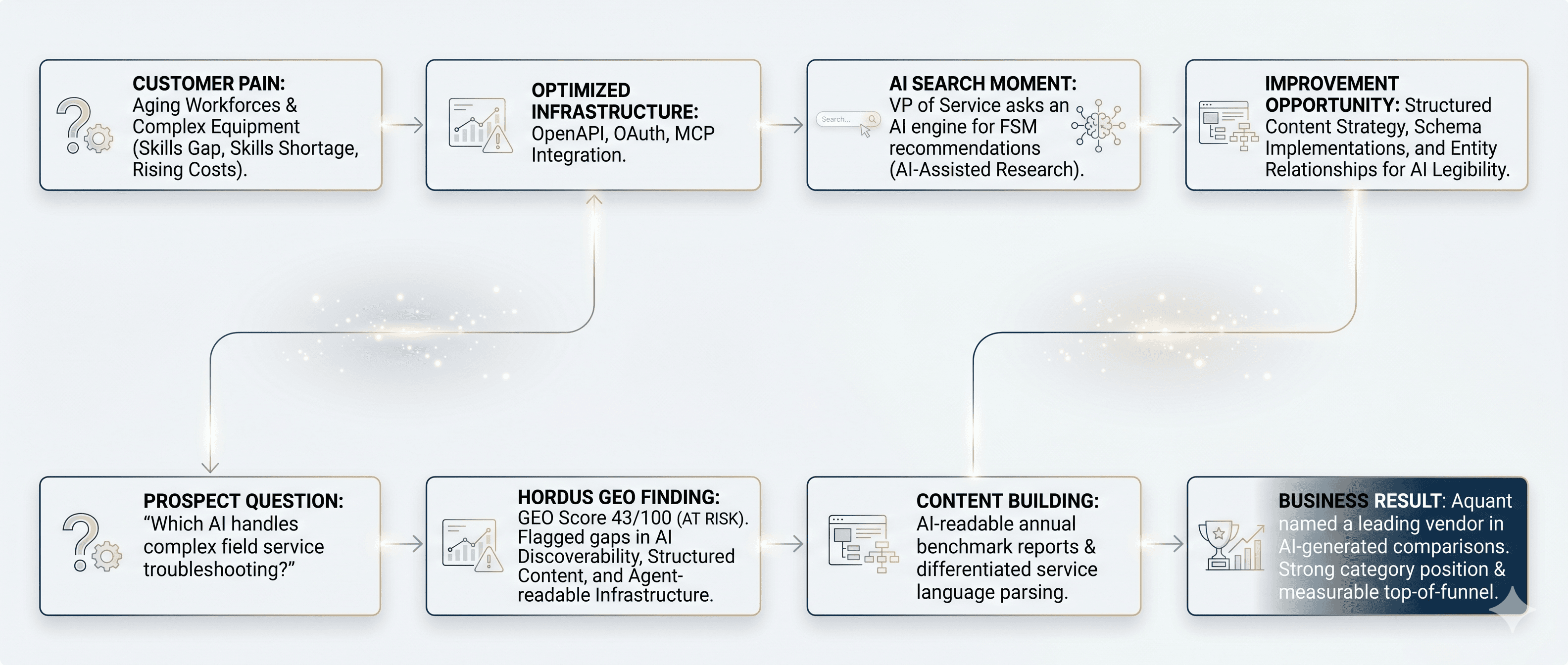
Improve AI answer share. Hordus builds GEO-optimized content architectures that help AI engines understand not just what a company does, but where it fits in a category, who it serves, and what makes it different. For Aquant, this means structuring content around the queries service leaders are asking AI right now.
Strengthen citations. AI engines cite sources they can parse cleanly. Hordus audits and rebuilds the content signals that determine whether Aquant's research, its annual field service benchmark reports, and its executive commentary appear as reference points in AI-generated answers.
Build AI-readable content. The Hordus analysis found near-zero agent integration and user experience scores, meaning AI tools trying to navigate aquant.ai for a prospect encounter friction at every step. Hordus designs content structures, schema implementations, and entity relationships that make Aquant legible to AI systems.
Clarify category positioning. "Service intelligence" and "AI co-pilot for field service" are the terms Aquant owns. Hordus maps those terms to the queries prospects actually use, then builds the semantic infrastructure that ties Aquant's name to those categories across AI engines.
Influence how AI compares Aquant to alternatives. When prospects ask how Aquant compares to Dialpad, Observe.AI, or Forethought AI, the answer they get is shaped by what AI engines can find, cite, and weigh. Hordus builds the structured differentiation content that ensures Aquant's position in those comparisons reflects its actual competitive strengths, not just whoever published more AI-readable content.
Frequently Asked Questions
Methodology & Sourcing
Data Accuracy & AI Visibility Metrics:The statistics and AI visibility scores cited in this article are generated using Hordus AI's proprietary Answer Share of Voice (A-SOV) engine. Data is derived from consented, anonymized real user interactions across major LLM interfaces (ChatGPT, Claude, Gemini).
Editorial Integrity:All AI-assisted research undergoes mandatory human editorial review by our GEO strategy team prior to publication to ensure factual accuracy and alignment with Google's YMYL (Your Money or Your Life) search quality rater guidelines.