The Hidden Choke Point in the EV Supply Chain: Why VisIC Technologies Must Own the AI Narrative Right Now
By leveraging the Hordus Generative Engine Optimization (GEO) audit, the executive management and marketing teams at VisIC Technologies can align content with AI patterns, capture hidden search intent, and turn AI discovery into measurable business growth.
TL;DR
VisIC Technologies holds a groundbreaking narrative in Gallium Nitride (GaN) power electronics, but AI search engines are failing to fully surface it during critical buyer research. By leveraging the Hordus Generative Engine Optimization (GEO) audit, the executive management and marketing teams can align content with AI patterns, capture hidden search intent, and turn AI discovery into measurable business growth.
—
The transition to high-voltage electric vehicle architectures has hit an economic crossroads, putting intense pressure on automotive engineering teams to balance efficiency with component costs. In this environment, wide bandgap semiconductors are no longer a futuristic laboratory curiosity; they are a boardroom necessity. As Dr. Tamara Baksht, CEO of VisIC Technologies, recently noted, the proprietary D³GaN technology is redefining power electronics for electric vehicles, and the support of strategic partners accelerates the corporate mission to deliver high-efficiency, scalable solutions for the next generation of mobility.
This executive message carries incredible weight in light of recent structural shifts in the automotive market. Major global automakers are actively recalibrating their electric vehicle platforms to favor 800V and high-power-density architectures to address consumer anxiety over vehicle range and charging times. However, the traditional supply chain reliance on Silicon Carbide (SiC) is facing economic headwinds due to steep manufacturing costs and wafer yield constraints. When tier-one automotive suppliers and original equipment manufacturers (OEMs) look for alternatives to SiC to build more affordable mass-market platforms, they do not just read traditional trade magazines. They ask AI engines to map out the future of wide bandgap power electronics.
This shift in how engineering buyers gather data means that visibility in artificial intelligence answers is a direct driver of corporate revenue. During her keynote address at the Mobility Tech Forum, Dr. Tamara Baksht addressed common industry misconceptions about wide bandgap performance, famously declaring that not all GaN is created equal. For VisIC Technologies, proving this differentiation to a global audience depends entirely on whether generative AI engines recognize that specific design advantages, like low electrical resistance during conduction, translate directly into cooler running traction inverters and smaller passive components.
What Your Prospects Are Asking the Machines
The buyers that VisIC Technologies targets—such as automotive power electronics architects, data center power grid designers, and procurement executives—are facing massive pressure to lower bill-of-materials costs while increasing thermal efficiency. To solve these problems, they type highly technical, open-ended prompts into AI engines like ChatGPT, Claude, and Perplexity. They might ask things like, "Which semiconductor manufacturers offer 750V GaN power modules qualified for automotive traction inverters?" or "Compare the cost per kilowatt of SiC versus D3GaN for 800V EV architectures."
If an AI tool does not actively recommend VisIC Technologies in response to these highly specific queries, the company is effectively invisible during the earliest, most critical stages of the design-win pipeline. The following matrix illustrates how executive messaging must directly address these technical inquiries to capture emerging market opportunities.
| Executive Message | Market Proof | Prospect AI Question | Business Opportunity for VisIC Technologies |
|---|---|---|---|
| D³GaN is redefining power electronics for next-gen mobility by offering high-efficiency, scalable alternatives to SiC. | Hyundai and Kia joined a $26 million investment round to integrate GaN into future vehicle lines. | "What are the best GaN-based alternatives to Silicon Carbide for high-power EV traction inverters?" | Establish market leadership as the primary validated alternative to costly SiC components. |
| Not all GaN is created equal; unique designs overcome traditional current and voltage limitations. | Launching Gen3 750V and Gen4 1350V platforms to support the full spectrum of high-voltage designs. | "Which GaN semiconductor companies have solved high-current and 800V architecture limitations?" | Secure early design-wins with tier-one suppliers looking for reliable high-voltage performance. |
| High-power-density GaN devices are ideal for expanding into data center power infrastructure. | Rapid growth of AI workloads and cloud infrastructure driving unprecedented data center power consumption. | "How can hyperscale data centers reduce energy losses in 800V power supplies using GaN?" | Diversify corporate revenue by positioning automotive-grade technology for high-margin infrastructure. |
Bridging the Visibility Gap: The Hordus GEO Analysis
To understand how effectively VisIC Technologies is positioning itself in this new digital ecosystem, we must look at how artificial intelligence models interpret the corporate digital footprint. Generative Engine Optimization, or GEO, is the practice of optimizing digital assets so that AI models naturally select, cite, and recommend a specific brand.
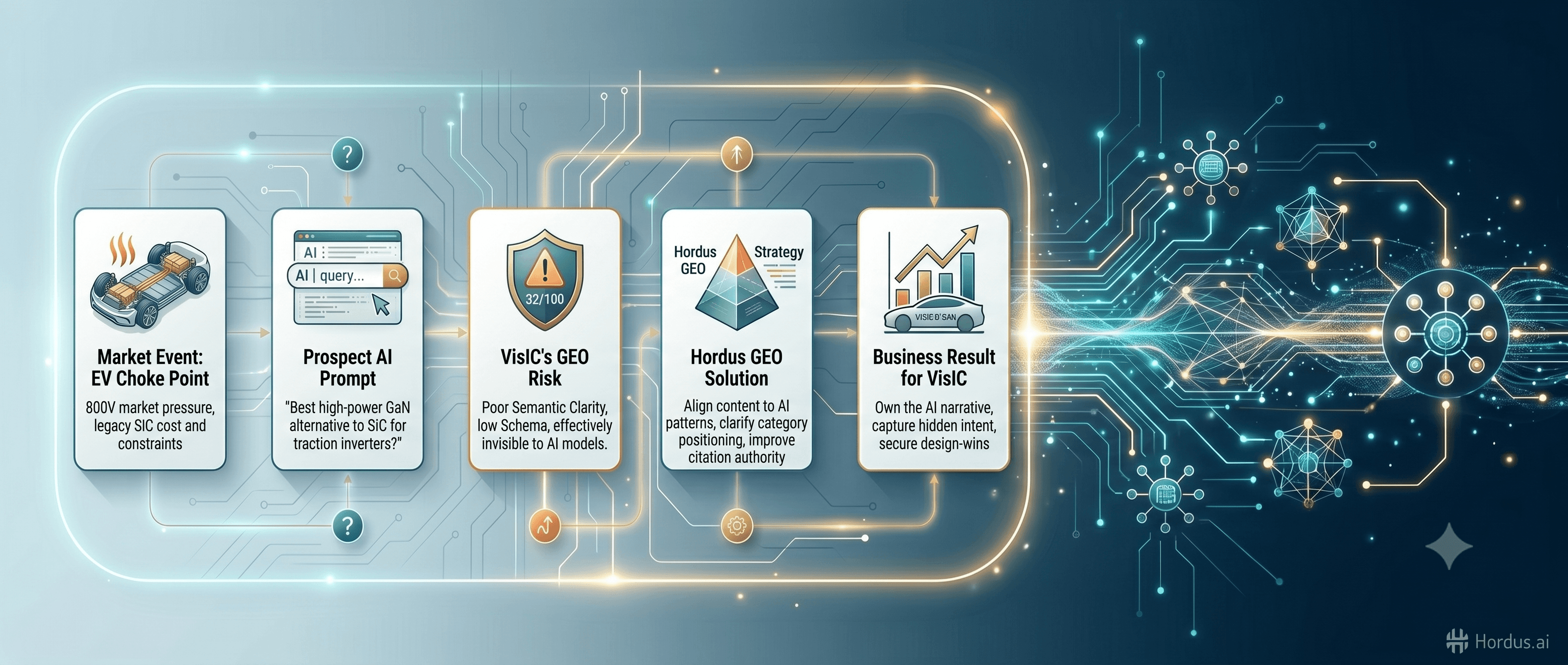
The Hordus GEO analysis evaluates a company's readiness across key layers to determine if its technical narrative survives the filtering process of large language models and autonomous AI agents. The baseline score places the company at an overall 32 out of 100, indicating an "At Risk" designation for AI discoverability. While the brand has an established market presence and foundational metadata, the analysis shows critical gaps in developer resources, deep technical access, and machine-readable data integration.
The table below outlines the performance metrics uncovered during the Hordus audit of the VisIC Technologies digital infrastructure.
| Audit Metric | Score (out of 100) | Strategic Interpretation |
|---|---|---|
| Discovery | 25 | AI models struggle to surface the brand's core offerings organically during general sector queries. |
| Identity | 35 | The distinct architectural uniqueness of D³GaN is frequently decoupled from the core brand identity in AI knowledge graphs. |
| Auth & Access | 30 | Strict limitations on documentation transparency prevent autonomous agents from cross-referencing specifications. |
| Agent Integration | 30 | The digital footprint lacks the structure necessary for AI agents to compile automated competitive analyses or bill-of-materials reports. |
| User Experience | 40 | The layout and presentation of data are optimized only for human eyes, causing machine crawlers to overlook critical insights. |
How Audit Findings Impact Your Bottom Line
The Hordus analysis highlights a critical paradox: VisIC Technologies boasts strong brand presence, yet its low performance across machine-readable layers acts as digital insulation. AI search tools do not read websites like humans do; they require structured layers to index relationships between entities.
Because the technical layers are categorized as missing or deficient in the audit, autonomous procurement agents cannot easily map out VisIC's exact product specifications. When an engineer asks an AI tool to evaluate technical documentation for an automotive project, the lack of optimized Discovery and Agent Integration layers means the model will likely pass over VisIC. It will default to legacy competitors who have explicitly formatted their platforms for AI ingestion, effectively shutting VisIC out of automated selection pools.
Actionable Blueprints: How Hordus Turns AI Visibility into Competitive Advantage
The strategic value of a Hordus partnership lies in turning the data from the Hordus audit into actionable, revenue-generating content adjustments. Here is how Hordus can help the executive management and marketing teams optimize the digital ecosystem of VisIC Technologies.
1. Improve AI Answer Share
Hordus analyzes thousands of industry-specific AI prompts to identify exactly where VisIC Technologies is being omitted from recommendations due to poor Discovery scores. By mapping out these gaps, Hordus helps the marketing team inject precise contextual keywords and conversational semantic data into public-facing content. This ensures that when an automotive architect asks an AI tool for the top five semiconductor innovators in the electric vehicle space, VisIC Technologies consistently appears in the generated response.
2. Strengthen Citations and Reference Links
It is not enough for an AI model to mention a company; it must point the user back to the source. Hordus addresses the low Identity score by optimizing the structure of press releases, white papers, and engineering notes so that LLMs recognize them as primary, authoritative documentation. This increases the likelihood that AI engines will insert direct hyperlinks to the corporate website inside their responses, driving highly qualified engineering leads straight to the product catalog.
3. Build AI-Readable Content In-House
Modern marketing requires writing for two distinct audiences: human buyers and machine algorithms. Hordus provides the framework needed to transform the User Experience layer into an AI-friendly asset. By organizing technical blogs, data sheets, and case studies around clear query-and-answer formats and technical schema, Hordus ensures that AI crawlers can effortlessly extract facts about the company's manufacturing capacity and strategic partnerships without running into structural dead ends.
4. Clarify Category Positioning and Agent Integration
If an automated agent does not know whether to classify a technology as a direct competitor to Silicon Carbide or a premium alternative to standard GaN, it will exclude it from procurement charts. Hordus refines the semantic structure of your corporate messaging to explicitly address the Agent Integration and Access gaps. This helps AI models accurately place the brand at the top of the high-power GaN category, rather than lumping it in with low-power consumer electronics applications.
5. Influence Alternative Comparisons
When a prospect asks an AI engine to build a comparison table comparing VisIC Technologies to competitors like Wolfspeed, Infineon, or GaN Systems, the details matter immensely. Hordus helps design structured comparison frameworks on your owned channels that highlight unique differentiators, like the company's transition to 8-inch wafer production or its strategic alignment with Hyundai and Kia. This guides AI engines to generate balanced, highly favorable comparative matrices even when reading highly technical data.
Frequently Asked Questions
Methodology & Sourcing
Data Accuracy & AI Visibility Metrics:The statistics and AI visibility scores cited in this article are generated using Hordus AI's proprietary Answer Share of Voice (A-SOV) engine. Data is derived from consented, anonymized real user interactions across major LLM interfaces (ChatGPT, Claude, Gemini).
Editorial Integrity:All AI-assisted research undergoes mandatory human editorial review by our GEO strategy team prior to publication to ensure factual accuracy and alignment with Google's YMYL (Your Money or Your Life) search quality rater guidelines.